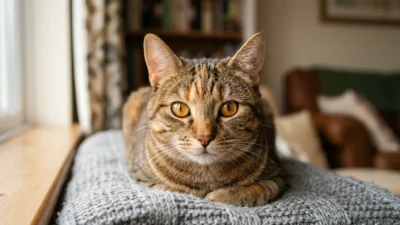

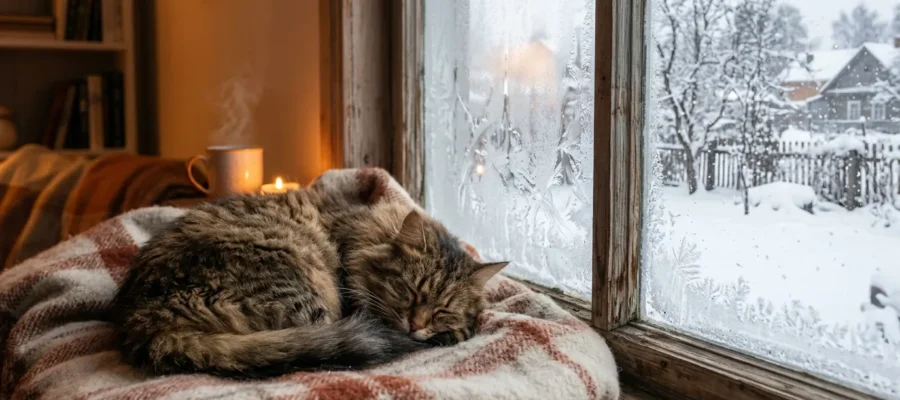
Yes, cats get cold. They feel temperature drops, they respond to them physically, and in serious cases they can develop life-threatening hypothermia. Knowing the thresholds — and spotting the warning signs early — can make a real difference for your cat.
This guide covers everything: exact temperature limits, the most vulnerable cats, signs of cold stress, hypothermia stages, and practical steps to keep your cat safe. If your cat is already showing symptoms, our Pet Symptom Checker can help you decide if a vet visit is needed.
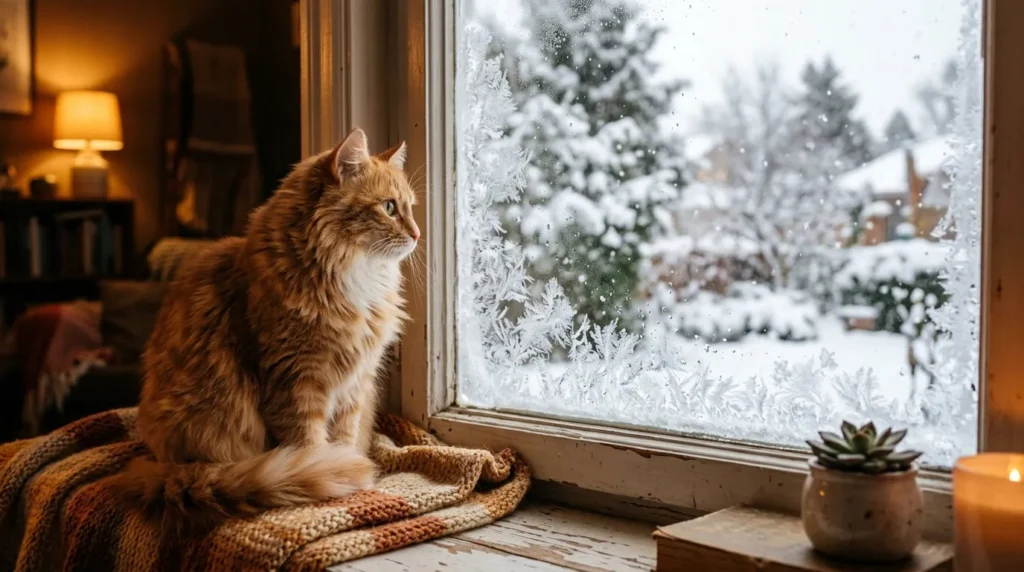
feel it much more sharply than others.
Do Cats Actually Feel Cold?
Cats feel cold. They are warm-blooded mammals that maintain a core body temperature between 100.5°F and 102.5°F (38.1°C–39.2°C). When environmental temperatures drop, their bodies work to hold that range. But that process has limits.
Why Cats Prefer Warmth
Cats are drawn to heat sources instinctively. Warm windowsills, sunbatches, heated blankets, the spot next to the radiator — none of that is random. Their thermoregulation system burns energy to maintain core temperature. Warmer surroundings reduce that workload. Cold surroundings increase it.
Curious how cats manage body heat differently to humans? Our guide on do cats sweat explains exactly how feline temperature regulation works — and why it breaks down faster in cold conditions.
When ambient temperature falls far enough, the body can’t keep up. That’s when cold becomes dangerous.
A Cat’s Normal Body Temperature
A healthy cat runs between 100.5°F and 102.5°F. Once rectal temperature drops below 99°F, mild hypothermia begins. Below 90°F is severe and requires emergency veterinary care. These aren’t estimates — they’re clinical thresholds that vets use to assess cold-related emergencies.
How Cold Is Too Cold for Cats?
Most cats start feeling uncomfortable below 45°F (7°C). Below 32°F (0°C), all cats are at risk of frostbite and hypothermia, regardless of coat thickness or breed.
Temperature Threshold Breakdown
| Temperature | Risk Level | What Happens |
|---|---|---|
| Above 60°F (15°C) | Safe for most cats | Normal comfort zone |
| 45–60°F (7–15°C) | Uncomfortable for sensitive cats | Shivering possible, seeking warmth increases |
| 32–45°F (0–7°C) | Risky for all cats | Real hypothermia risk, especially with wind or moisture |
| Below 32°F (0°C) | Dangerous for all cats | Frostbite and life-threatening hypothermia possible |
Vulnerable cats — kittens, seniors, hairless breeds, and cats with health conditions — can struggle even at 60°F (15°C). Don’t use the general thresholds for high-risk cats.
Indoor Temperature: When Your House Is Too Cold
This one catches people off guard. Indoor cats can get cold too. If your home drops below 60°F (15°C) in winter — common in drafty houses or when heating is kept low overnight — some cats will feel it. Kittens and elderly cats feel it first.
Keep your home above 65°F (18°C) if you have a vulnerable cat. For healthy adult cats, 60°F is the lower acceptable limit.
Which Cats Are Most Vulnerable to Cold?
Cold tolerance varies a lot. Not every cat responds the same way to a 45°F day.
Age: Kittens and Senior Cats
Kittens under 4 weeks old cannot regulate their own body temperature at all. They rely entirely on their mother or an external heat source. Even at room temperature, a separated newborn kitten can become hypothermic within hours.
Senior cats, generally those over 12 years, have reduced metabolic efficiency. Their muscles are less effective at generating heat through shivering, and underlying conditions — arthritis, kidney disease, hyperthyroidism complications — make temperature regulation harder. Not sure how old your cat is in human terms? Use our Pet Age Calculator to understand where your cat falls on the aging scale and how that affects their health needs.
Coat Type and Breed
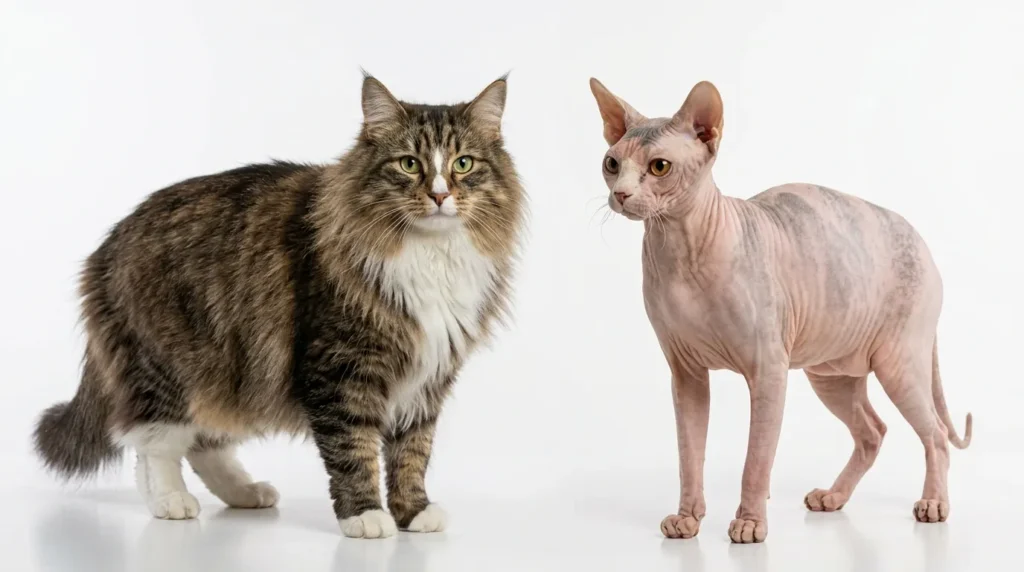
tolerance — a Sphynx and a Norwegian Forest Cat are not
in the same situation at 50°F.
Thick double-coated breeds handle cold better. Thin-coated and hairless breeds struggle significantly.
- Most cold-tolerant: Norwegian Forest Cat, Maine Coon, Siberian — bred for harsh climates with dense undercoats. See our full guide on how big Maine Coon cats get — their size and coat are both cold-weather advantages.
- Moderate tolerance: Domestic shorthair, British Shorthair
- Low cold tolerance: Sphynx, Cornish Rex, Devon Rex, Egyptian Mau
A Sphynx at 50°F is in a very different situation than a Norwegian Forest Cat at the same temperature. Sphynx cats have unique care needs beyond just cold sensitivity — our Sphynx cat grooming guide covers what it actually takes to keep this breed comfortable year-round.
Not sure which breed you have or which might suit your lifestyle? Try the Pet Breed Finder Quiz to find breeds that match your home environment, including climate considerations.
Health Conditions That Increase Risk
Several conditions impair thermoregulation directly:
- Hypothyroidism — reduces metabolic heat production
- Cardiovascular disease — limits circulation to extremities
- Diabetes — can affect peripheral circulation
- Anemia — reduces oxygen-carrying capacity, limiting heat generation
- Recent surgery or anesthesia — anesthesia suppresses the body’s normal thermoregulatory response, leaving post-surgical cats especially vulnerable to cold in the hours after a procedure
Persian cats are among the breeds most prone to compounding health issues that raise cold risk. If you own one, our guide to Persian cat health problems is worth a read before winter arrives.
If your cat has any of these conditions, assume their cold tolerance is lower than average and adjust accordingly.
Body Weight and Build
Underweight cats lose heat faster. Fat tissue acts as insulation — without it, the body loses heat to the environment more quickly. A cat with a body condition score (BCS) of 2 out of 9 has almost no thermal buffer. Small-framed cats also have a higher surface-area-to-mass ratio, meaning they radiate heat faster than larger cats.
Nutrition plays a direct role here. Cats that aren’t eating enough lack the caloric fuel to generate adequate body heat. Our guide on how much wet food to feed your cat can help you confirm your cat is getting the right amount going into cold months.
Signs Your Cat Is Cold
Cats can’t tell you they’re uncomfortable. These are the signals to watch for. <!– IMAGE SUGGESTION Prompt: A cat curled tightly into a ball on a fleece blanket, eyes half-closed, looking lethargic and cold, soft warm indoor lighting, photorealistic close-up. File name: signs-cat-is-cold.jpg Caption: A cat curled into a tight ball is reducing exposed surface area — a classic sign they’re trying to conserve heat. Alt text: Cat curled tightly into a ball on a blanket showing signs of being cold –>
Behavioral Signs
- Seeking warmth aggressively — pressing against heating vents, radiators, or warm bodies more than usual
- Curling into a tight ball — a direct effort to reduce exposed surface area
- Reluctance to move — cold muscles are slower and less comfortable to use
- Hiding under blankets or burrowing — instinctive insulation behavior
- Reduced appetite or lethargy — early cold stress often shows up as low energy or disinterest in food
Physical Signs
- Shivering or trembling — the body’s primary heat-generation mechanism
- Cold ears, paws, or tail — extremities lose heat first; cold to the touch is a clear sign
- Hunched posture — tucking limbs close to the body to conserve heat
- Pale or bluish gums — a serious sign, indicating poor circulation; requires immediate attention
- Slow, shallow breathing — in moderate to severe cold stress
If you notice any of these signs and aren’t sure how serious they are, use the Pet Symptom Checker to assess next steps. If you see pale gums or breathing changes, treat it as an emergency — don’t wait.
Can Cats Get Sick from the Cold?
Yes. Two cold-related conditions are medically serious: hypothermia and frostbite.
Hypothermia in Cats — What to Know
Hypothermia occurs when core body temperature drops below
normal. It progresses in stages.
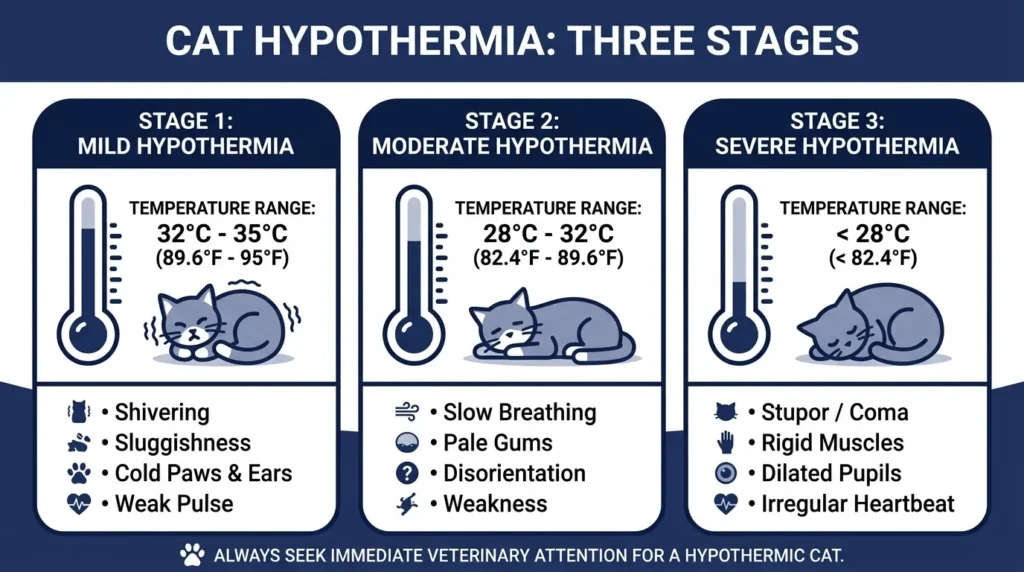
stages — knowing the difference between mild and severe
can determine the right response.
Mild Hypothermia (Core Temperature: 90–99°F / 32–37°C)
- Shivering
- Weakness, mild lethargy
- Cold extremities
- Reduced heart rate
At this stage, the body is still trying to self-correct. Most cats can recover with external warming if caught here.
Moderate Hypothermia (Core Temperature: 82–90°F / 28–32°C)
- Shivering stops (the body is too depleted to continue)
- Muscle stiffness
- Slowed breathing
- Dilated pupils
- Confusion or unresponsiveness
Shivering stopping is not a good sign — it means the body has lost the ability to generate heat. This stage requires veterinary care.
Severe Hypothermia (Core Temperature: Below 82°F / 28°C)
- No voluntary movement
- Very slow or absent heartbeat
- Fixed, dilated pupils
- Loss of consciousness
- Can be fatal without immediate veterinary intervention
Severe hypothermia is life-threatening. Do not attempt to rewarm a severely hypothermic cat at home with hot water or heating pads — uncontrolled rewarming can cause cardiac arrhythmias. Transport immediately with gentle warming (warm towels, your body heat) and get to a vet.
Frostbite in Cats
Frostbite affects the extremities — ear tips, tail, toes, and nose — first. Blood flow is redirected to protect core organs in the cold, leaving peripheral tissues exposed.
Signs of frostbite:
- Skin appears pale, gray, or white in the affected area
- The area feels hard or waxy to the touch
- Painful when touched (after rewarming)
- Skin may blister or turn dark/black in severe cases — this is tissue death
Do not rub frostbitten tissue. Do not apply hot water. Warm the area gently with lukewarm (not hot) water and get your cat to a vet. Tissue damage from frostbite may not be fully visible for several days.
What to Do If Your Cat Is Too Cold
At-Home Warming Steps
- Move them indoors immediately. Get them out of the cold environment first.
- Wrap in warm, dry towels. Pre-warm towels in the dryer for 2–3 minutes. Avoid wet towels.
- Place on a warm (not hot) surface. A heating pad on its lowest setting with a thick towel between the cat and the pad. Never let them lie directly on a heating pad.
- Offer warm (not hot) water if they’re conscious and able to drink.
- Check extremities. Ears, paws, and tail — look for frostbite signs.
- Take temperature if possible. Use a rectal thermometer. Below 99°F = contact vet.
When to Go to the Vet
Go immediately if:
- Shivering has stopped but the cat is still cold or unresponsive
- Gums are pale, white, or bluish
- Breathing is very slow or labored
- The cat is unconscious or unresponsive
- You suspect frostbite
- Core temperature is below 95°F
Do not wait to see if they improve. Moderate and severe hypothermia require IV fluids, internal warming, cardiac monitoring, and oxygen — none of which can be managed at home.
How to Keep Your Cat Warm
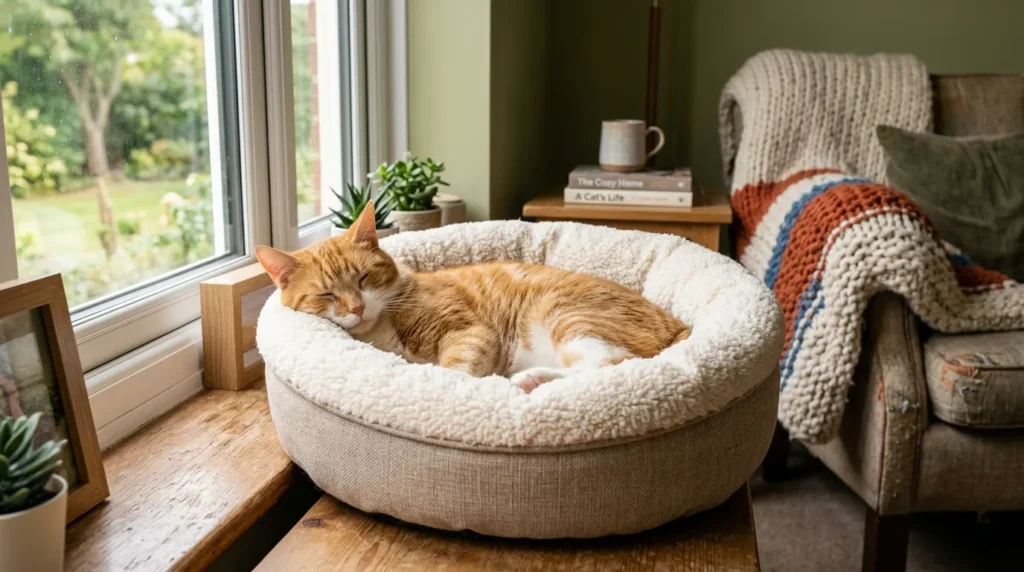
one of the simplest and most effective ways to keep your
cat comfortable in winter.
Indoor Cat Warmth Tips
- Keep your home above 65°F (18°C) during cold months, especially at night
- Provide at least one dedicated warm sleeping spot away from drafts — floor level is colder, elevated beds help
- Block drafts under doors and windows in rooms your cat uses regularly
- Give them access to more than one warm resting area in case one is occupied
Keeping your cat well-fed through winter also helps. A cat running on the right caloric intake generates more body heat. Our high-protein cat recipes for active cats are a solid starting point if you want to boost their nutritional intake during cold months.
Outdoor Cat Winter Safety
- Bring outdoor cats inside when temperatures drop below 45°F
- If a fully outdoor cat cannot be brought in, provide an insulated shelter with straw bedding (not hay — hay retains moisture; straw doesn’t)
- Elevated shelters lose less heat than ground-level ones
- Check warm car engines before starting — cats shelter under hoods in cold weather
Heated Beds and Warming Products
Self-warming beds use reflective material to retain your cat’s own body heat — these are safe and require no electricity. Electrically heated pet beds are also safe when designed specifically for pets, but use them with caution:
- Never substitute a human heating pad — they run too hot and lack automatic shutoff
- Always provide an unheated escape option so your cat can move away if too warm
- Check cords regularly for chew damage
Hot water bottles wrapped in a towel work well for short-term warming, especially for kittens or post-surgical cats. Replace when cool.
Do Indoor Cats Get Cold?
Yes. Indoor cats are not immune to cold. In an insufficiently heated home, a cat sitting on a cold floor near an exterior wall in January is going to feel it.
Indoor cats are also less acclimatized to temperature variation than outdoor cats. An outdoor cat builds some physical adaptation to cooler weather over weeks. An indoor cat that rarely experiences temperature change may be more sensitive to even moderate drops.
Signs an indoor cat is cold are the same as for any other cat: tight curling, seeking warmth, lethargy, cold extremities. Don’t assume “they’re inside, they’re fine.” Check the actual temperature in the rooms they use.
FAQ
Can cats catch a cold from being cold?
Not directly. Upper respiratory infections in cats are caused by viruses — specifically FHV-1 and FCV — spread through contact with infected cats. Cold air alone doesn’t cause infection. However, cold stress suppresses immune function, which can allow latent viruses to reactivate. Being cold doesn’t give a cat a cold, but it can make a cat more likely to develop one. If your cat starts sneezing after cold exposure, our guide on why cats sneeze can help you work out what’s going on.
Do cats need a coat or sweater?
Most healthy adult cats don’t need one. Their coats handle normal cold reasonably well. Exceptions include hairless breeds like the Sphynx, very elderly cats, underweight cats, and cats with certain health conditions. If you do use a cat sweater, make sure it fits properly — too tight restricts movement; too loose becomes a hazard.
How do I know if my house is too cold for my cat?
Check the actual room temperature with a thermometer — don’t rely on feeling. If any room regularly drops below 60°F (15°C), it’s cold enough to affect sensitive cats. If you have a kitten, senior cat, or cat with health issues, keep rooms above 65°F (18°C).
Do outdoor cats survive winter?
Healthy adult outdoor cats with access to shelter can manage temperatures as low as 32°F (0°C) for short periods. Below that, even hardy outdoor cats are at real risk. The danger increases sharply with wind chill and moisture. Feral cats in managed colonies survive with community-provided insulated shelters, but domestic cats are less acclimatized and should be brought inside in freezing weather.
What’s the fastest way to warm a cold cat?
Wrap them in a warm dry towel, hold them close to your body, and move to a warm indoor environment. Take their temperature if you can. If they’re below 99°F, shivering has stopped, or they seem unresponsive — call a vet. Don’t use a hair dryer or hot water. Controlled, gradual rewarming is safer than rapid heat application. Use our Pet Symptom Checker if you’re unsure whether what you’re seeing warrants urgent care.
Final Word
Cats feel cold. They respond to it physically, and when temperatures get serious, so do the health risks. The key numbers to remember: below 45°F is uncomfortable for most cats, below 32°F is dangerous for all cats, and below 99°F core temperature means hypothermia has already started.
Pay attention to the signs — tight curling, cold extremities, lethargy, shivering — and don’t dismiss them. If your cat is shaking and cold to the touch, that’s not just “being a cat.” That’s a body working hard to stay warm. Your job is to make that easier.