
Quick Answer
Unspayed female cats go into heat every 2 to 3 weeks during breeding season. In most of the world, that season runs from February through October. Each heat lasts 3 to 14 days. If a cat doesn’t mate, the cycle restarts within 1 to 3 weeks.
That means a single unspayed cat can go through heat 2 to 4 times — or more — in one season, repeatedly, until she either mates, gets pregnant, or the season ends naturally.
At What Age Do Cats First Go Into Heat?
Most cats reach sexual maturity between 5 and 9 months of age. Some start as early as 4 months. Others, especially certain longhaired breeds, may not cycle until 12 to 18 months.
Body weight plays a role. Cats that reach a heavier weight earlier tend to cycle sooner. A well-fed domestic shorthair can enter her first heat months before a slower-developing Persian or Ragdoll.
It’s also worth knowing that reproductive maturity and full physical growth aren’t the same thing. A cat can go into heat well before she’s done growing — understanding when cats stop growing gives useful context if you have a young female at home.
Breed Differences Matter
Shorthaired breeds — Siamese, Burmese, Abyssinian, and Domestic Shorthairs — typically reach their first heat at 4 to 6 months. The Siamese in particular is known for cycling early and vocalizing intensely during estrus.
Longhaired breeds including Persians, Maine Coons, and Ragdolls tend to start later, often at 10 to 18 months. Their slower developmental pace delays the hormonal trigger.
Indoor vs. Outdoor Timing
Outdoor cats respond directly to daylight. Longer days in spring send a hormonal signal to begin cycling. Their seasons follow the February–October pattern closely.
Indoor cats live under artificial lighting year-round. That constant light can disrupt the natural seasonal rhythm, causing some indoor cats to cycle outside the normal window — including in the middle of winter.
How Often Do Cats Go Into Heat?
Cats are seasonally polyestrous. That means they have multiple heat cycles throughout a defined season, not just one per year like many other mammals.
Here’s the pattern:
- Breeding season peaks from February to April
- Cycles continue through October in most regions
- If the cat doesn’t mate, she returns to heat within 1 to 3 weeks
- That cycle repeats until she mates, becomes pregnant, or anestrus arrives
Cats are also induced ovulators. Their ovaries only release eggs when mating occurs. No mating means no ovulation, no pregnancy, and the heat cycle starts over again almost immediately.
This is very different from dogs, which typically cycle twice a year with long gaps between heats. A cat left unspayed through an entire breeding season can easily complete 4 to 6 heat cycles.
How Long Does a Cat’s Heat Last?
The active estrus phase lasts 3 to 14 days, with most cats averaging around 7 days per cycle.
If the cat mates and ovulation occurs but fertilization doesn’t happen, she enters a 30 to 40-day pause called metestrus. If she becomes pregnant, the gestation period runs approximately 63 to 65 days.
If no mating happens at all, she’ll cycle back into heat within 1 to 3 weeks.
The Four Stages of the Cat Heat Cycle
Most people think of heat as an on/off switch. It isn’t. There are four distinct stages with different durations and different behaviors.
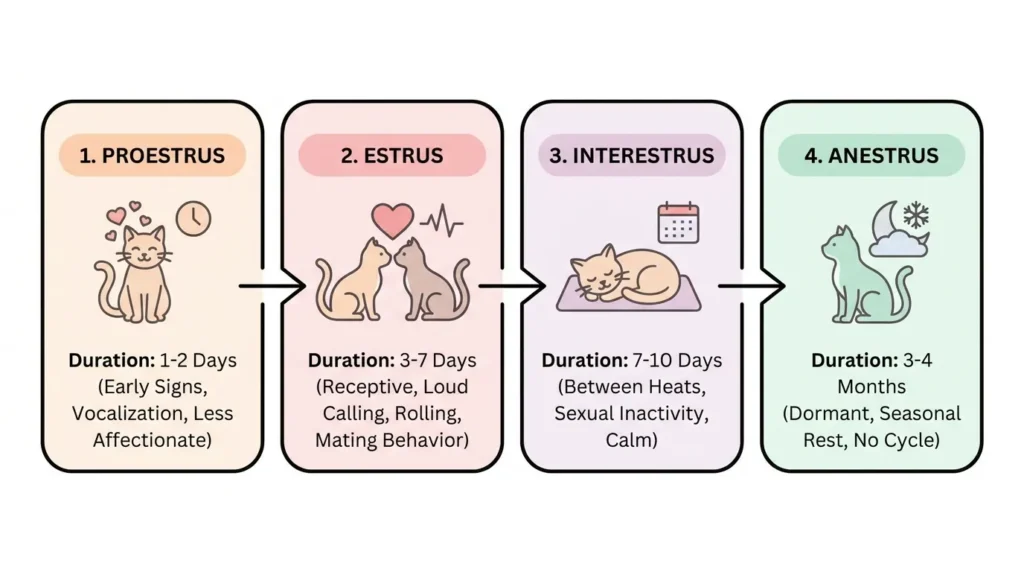
Stage 1: Proestrus (1–2 Days)
Estrogen levels start rising. Your cat may become slightly more affectionate than usual, but she won’t accept a male yet. This stage is easy to miss — the behavioral changes are subtle.
Male cats in the area may begin showing increased interest. The female won’t respond to them.
Stage 2: Estrus — The True “Heat” Phase (3–14 Days)
This is what people mean when they say a cat is in heat. The hormonal shift is significant and the behavioral changes are obvious:
- Loud, low-pitched yowling or “calling”
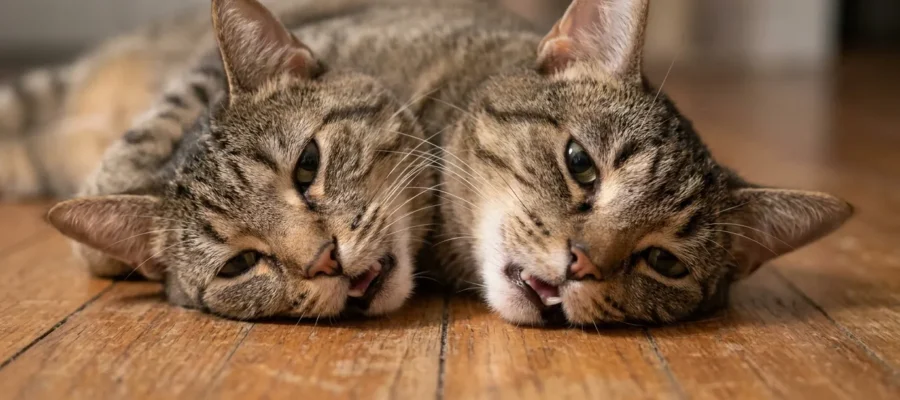
- Rolling on the floor repeatedly
- Rubbing against furniture, walls, and people
- Raising the hindquarters and shifting the tail to one side when touched along the spine (this posture is called lordosis)
- Decreased appetite
- Attempts to get outside
Some owners mistake this behavior for pain or illness. It isn’t. These responses are hormonal. But the intensity can be alarming, especially during a first heat.
Stage 3: Interestrus or Metestrus
What happens next depends on whether mating occurred:
- No mating at all: The cat enters interestrus — a 1 to 3-week resting period before cycling again.
- Mating occurred, no fertilization: Metestrus begins and lasts 30 to 40 days.
- Mating with fertilization: Pregnancy begins.
Many owners are surprised to learn that cats don’t experience their reproductive cycle the way humans do. Unlike humans, cats don’t have periods or monthly bleeding cycles — the feline system is built entirely around induced ovulation and seasonal cycling.
Stage 4: Anestrus (2–3 Months)
This is the seasonal “off” period. In the Northern Hemisphere, it typically covers late October through January. Hormone activity drops to baseline, cycles stop, and the cat rests reproductively. It’s the only natural break in an otherwise continuous cycle.
Indoor cats in artificially lit environments may have a shortened or absent anestrus period.
Signs Your Cat Is in Heat
Almost all signs of feline heat are behavioral. Unlike dogs, cats rarely bleed during estrus. Here’s what to watch for:
Common behavioral signs:
- Sudden, persistent loud vocalization — yowling, calling, moaning
- Rolling on the floor more than usual
- Rubbing on objects, walls, ankles, and furniture
- Lordosis posture when touched across the lower back
- Reduced appetite
- Constant attempts to escape through doors or windows
- Urine marking inside the house
If your cat has been meowing far more than usual with no obvious cause, heat is one of the first things worth ruling out — especially in unspayed females under 2 years old. Similarly, sudden indoor urine spraying or scent marking is a documented heat behavior. Female cats in estrus mark their territory with pheromone-rich urine to signal availability to nearby males.
Not sure what’s driving your cat’s symptoms? Our pet symptom checker can help you quickly identify whether what you’re seeing fits a heat pattern or points to something else.
Do Cats Bleed When in Heat?
No. A healthy cat does not bleed during heat. You may rarely see a small amount of clear discharge in early proestrus, but this is uncommon and minimal.
Visible blood from the vulva is always abnormal in cats. It warrants a same-day vet visit. Causes range from trauma to pyometra to other reproductive conditions — none of which should wait.
What To Do When Your Cat Is in Heat
There’s no medical treatment needed for a normal heat cycle. But the behavioral changes can be disruptive. A few things that genuinely help:
- Keep her strictly indoors. A cat in estrus will escape if given any opportunity. A single encounter with an intact male can result in pregnancy.
- Add enrichment. Puzzle feeders, extra play sessions, and interactive toys reduce restlessness.
- Give her a quiet space. A calm retreat away from noise and household activity helps her settle.
- Avoid hormonal suppressants. Products that temporarily halt cycling are associated with serious health risks including mammary tumors and pyometra. Most vets no longer recommend them.

Health Risks of Repeated Heat Cycles
This is the section most guides skip. It matters.
Cats that cycle repeatedly for years — without mating and without being spayed — face cumulative health risks that grow with every cycle.
Pyometra is a bacterial infection of the uterus. It develops when hormonal changes from repeated cycles cause the uterine lining to thicken abnormally, creating an environment where bacteria multiply. The uterus can fill entirely with pus. Without emergency surgery, it is fatal. It’s most common in middle-aged queens with a long history of unspayed cycling.
Pseudopregnancy (false pregnancy) occurs when ovulation happens but fertilization doesn’t. The cat’s body behaves as if pregnant — mammary glands swell, behavioral changes appear, and she may even produce milk. It resolves on its own but can recur.
Mammary tumors occur at a significantly higher rate in intact females than in spayed ones. Studies in feline oncology consistently show that spaying before the first heat dramatically reduces mammary cancer risk. Every completed heat cycle slightly increases that risk.
Mucometra — a condition where the uterus fills with sterile mucus — can develop in cats with chronic hormonal cycling. It requires surgical intervention.
These aren’t rare worst-case scenarios. They’re well-documented, predictable outcomes of long-term intact cycling. Any vet will confirm this.
How to Stop Heat Cycles: Spaying
Spaying — the surgical removal of the ovaries and uterus (ovariohysterectomy) — is the only safe, permanent solution to repeated heat cycles. Once spayed, a cat will never go into heat again, cannot become pregnant, and has substantially lower lifetime risk of the conditions listed above.
If cost is part of your decision, it helps to get a clear picture of what’s involved. This guide on how much it costs to spay a cat breaks down prices by clinic type, region, and what the procedure includes.
Best Age to Spay
The American Association of Feline Practitioners (AAFP) recommends spaying female cats by 5 months of age — before the first heat cycle begins. This timing provides the greatest health benefit and eliminates the risk of accidental pregnancy entirely.
There is no evidence that allowing a cat to experience one heat before spaying offers any health benefit. It’s a persistent myth. Waiting only increases the chance of an unwanted litter.
Can You Spay a Cat Already in Heat?
Yes. It’s done routinely. Blood vessels in the reproductive tract are slightly more engorged during estrus, which can make the procedure marginally more complex — but not prohibitively so. Most experienced vets perform mid-cycle spays without issue.
Waiting months for anestrus to arrive means leaving a cat exposed to health risks and ongoing behavioral disruption unnecessarily.
Frequently Asked Questions
How many times a year does a cat go into heat? During breeding season (February–October), an unspayed cat cycles every 2 to 3 weeks. That typically adds up to 2 to 4 cycles per season, though frequent cyclers can exceed this.
Can indoor cats go into heat year-round? Yes. Artificial lighting mimics long-day conditions. Some indoor cats cycle during winter months when outdoor cats are in anestrus. This is more common in cats near bright windows or in well-lit homes.
How soon after giving birth can a cat go into heat again? As quickly as 1 to 2 weeks postpartum. Nursing does not reliably prevent heat. A queen can become pregnant again while still feeding a current litter.
Do cats go into heat after being spayed? No. Spaying removes the ovarian tissue that drives the estrous cycle. Without it, heat cycles cannot occur.
Do senior cats still go into heat? Yes. Cats don’t experience menopause. An intact queen may cycle less frequently as she ages, but she remains fertile and continues going into heat. Older intact females are also at higher risk of pyometra.
What does a cat in heat sound like? The sound is distinct — loud, repetitive, low-pitched yowling or “calling” that’s different from ordinary meowing. Some describe it as sounding like a distressed animal. It can happen at any hour, including throughout the night.
Can a cat get pregnant during her first heat? Absolutely. Age is not a barrier to conception. Pregnancy during a first heat, at 4 to 6 months old, is entirely possible — and more common than many owners expect.
Is being in heat painful for cats? Heat itself is not physically painful. The intense behavioral changes are hormone-driven, not a response to pain. That said, the experience can be uncomfortable and stressful — especially for cats going through frequent unbroken cycles.
Final Thoughts
An unspayed female cat can go into heat every 2 to 3 weeks for the better part of the year. The cycle is relentless by design — cats are built to reproduce, and their biology doesn’t pause out of convenience.
Left unmanaged over years, those cycles carry real cumulative health risks: pyometra, mammary tumors, pseudopregnancy. The behavioral disruption is the least of it.
Spaying before 5 months eliminates the cycle permanently and offers measurable health benefits. If your cat is already cycling, the right time to act is now — not after the next season, and not after the first litter.