

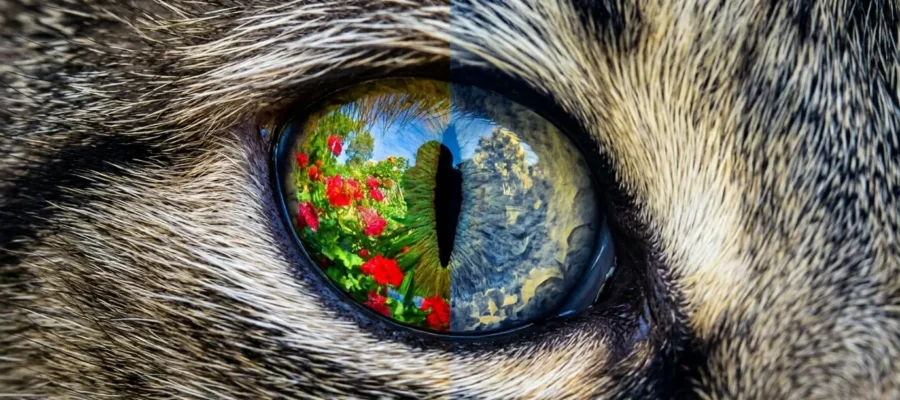
Cats are not color blind in the way most people think. They don’t see the world in black and white. Cats have limited color vision — they can distinguish blues and yellows but cannot tell red from green. It’s a common misconception worth correcting, because the reality of how cats see is actually more interesting.
The Short Answer
Cats have dichromatic vision. That means their eyes contain two types of color-detecting cells instead of three. Humans with normal vision are trichromatic — we have three cone types that together let us see the full visible spectrum. Cats are missing the cone type that processes red and green wavelengths.
The closest human equivalent is red-green color blindness. A person with that condition and a cat are looking at roughly the same color world — muted, cool-toned, and missing warm reds entirely.
How Cat Eyes Are Built
Rods vs. Cones
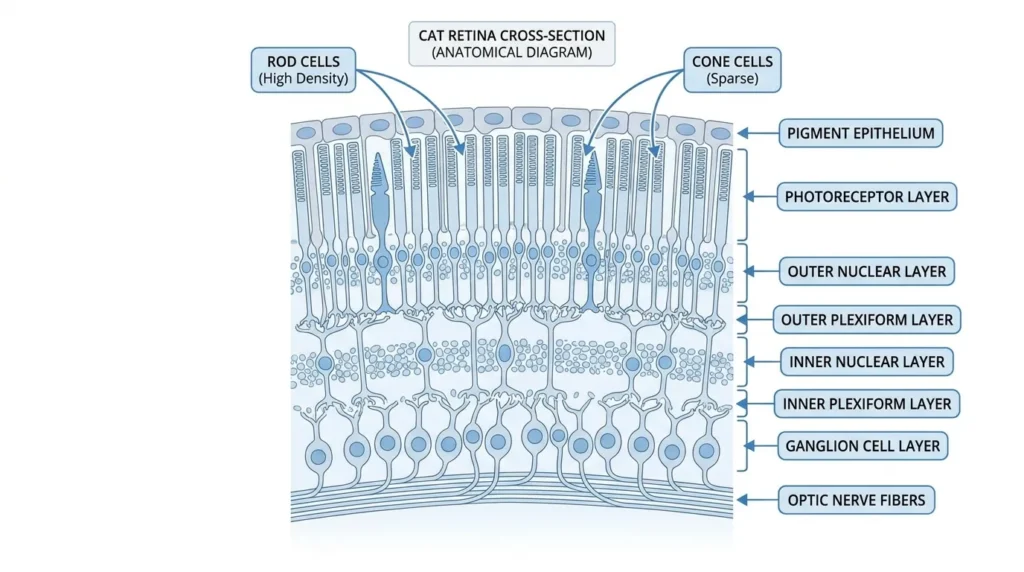
The retina has two types of photoreceptors: rods and cones.
Rods handle low-light and motion detection. Cones handle color. The ratio of these two cells in the retina determines how well any animal sees color versus how well it sees in the dark.
Cats have a retina that is heavily loaded with rods — far more than humans. That trade-off is intentional. More rods means sharper night vision and faster motion detection. Fewer cones means weaker color resolution.
Cone Count Comparison
| Cone Types | Approximate Cone Cells | |
|---|---|---|
| Humans | 3 | ~6 million |
| Cats | 2 | ~10,000–25,000 |
| Dogs | 2 | ~200,000 |
Cats have dramatically fewer cones than humans. Even compared to dogs, cats fall short on pure cone density. Color simply isn’t what feline eyes are optimized for.
What Colors Can Cats Actually See?
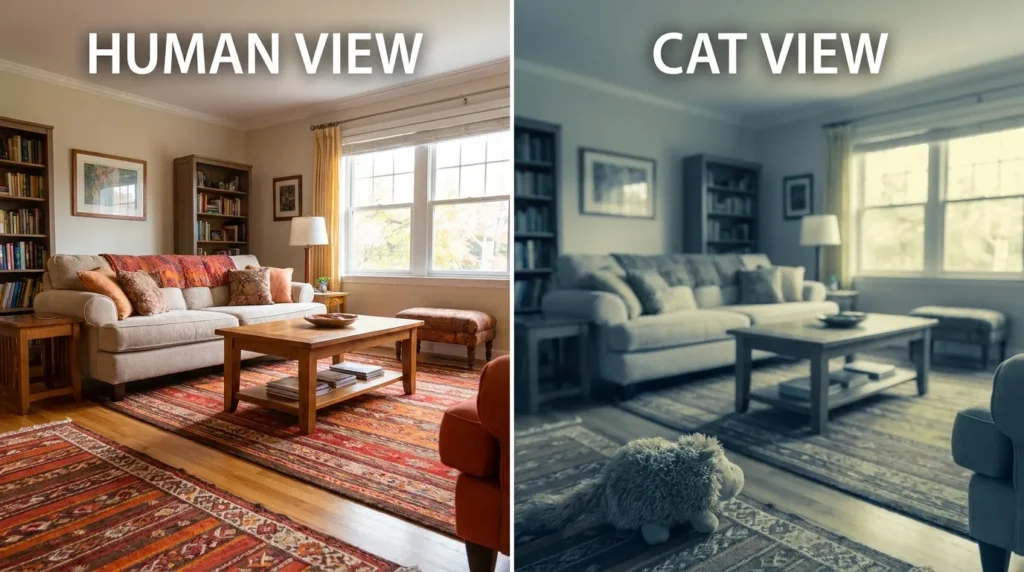
Cats detect color in the blue and yellow range. They can distinguish:
- Blue and blue-violet wavelengths — these come through clearly
- Yellow and yellow-green tones — also visible
- Muted greens — partially detectable, but not vivid
What cats cannot distinguish:
- Red — appears dark or grayish
- Orange — likely seen as a dull brownish tone
- Bright green — gets washed out or confused with yellow
The visible wavelength range for cats spans roughly 450–560 nm, compared to the human range of 380–700 nm. That narrower window explains why the upper end of the spectrum — warm reds, oranges, vivid greens — disappears from their view entirely.
This has a real practical implication for cat owners. That bright red toy you bought? Your cat is chasing it based on movement and contrast, not because the red color grabbed its attention. If you want a toy your cat can actually see clearly, blue and yellow options give them the best visual signal.
How Cat Vision Compares to Humans
Color isn’t the only place cats and humans differ visually.
Field of view: Cats have a wider peripheral field — roughly 200 degrees versus 180 degrees in humans. Better for detecting movement at the edges.
Visual acuity: Cats are nearsighted. Their sharp focus range sits at about 20 feet. A human with 20/20 vision sees clearly at distances a cat finds blurry. Up close, though, cats see fine.
Brightness sensitivity: Cats need about one-sixth the light humans do to see in the same environment. This comes from two structural advantages — more rods, and a layer of reflective cells behind the retina called the tapetum lucidum. That layer bounces light back through the photoreceptors a second time, effectively doubling the signal in dim conditions. It’s also why cats’ eyes glow in photos taken with a flash.
Many people wonder whether cats can see in complete darkness — they can’t, but they come close. For a deeper look at how animal night vision compares, the breakdown in how dogs see in the dark offers a useful side-by-side reference.
Why Cats Evolved This Way
Cats are obligate carnivores that evolved as crepuscular hunters — most active at dawn and dusk. In those lighting conditions, detecting the subtle movement of a small animal in low light matters far more than seeing it in full color.
A mouse doesn’t need to be red to be noticed. It needs to move. Cats developed eyes that are extraordinarily good at picking up motion and functioning in near-darkness. Color resolution was the trade-off, and evolution made the call that it wasn’t worth the cost.
This is also why cats are often considered nocturnal — though technically, their peak activity windows are low-light rather than full darkness.
What Cats Use Instead of Color
When color vision is limited, cats lean hard on other systems:
Motion detection — Cats can detect movement at speeds humans can’t track. Their high rod density makes them sensitive to even slight visual shifts in the periphery.
Contrast sensitivity — Cats are highly responsive to differences in light and shadow. They read the world in contrast more than color.
Smell and hearing — Cats have roughly 45–80 smell receptors compared to a human’s 5 million — wait, actually cats have far more olfactory receptors. Cats have around 45–80 million olfactory receptor cells. Their nose and ears fill in what their eyes miss. If you’ve noticed your cat staring at a blank wall, it’s often responding to a scent or sound rather than something visual. Cats who seem to fixate on you specifically are likely picking up on multiple cues at once — a behavior explained further in why cats stare at you.
Does This Affect Cat Behavior?
Yes, in a few concrete ways.
Toy selection: Blue and yellow toys are more visually stimulating to cats than red or orange ones. Feather toys that contrast against a light background will get more engagement than a red ball on a wood floor — which may look nearly invisible to your cat.
Hunting behavior: Cats aren’t tracking prey by color. They’re tracking motion, sound, and scent. That explains why even an indoor cat can become intensely focused on a tiny insect — not because it sees its color, but because it sees it move.
Interaction with screens: Cats that watch TV or phone screens are responding to movement, not color fidelity. Higher frame-rate content tends to hold cat attention longer than standard footage because it reduces motion blur.
Understanding your cat’s sensory world can help you choose toys, arrange their environment, and understand seemingly odd behaviors — like why cats are drawn to boxes or react intensely to certain smells they dislike.
Frequently Asked Questions
Are cats completely color blind? No. Cats have dichromatic vision and can see blues and yellows. They cannot distinguish red from green, but they do not see in black and white.
Can cats see red? No. Cats lack the cone type needed to process red wavelengths. Red objects likely appear as a dull gray or dark brown tone to a cat.
Do cats see better than humans in the dark? Yes. Cats need about one-sixth the light humans need to see clearly. Their high rod density and the tapetum lucidum — a reflective layer behind the retina — give them a significant low-light advantage.
What does the world look like through a cat’s eyes? Muted, cool-toned, and lower in sharpness at distance. Blues and yellows come through clearly. Reds and bright greens disappear. Motion is sharp. Details beyond about 20 feet are blurry.
Can cats see TV? Yes, though differently than humans. Modern high-refresh-rate screens look more fluid to cats. They respond primarily to movement on screen, not to color.
Final Takeaway
Cats are not color blind in the classic sense — they just see a narrower slice of the color spectrum than we do. Blues and yellows, yes. Reds and greens, no. Their eyes are built for something else entirely: detecting motion in the dark, tracking fast-moving targets, and operating in conditions where human vision starts to fail.
If you’re still figuring out which cat breed fits your lifestyle and environment, the cat breed quiz can help you match based on temperament, space, and care needs — useful context for understanding how different breeds may also vary in sensory behavior.