


Most cat-dog introductions fail in the first 10 minutes. Not because the animals are incompatible — but because the process was rushed. Done correctly, a safe introduction takes 2 to 4 weeks. Done wrong, it creates lasting fear and reactivity that’s hard to reverse.
This guide walks through the full process: how to prepare before they ever share space, three staged phases with specific timelines, and what to do when things don’t go smoothly.
Before you begin, it’s worth running both pets through the Pet Compatibility Checker to get a baseline read on how well your specific combination is likely to work.
Why Most Introductions Go Wrong
Prey Drive Is Not the Same as Aggression
A dog that chases a cat isn’t necessarily aggressive. In most cases, it’s prey drive — a hardwired instinct to pursue fast-moving objects. This is especially strong in terriers, sighthounds, herding breeds, and working dogs.
The distinction matters. An aggressive dog is reacting to a perceived threat. A prey-driven dog is reacting to movement. Both need careful management, but the approach is different. If your dog has shown biting behavior toward people or other animals before, that history needs to be factored into your expectations before starting.
The Biggest Mistake: Moving Too Fast
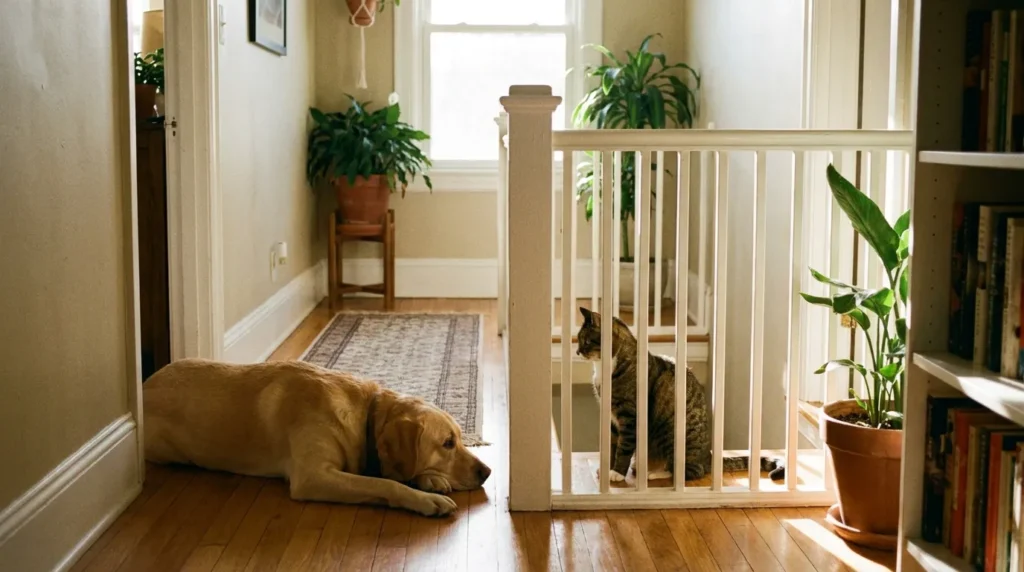
Letting them “meet and figure it out” is the most common mistake owners make. A single bad first meeting — even one lasting 30 seconds — can set the relationship back by weeks. Both animals form negative associations fast. The goal of a staged introduction is to build a positive association before any direct contact happens at all.
Before the Introduction Begins
Set Up a Dedicated Safe Room for the Cat
Before the introduction starts, the cat needs a room it owns completely. This means:
- Food, water, litter box, and bedding all in one space
- A door the dog cannot open, push through, or see under
- Vertical space — a cat tree, shelving, or climbable furniture
The cat must be able to eat, sleep, and use the litter box without any risk of encountering the dog. This room stays in place until Stage 3 is fully stable. Make sure the cat maintains normal appetite throughout — if you’re unsure about how much wet food to feed your cat during a stressful transition, keep portions consistent and watch closely for any change.
Assess Your Dog’s Behavior Honestly
Before starting, answer these questions:
- Does your dog fixate on small animals outdoors?
- Does it pull hard toward squirrels, birds, or rabbits on walks?
- Has it ever chased or harmed a small animal?
- Can it hold a “leave it” command under mild distraction?
A dog that can’t hold “leave it” for 10 seconds needs foundational obedience training before beginning this process. That’s not a dealbreaker — it just means the introduction waits until you have reliable impulse control.
What You’ll Need
- A sturdy baby gate — ideally one the cat can jump over but the dog cannot
- A standard 6-foot leash
- High-value dog treats (cooked chicken, small cheese cubes)
- A pheromone diffuser — Feliway Classic in the cat’s room and Adaptil near the dog’s resting area help reduce baseline anxiety in both animals during the transition
Stage 1 — Scent Introduction (Days 1–3)
This stage involves zero visual contact. The animals do not see each other.
How to Run a Scent Swap
Take a soft cloth from the cat’s bedding. Place it near the dog’s resting area. Do the reverse: take a cloth carrying the dog’s scent and place it outside the door to the cat’s room — not inside. Let each animal investigate at their own pace.
Repeat once per day. After 24 hours, move the dog’s scent item closer to the entrance of the cat’s room.
What a Calm Reaction Looks Like
Dog: Sniffs the cloth, then moves on. Returns to normal behavior within minutes. No fixating, no whining, no persistent pawing at the cat’s door.
Cat: Approaches the scent, sniffs, may hiss once, then walks away. Continues eating and using the litter box normally.
If the dog whines at the door for extended periods, paces, or refuses to settle — stay at Stage 1 longer. Don’t advance until both animals show minimal stress response to the other’s scent.
Stage 2 — Visual Contact Without Touch (Days 4–7)
Baby Gate or Cracked Door Method
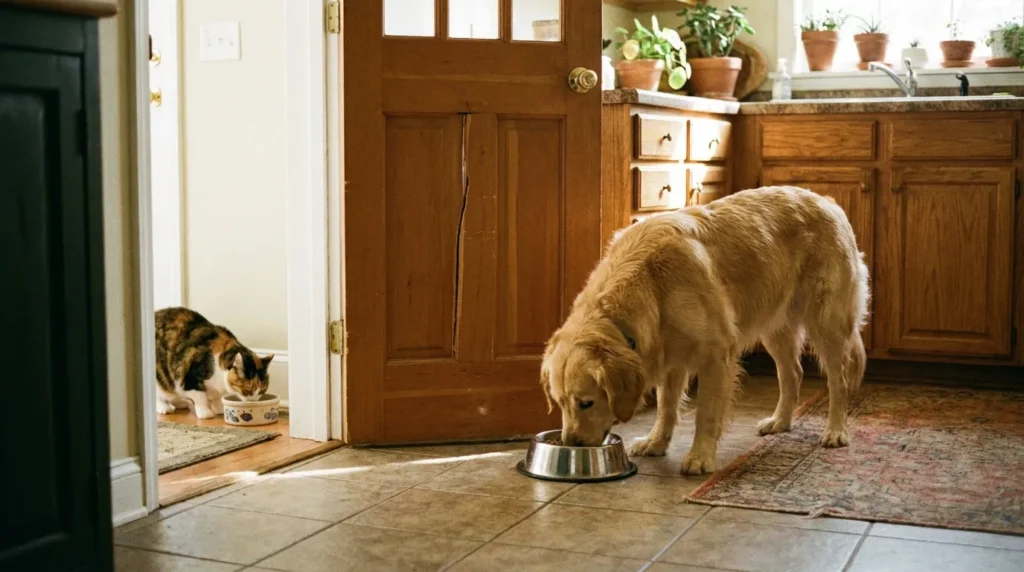
Crack the cat’s door 2–3 inches, or install the baby gate. Feed both animals near the barrier at the same time — cat on one side, dog on the other. Keep the dog on a leash.
The mechanics here are straightforward: the presence of the other animal now predicts something good (food). Sessions should last 5–10 minutes. Run 2–3 sessions per day.
Body Language Signals to Watch
Dog — signs it’s calm and safe to continue:
- Loose, wiggly body posture
- Able to eat treats while the cat is visible
- Glances at the cat, then looks away
- Relaxed, low tail wag (understanding what different tail positions mean can help you read this correctly)
Dog — signs it’s too aroused (slow down):
- Stiff body, fixed stare at the cat
- Stops eating when the cat appears
- Whining, barking, or lunging toward the barrier
- Hackles raised along the spine
Cat — signs it’s managing:
- Stays near the barrier voluntarily
- Eats during sessions
- Hisses occasionally but doesn’t flee and hide
Cat — signs it’s overwhelmed (slow down):
- Stops eating completely
- Hides for hours after sessions
- Refuses to approach the barrier at all
Stage 3 — Controlled Face-to-Face Meeting
Don’t start this stage until both animals pass Stage 2 comfortably over at least 2–3 consecutive days.
How to Set Up the First Meeting
- Dog on a leash, held loosely — not tight. A taut leash increases arousal and frustration.
- Cat moves freely through the room. Do not hold or restrain the cat.
- Use a neutral room, not the cat’s safe room. Neutral territory reduces territorial reactivity.
- Have high-value treats ready and visible.
Let the cat set the pace entirely. If it chooses to approach, allow it. If it walks away, let it. The cat must always have an unobstructed escape route. Cats that feel cornered react with aggression or panic — that single event can undo weeks of progress.
Keep the dog in a sit or down if it has the training to hold it. Reward calm behavior heavily. The moment the dog shows a hard stare or forward-leaning fixation on the cat, redirect with a treat and increase the distance between them.

Session Length and Frequency
- First sessions: 5 minutes maximum, twice per day
- Week two: gradually extend to 10 minutes
- Week three: extend to 15–20 minutes if both animals remain calm
Always move at the pace of the slowest animal.
If Things Go Wrong in the Moment
Dog lunges: Calmly remove the dog from the room without raising your voice. Shouting increases arousal and makes the next session harder. End it and try again in a few hours with more physical distance.
Cat attacks the dog: This is almost always fear-driven. Give the cat space to retreat. Reassess whether the dog was staring at or physically crowding the cat before it happened.
Both freeze in a stare: Interrupt immediately with a sound or hand clap. Don’t allow a staredown to continue — it escalates quickly in both species.
Building Long-Term Coexistence
Territory and Resource Setup
Once Stage 3 is stable, focus on the permanent household setup:
Feeding: Feed the cat in a location the dog physically can’t reach — a raised counter, a platform, or inside the cat’s room via a cat-flap-only opening.
Litter box: This is non-negotiable. A dog that accesses the litter box creates major ongoing stress for the cat. A covered box inside a closet with a small cat door is the most reliable solution.
Vertical space: Cats with access to climbing options — shelving, cat trees, window perches — feel significantly safer in multi-pet homes. When a cat can observe the dog from above and disengage at will, conflict drops substantially. The ability to escape upward is just as important as having an escape route at floor level.
When Can You Leave Them Alone Together?
The minimum benchmark before leaving them unsupervised:
- Both animals voluntarily share the same room without intervention
- The dog is not tracking or following the cat through the house
- The cat is not hiding, hissing, or avoiding rooms the dog occupies
- You’ve observed 10–14 consecutive days of calm, stable coexistence during supervised sessions
Even after hitting these benchmarks, start with short solo periods — 15 to 30 minutes — before extending to a full workday. The How Long Can You Leave a Pet Alone guide covers practical time benchmarks by pet age and species if you need reference points.
Special Cases
Puppies vs. Adult Dogs
Puppies under 16 weeks generally have lower established prey drive, but they make up for it in raw, uncontrolled energy that terrifies most cats. A bouncing, yipping puppy is less dangerous than an adult with prey drive — but equally stressful from the cat’s perspective.
The staged process is identical. The difference is that a puppy needs crate training and impulse control developed alongside the introduction process, not as an afterthought once problems appear.
High-Prey-Drive Breeds — Honest Expectations
Some breeds require a realistic outlook before starting. High prey drive is common in:
- Terriers (Jack Russell, Airedale, Scottish, Bull Terrier)
- Sighthounds (Greyhound, Whippet, Saluki)
- Hunting and working breeds (Siberian Husky, Malamute, some Beagles)
- Certain herding lines with strong chase instinct (some Border Collies, Australian Shepherds)
This doesn’t mean they can never live safely with a cat. It means the process takes longer, physical management — baby gates, leashes, separate zones — needs to remain permanent in some households, and unsupervised coexistence may never be fully safe for certain individual dogs regardless of training effort.
If you’re still choosing a dog and want one more likely to coexist with cats, the Dog Breed Quiz can help identify lower-prey-drive breeds that suit your household.
When to Stop and Get Professional Help
Stop the process and contact a certified applied animal behaviorist (CAAB) or veterinary behaviorist if:
- The dog has broken through or over a barrier to reach the cat
- After 4+ weeks of consistent training, the dog cannot disengage from fixating on the cat
- The cat has stopped eating, is eliminating outside the litter box, or is hiding for 12 or more hours at a time
- Either animal has been physically injured
Some pairings — particularly a high-prey-drive dog with a fearful or reactive cat — may need a professional to make an honest assessment of whether the combination is workable long-term. That’s not a failure. It’s information that protects both animals.

