

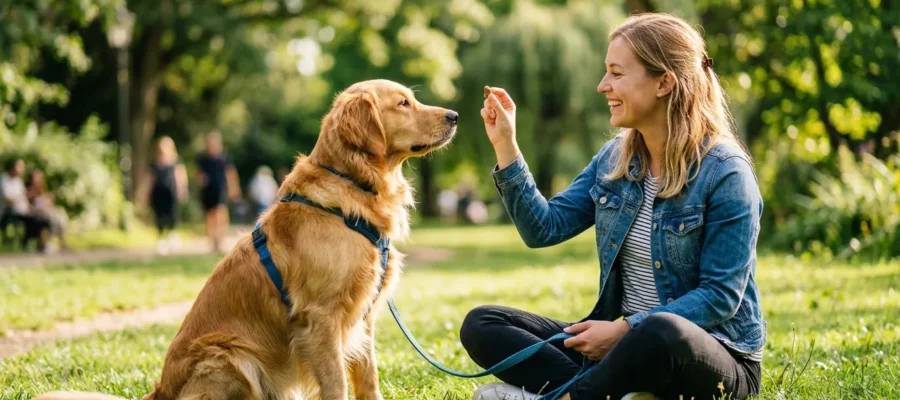
Most dog owners start in the same place. The dog pulls on the leash, ignores its name, jumps on every guest, and chews whatever it wants. It’s not a bad dog. It’s an untrained one. And that’s fixable — at any age, with any breed, using the right approach.
This guide covers everything from how dogs actually learn to the 6 commands you should teach first. It’s built for beginners but goes deep enough to help owners who’ve tried and hit a wall. By the end, you’ll have a clear system — not just a list of tips.
Why Training Your Dog Matters More Than You Think
Training isn’t about control for its own sake. It’s about safety, communication, and giving your dog a way to succeed in a world built for humans.
An untrained dog is a stressed dog. Dogs thrive on predictability. When they don’t know what’s expected, they test everything — furniture, fences, patience. That’s not dominance. That’s anxiety looking for structure.
If you’re just getting started and still figuring out which dog suits your lifestyle, our pet breed finder quiz can help you match with a breed that fits your energy level and living situation — which matters a lot when it comes to training expectations.
What Happens Without Training
Dogs that never learn basic commands face real consequences. Off-leash recalls that don’t work cost lives. Dogs that jump on elderly people cause injuries. Dogs that resource-guard food or toys become bite risks. These aren’t personality flaws — they’re gaps in communication that training closes.
The American Kennel Club (AKC) reports that dogs who complete the Canine Good Citizen (CGC) program have significantly lower rates of behavioral surrender to shelters. The single biggest reason dogs are surrendered isn’t aggression — it’s behaviors that were never addressed early.
Many of these problems come from patterns owners accidentally create. Our guide on common dog owner mistakes walks through the most frequent ones — and how to stop them from setting in.
Benefits Beyond Obedience
A trained dog is easier to take places. Vet visits go smoother. Guests feel comfortable. Kids can interact safely. Training also builds a specific kind of bond — the kind that comes from working through something together.
Dogs that train regularly are mentally tired in a good way. A 10-minute training session uses as much energy as a 30-minute walk for many dogs, especially high-drive breeds.
How Dogs Actually Learn
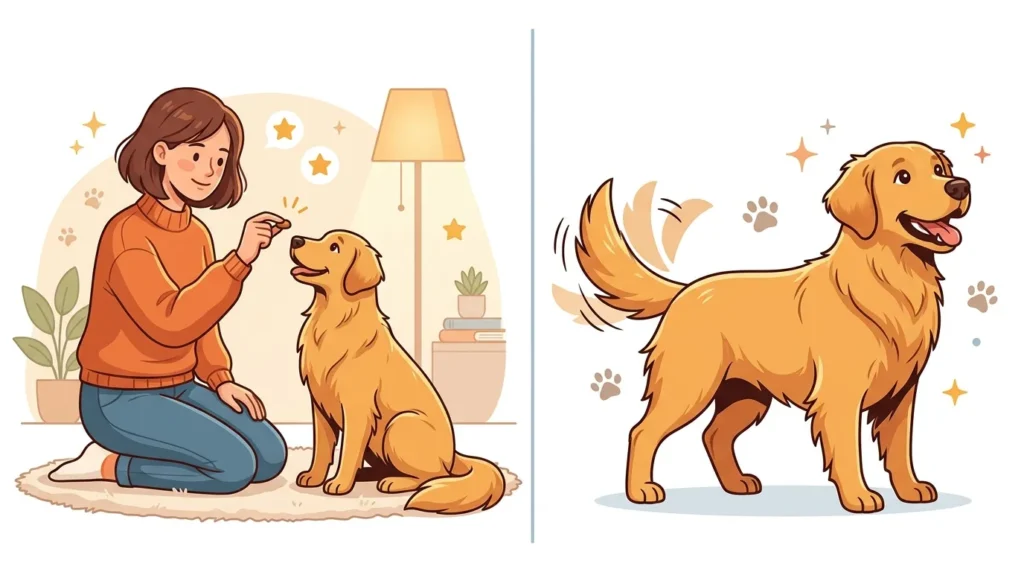
Before picking a method or teaching a command, understand how dogs process new information. This changes everything about your timing and approach.
Dogs don’t learn the way most people assume. They don’t reason through rules. They notice patterns. They learn that their own behavior produces outcomes — good ones worth repeating, and neutral or unpleasant ones worth avoiding.
Classical Conditioning (Pavlov’s Legacy)
In 1927, Russian scientist Ivan Pavlov published his findings on conditioned reflexes while studying digestion in dogs. He discovered that dogs began salivating when they heard the sound that preceded feeding — even before food appeared. The sound alone triggered the physical response. That’s classical conditioning.
In dog training, classical conditioning is how you attach meaning to a word or signal. When you say “sit” and the dog sits and gets rewarded, the word “sit” starts to mean something specific. The dog didn’t reason through it. It learned an association through repetition.
This is why the word you choose doesn’t matter much. “Sit,” “park,” “banana” — any word works as a cue if you build the association correctly. What matters is consistency.
Operant Conditioning Explained Simply
Operant conditioning, developed by B.F. Skinner, is about cause and effect. Dogs learn that their behavior produces consequences. Reinforcement makes a behavior more likely. Punishment makes it less likely.
Here’s what those terms actually mean:
- Positive reinforcement — you add something the dog wants (a treat, praise, a toy) after a behavior. The behavior increases.
- Negative reinforcement — you remove something unpleasant when the dog does the right thing. The behavior increases. (Less common in modern pet training.)
- Positive punishment — you add something the dog dislikes after a behavior. The behavior decreases.
- Negative punishment — you remove something the dog wants after a behavior. The behavior decreases. (Turning your back when a dog jumps is an example.)
Most trainers working with pet dogs today focus primarily on positive reinforcement. It’s the most effective starting point and produces dogs that are engaged rather than avoidant.
Why Timing Is Everything
Dogs connect consequences to the behavior they were doing at the moment the consequence happens — not two seconds later. If your dog sits, and you reach for a treat, and the dog stands up, and then you give the treat, you just rewarded standing up.
The reinforcement window is 1–2 seconds. That’s it. This is why marker training (covered next) is so effective — it closes the gap instantly.
The Best Training Method for Most Dogs
There is no single best training method that works identically for every dog. Trainers disagree about almost everything. But there’s strong consensus in the professional community — IACP, CCPDT, and AKC-aligned trainers alike — that reward-based training is the most effective and least harmful starting point for the vast majority of dogs.
What Positive Reinforcement Actually Means
Positive reinforcement is not “treat training.” That’s a common oversimplification. It’s the systematic use of rewards to increase specific behaviors. The reward doesn’t have to be food. It can be play, praise, a toy, access to something the dog wants — whatever your dog values most.
The reason it works is simple: dogs repeat what works. If sitting produces a treat, a dog will sit more. If jumping produces attention — even the word “no” — a dog will jump more. Positive reinforcement puts that logic to work intentionally.
Finding What Motivates Your Dog
The biggest mistake beginners make is assuming all dogs want the same thing. Some dogs will work all day for a piece of chicken. Others are toy-driven. Some are motivated by verbal praise and physical contact. Working dogs with high prey drive often prefer a tug toy over any food.
Run a simple test. Offer your dog a piece of high-value food (cooked chicken, hot dog, cheese) and watch the reaction. If the dog barely responds, food motivation is low. Try a squeaky toy. Try a game of tug. Find what your dog actually wants — then use that as the reward.
A dog with no apparent motivation is usually a dog that isn’t hungry enough during training, is overwhelmed by the environment, or hasn’t been offered the right reward yet.
The Science Behind Reward-Based Training
Research from the Journal of Veterinary Behavior (2020) found that dogs trained with aversive methods showed significantly higher rates of stress behaviors — yawning, lip-licking, low posture — than dogs trained with reward-based methods. Dogs trained with punishment also took longer to learn new tasks and showed more avoidance behaviors toward their handlers.
This isn’t about being soft. It’s about what’s efficient. A dog that wants to work with you learns faster than a dog that’s working to avoid something.
Essential Training Tools
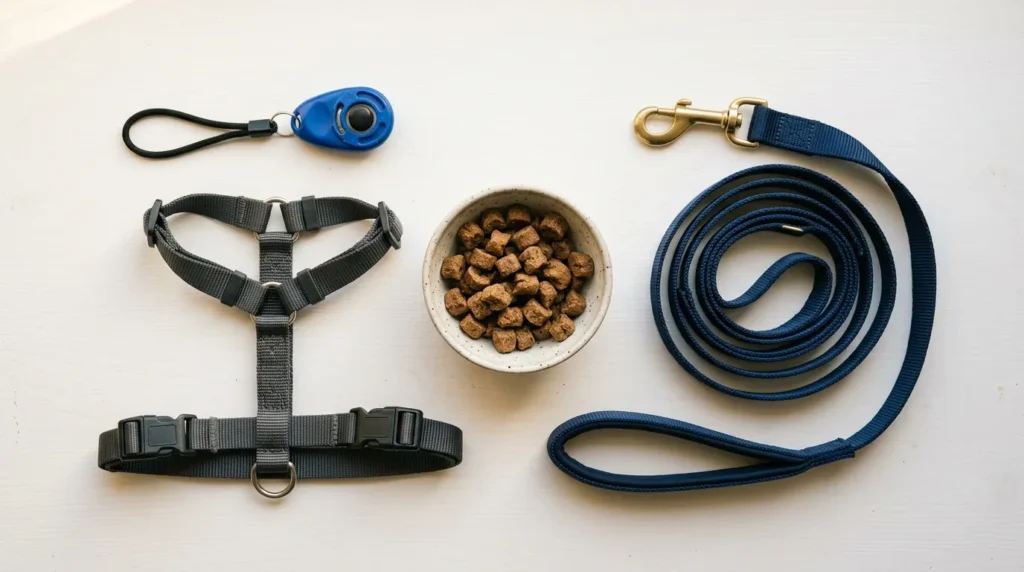
You don’t need much to start. A few tools make the process cleaner and faster.
Treats — What Works and What Doesn’t
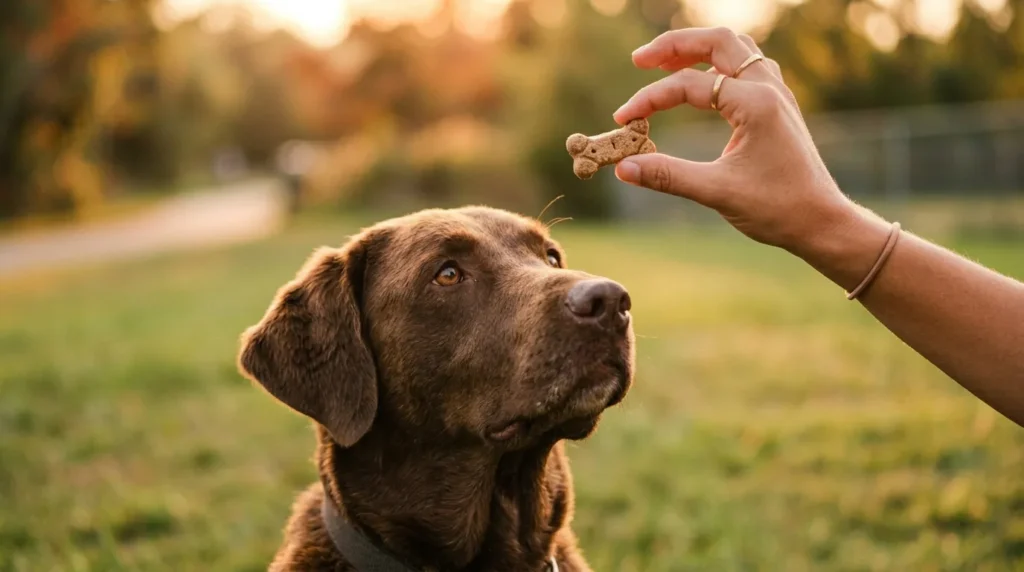
Use high-value, small, soft treats during training. Small means your dog can chew and swallow in under a second and stay focused. Soft means no crumbling, no chasing pieces across the floor.
Good options: small pieces of cooked chicken, hot dog slices, cheese cubes, or commercial training treats. Kibble works in low-distraction environments. In a park with squirrels, you’ll need something better.
Keep treat size to roughly the volume of a pea. You may give 30–50 treats in a 10-minute session. Kibble from the daily food allowance is a good way to manage calorie intake.
If you’re unsure whether a human food is safe to use as a training reward, check whether peanut butter is good for dogs or browse our safety guides on foods like broccoli, cucumbers, and other common treat options — not everything that seems healthy is safe.
Verbal Markers vs. Clicker
A marker is a signal that tells the dog: “That’s the exact thing I want — reward is coming.” It closes the timing gap between behavior and treat delivery.
Two main options:
Clicker — a small handheld device that makes a distinct clicking sound. Precise, consistent, neutral. Requires a free hand.
Verbal marker — a short, distinct word like “yes” said in a consistent tone. No equipment needed. Works just as well for most owners.
Karen Pryor Academy has long promoted the clicker as superior. A 2019 study at the University of Lincoln found no measurable difference in learning speed between clicker and verbal markers when timing was controlled. Use whichever you’ll apply consistently.
To condition a marker: say “yes” (or click), then immediately give a treat. Repeat 10–15 times over a few sessions. The marker becomes meaningful through repetition.
Leash, Collar, and Harness Basics
A 6-foot flat leash is the standard tool for basic training. Retractable leashes teach dogs to pull — avoid them during training.
For most dogs, a flat collar or a front-clip harness works well for early leash training. Front-clip harnesses redirect pulling toward the handler without causing discomfort. For dogs that pull hard and are at risk of tracheal injury, a harness is preferable to a collar.
Crates are not punishment. Properly introduced, a crate becomes a dog’s preferred resting place and is essential for house training. We cover the full process in our dedicated guide on how to crate train your dog.
How to Structure a Training Session
Structure matters as much as content. Short, focused sessions produce better results than long, unfocused ones.
Ideal Session Length by Age
| Age | Session Length | Sessions Per Day |
|---|---|---|
| 8–12 weeks | 3–5 minutes | 3–5 |
| 3–6 months | 5–10 minutes | 3–4 |
| 6–12 months | 10–15 minutes | 2–3 |
| Adult dog | 10–20 minutes | 1–3 |
Puppies fatigue mentally within minutes. Adult dogs can sustain longer sessions, but diminishing returns usually kick in after 15–20 minutes. End every session while the dog is still engaged — not after it’s checked out.
How Often to Train
Daily training produces faster results than sporadic sessions. Two 10-minute sessions per day outperform one 30-minute session. The brain consolidates learning during rest. Shorter, more frequent exposure builds retention faster.
Training doesn’t only happen in formal sessions. Every walk, every meal, every door opening is an opportunity to reinforce what you’re teaching.
Where to Train (Environment Matters)
Start in the least distracting environment possible — usually indoors. A dog that reliably sits in your kitchen will not reliably sit in a park with other dogs nearby. That’s not disobedience. It’s a training gap.
Gradually introduce more challenging environments as the behavior becomes consistent. This process is called proofing. A proofed recall command, for example, works at the front door, at the park, off-leash in a field, and when a squirrel runs by. That takes weeks — but it’s achievable.
The 6 Basic Commands Every Dog Should Know
These are the foundation. Teach these first, in this order. Each one builds on the last.
For a quick companion reference as you work through these, our simple dog training steps guide covers the core commands in a condensed format you can keep open during practice sessions.
1. Sit
Why it matters: Sit is the default behavior for impulse control. It replaces jumping, rushing through doors, and general chaos.
How to teach it:
- Hold a treat at your dog’s nose.
- Slowly move your hand up. The dog’s rear will lower as its head follows the treat.
- The moment the rear touches the ground, say “yes” and give the treat.
- Repeat 5–10 times per session until the movement is automatic.
- Once the dog sits reliably, add the verbal cue “sit” just before the movement.
- Fade the lure over 3–5 sessions by switching to an empty hand signal.
Common mistake: Adding the cue too early. Say “sit” before the dog understands the motion and you’re attaching a word to confusion. Wait until the sit is happening reliably, then name it.
2. Stay
Why it matters: Stay teaches impulse control and prevents bolting through doors, gates, and out of cars.
How to teach it:
- Ask your dog to sit.
- Open your palm toward the dog. Say “stay.”
- Wait 2 seconds. Say “yes” and reward.
- Gradually increase the duration: 5 seconds, 10, 20, 30.
- Add distance only after duration is solid.
- Use a release word (“okay” or “free”) to end every stay.
Build duration before distance, and distance before distraction. Jumping ahead causes breakdowns. If the dog breaks the stay, reduce the difficulty — shorter duration, closer distance — and build back up.
3. Come (Recall)
Why it matters: A reliable recall is the most important safety command a dog can have.
How to teach it:
- Start indoors. Crouch down, open your arms, say “[dog’s name], come!” in a happy tone.
- When the dog reaches you, reward generously — treats, play, praise.
- Never punish a dog that comes to you, even if it took 10 minutes. You’re rewarding the arrival.
- Practice on a 15–20 foot long line outdoors before attempting off-leash.
- Use a high-value reward for recall every time — this command must remain the most rewarding thing you ask for.
Never call your dog to do something it dislikes (nail trim, bath) without following up with something good afterward. You’re building a word that means “good things happen.”
4. Down
Why it matters: Down is a calming position that helps manage excited or anxious dogs in public or at home.
How to teach it:
- Ask your dog to sit.
- Hold a treat at its nose, then slowly move it straight down to the floor between its front paws.
- As the dog folds down, say “yes” and reward.
- If the dog stands instead of lying down, try luring under your knee or a low coffee table so the dog has to drop to follow the treat.
- Once the down is reliable, add the verbal cue.
Some dogs find down difficult because it’s a vulnerable position. Be patient with dogs that resist. Short steps, high rewards.
5. Leave It
Why it matters: Leave it prevents dogs from eating dangerous objects, approaching hazards, or lunging at other animals.
How to teach it:
- Place a treat in your closed fist. Present your fist to the dog.
- The dog will sniff, paw, and lick your hand. Wait.
- The moment the dog backs off — even slightly — say “yes” and give a treat from your other hand (not the one the dog was trying for).
- Repeat until the dog backs off reliably.
- Progress to a treat on the floor covered by your foot, then uncovered, then in plain sight.
- Add the verbal cue “leave it” just before you present the object.
Leave it is especially useful outdoors where dogs encounter dropped food, animal waste, or toxic plants. Before heading out, it’s also worth knowing which foods are actually dangerous — like whether dogs can eat mushrooms or avocado, so you can react quickly if your dog tries to grab something on a walk.
6. Heel (Loose Leash Walking)
Why it matters: Pulling on leash is the most common complaint of dog owners. Loose leash walking makes every walk better for everyone.
How to teach it:
- Hold a treat at your left hip. Start walking.
- The moment the dog pulls, stop completely. Don’t pull back — just stop.
- Wait for the dog to return to your side, then say “yes” and reward.
- Restart. The rule is simple: pulling stops progress.
- Reward the dog every 5–10 steps when it’s walking in position.
- Gradually reduce treat frequency as the behavior becomes consistent.
It takes longer to teach heel than most owners expect. Budget 4–8 weeks of consistent work. Progress is faster when combined with regular impulse control practice (sit, stay, down).
Puppy Training: Where to Start and When
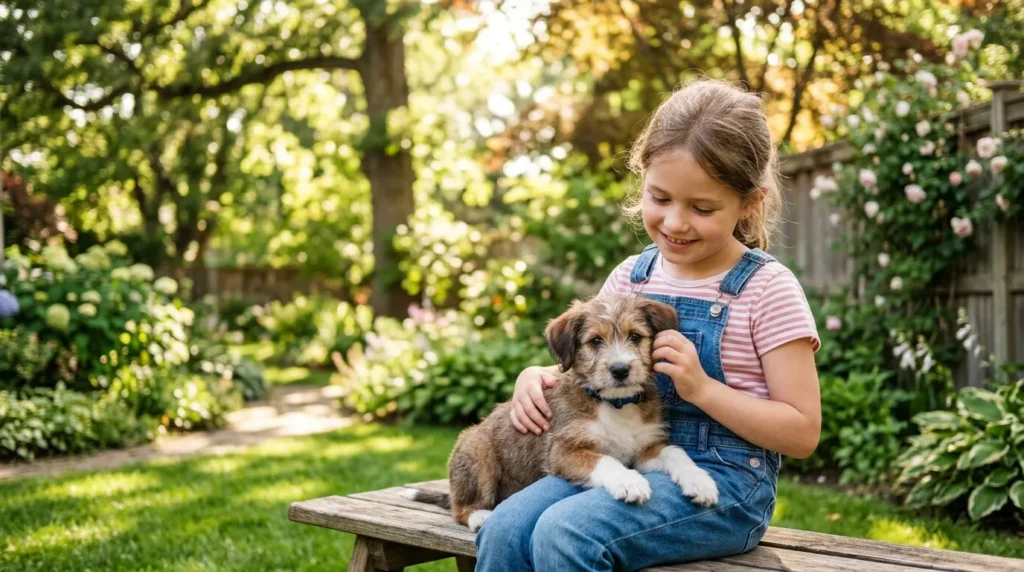
Puppies are learning constantly from birth. Formal training can begin as soon as you bring a puppy home — typically around 8 weeks.
The Best Age to Start Training
8 weeks is not too young. The idea that you should “wait until 6 months” is outdated and counterproductive. The brain is most plastic and receptive to new learning between 8 and 16 weeks.
Keep sessions short (3–5 minutes), reward heavily, and end on success. Puppies have no attention span. That’s not a problem — it’s a design feature you work with.
To understand where your puppy is in its development right now, use our pet age calculator — it converts dog age to human-equivalent years and helps contextualize what to expect at each stage.
Socialization Window (8–16 Weeks)
Between 8 and 16 weeks, puppies form permanent impressions about what is safe in the world. Exposure to different people, surfaces, sounds, animals, and environments during this window dramatically reduces fear and reactivity later.
The goal isn’t flooding. It’s calm, positive, low-pressure exposure. A puppy that sees 100 new things during this window, all associated with good outcomes, will be a more confident, adaptable adult.
If you have other pets at home, socialization includes them too. Getting a new dog and a cat to coexist takes some planning — our guide on how to introduce a dog to a cat covers the process step by step so the first impressions are good ones.
Crate Training and House Training Basics
Crate training works on a simple principle: dogs don’t want to eliminate where they sleep. A correctly sized crate gives puppies control over bladder and bowel, which accelerates house training.
Take puppies outside every 30–60 minutes during waking hours, immediately after eating, and immediately after waking from naps. Reward heavily for outdoor elimination. If accidents happen indoors, clean with an enzyme cleaner — regular cleaners don’t eliminate the scent signals that attract dogs back.
Our full guide on how to house train your dog walks through the complete schedule and what to do when accidents keep happening despite your best efforts.
Most puppies have reliable house training by 4–6 months with consistent management.
Training an Adult or Rescue Dog
The idea that “you can’t teach an old dog new tricks” is factually wrong. Adult dogs learn throughout their entire lives. What changes with age is the speed of initial acquisition — but reliability and consistency often improve.
Is It Too Late?
No. Dogs have been successfully retrained at 7, 10, and 12 years old. Behaviors that seem hardwired are usually just habits that were reinforced for a long time. With consistent new reinforcement, old patterns change.
Adult dogs have longer attention spans than puppies. Sessions can run 15–20 minutes. They also bring clearer temperament — you know exactly what you’re working with. Use our pet age calculator to get a sense of where your adult dog’s mental and physical maturity sits — it helps set realistic expectations for training pace.
Resetting Habits in Older Dogs
The key with adult and rescue dogs is management first, training second. A dog can’t unlearn jumping on the counter if it’s still successfully accessing the counter. Block the behavior temporarily while you train the replacement behavior.
Rescue dogs often need 2–4 weeks of “decompression” — low stimulation, low demands, time to settle — before training begins. A dog in survival mode can’t learn efficiently. Once the dog is sleeping, eating, and exploring calmly, structured training can start.
Mental Enrichment as Part of Training
Training is one form of mental stimulation. It shouldn’t be the only one. Dogs need regular mental exercise beyond just obedience practice.
Why Mental Stimulation Matters
Physical exercise burns energy. Mental exercise tires the brain. For high-drive breeds — Border Collies, Belgian Malinois, German Shepherds, Jack Russell Terriers — physical exercise alone often isn’t enough. These dogs will redirect unsatisfied mental energy into destructive behavior.
15 minutes of nose work, puzzle feeding, or scent games can produce the same tiredness as a 45-minute run in some breeds. Curious how much physical exercise your specific dog actually needs? Our guide on how much exercise a dog needs daily breaks it down by size, breed group, and age.
Brain Games and Enrichment Toys
Some practical options:
- Kong stuffed with frozen food — basic, cheap, effective. Takes 15–20 minutes to work through.
- Snuffle mats — scatter kibble through the fibers. Dog uses its nose to forage.
- Licki Mats — spread peanut butter, yogurt, or wet food. Calming and enriching simultaneously.
- Puzzle feeders (Nina Ottosson brand, Kong Wobbler) — varying difficulty levels from 1–4. Start at 1 and work up.
- Nose work / scent detection — hide treats in boxes, under cups, or in designated scent work containers. This is the most cognitively demanding enrichment for most dogs.
Feed meals in enrichment toys rather than a bowl three to four times per week. It costs nothing extra and adds 10–15 minutes of productive mental activity per meal.
Fixing Common Behavior Problems
Most behavior problems in dogs have the same underlying cause: a behavior that was unintentionally rewarded until it became habitual. The fix is almost always the same — remove the reward for the old behavior, reward a new incompatible behavior consistently.
Jumping on People
Jumping is rewarded by attention — including the attention of being pushed off. Every time a person interacts with a jumping dog, the jumping is reinforced.
Fix: Turn your back the moment all four paws leave the ground. Say nothing. When four paws hit the floor, immediately turn around and reward. Teach sit as the greeting behavior. Ask every visitor to do the same — inconsistency is what keeps jumping alive.
Pulling on the Leash
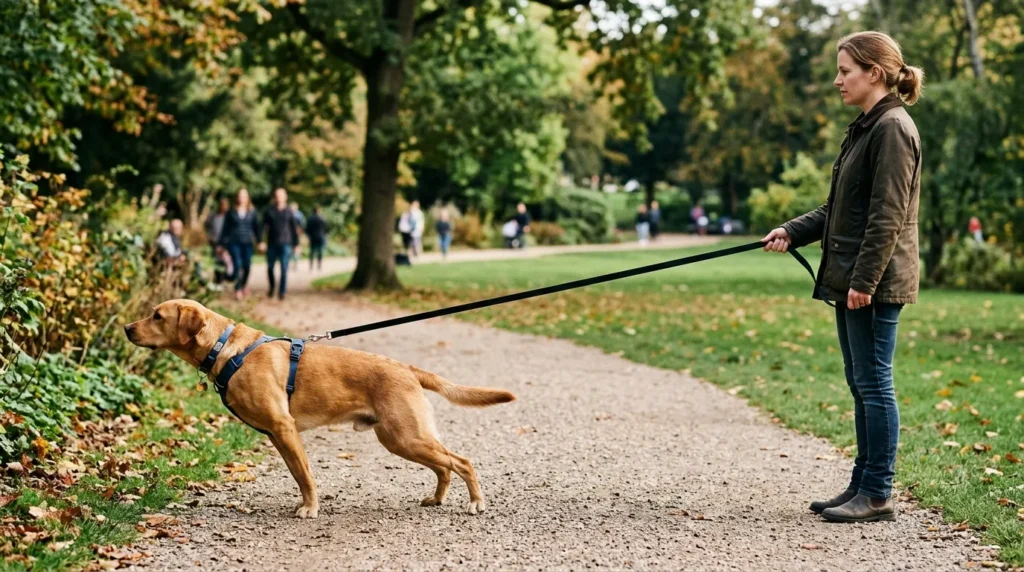
Pulling is rewarded by forward movement. The dog pulls, the owner follows, the dog learns that pulling works.
Fix: Stop when the leash tightens. Resume only when the leash is loose. It takes many repetitions for this to click, and the first few sessions may cover 50 feet in 10 minutes. That’s fine. Stay consistent.
Excessive Barking
Barking has different triggers — alarm, boredom, demand, anxiety. Identify the trigger before addressing it.
For demand barking (barking to get food, attention, or to go outside): ignore it completely. Reward when quiet. Any attention during barking — even “quiet!” — reinforces the behavior.
For alarm barking: teach “quiet” by waiting for a 2-second pause, then rewarding. Build duration gradually.
For anxiety-based barking: this often requires professional guidance and may involve desensitization protocols. Our detailed guide on how to stop dog barking covers all the common triggers and what works for each one.
Biting and Nipping
Puppy biting is normal developmental behavior. Puppies learn bite inhibition (how hard is too hard) through feedback from littermates and their environment.
When a puppy bites too hard: say “ouch” in a sharp tone and withdraw all interaction for 10–20 seconds. Resume. Repeat. This mimics the feedback a littermate would give.
Adult dog biting is a separate category. Any dog showing resource guarding, fear-based biting, or redirected aggression should be evaluated by a certified professional before any training attempts. If you’re seeing escalating nipping behavior, our article on why does my dog bite me breaks down the different causes and how to respond to each.
When to Hire a Professional Dog Trainer
Some problems are too complex, too entrenched, or too dangerous to navigate alone. Knowing when to get help is a skill, not a failure.
Signs You Need Help
Get professional help when:
- Your dog has bitten or attempted to bite a person
- Your dog shows severe anxiety (destructive, self-harming, cannot eat or rest)
- Your dog is reactive toward other dogs or people on leash
- Basic commands aren’t improving after 4–6 weeks of consistent work
- You feel unsafe handling your dog
The earlier you bring in a professional, the faster and cheaper the resolution. Most behavior problems are significantly easier to address at 6 months than at 2 years.
How to Choose a Qualified Trainer
The dog training industry is unregulated. Anyone can call themselves a trainer. Look for these credentials:
- CPDT-KA (Certified Professional Dog Trainer – Knowledge Assessed) from the CCPDT
- CDBC (Certified Dog Behavior Consultant)
- IACP CDTA (International Association of Canine Professionals Certified Dog Trainer)
Ask trainers specifically: “What do you do when a dog gets something wrong?” Any answer that involves pain, fear, or intimidation is a red flag. You want to hear “I reduce difficulty and set the dog up to succeed.”
Group classes are appropriate for puppies and dogs with basic manners issues. Private sessions are better for reactivity, aggression, anxiety, and specific behavioral problems.
If you’re a first-time dog owner trying to decide which breed to get before any of this becomes relevant, our guide on top dog breeds for new pet parents highlights breeds that are naturally easier to train — a head start that makes a real difference.
Frequently Asked Questions
How long does it take to train a dog? Basic commands like sit, stay, and come can be functional within 1–3 weeks of consistent daily practice. Reliable, proofed commands that hold up in all environments take 2–3 months. Complex behaviors or undoing deeply ingrained habits can take longer.
What is the best age to start training a dog? 8 weeks. The earlier, the better. Puppies can learn basic commands almost as soon as they’re home. The socialization window between 8 and 16 weeks is irreversible — use it.
How long should dog training sessions be? 3–5 minutes for puppies under 12 weeks. 10–15 minutes for adolescent and adult dogs. End every session while the dog is still engaged.
Can I train my dog without treats? Yes, but food is the most efficient reinforcer for most dogs at the start of training. As behavior becomes reliable, you can switch to variable reinforcement — rewarding intermittently — and rely more on praise and play. Eliminating rewards entirely early on slows learning significantly.
Should I use a clicker or verbal markers? Both work equally well when used consistently. Use whichever you’ll actually stick with. A verbal “yes” is simpler for most owners because it requires no equipment.
Is it too late to train my adult dog? No. Dogs learn throughout their lives. Adult dogs often train faster per session than puppies because of longer attention spans. Start now — later will always be harder than today.
Conclusion
Training a dog is a process, not an event. The dogs that end up well-trained aren’t the lucky ones — they’re the ones whose owners showed up consistently with clear expectations, the right rewards, and the patience to build behavior one repetition at a time.
Start with motivation. Find what your dog values. Use that to build sit, stay, come, down, leave it, and heel — in sessions short enough to keep engagement high. Proof those commands slowly, across real environments. Add mental enrichment daily. Fix behavior problems at the source rather than punishing the surface.
The gap between a chaotic dog and a reliable one is usually smaller than owners expect. A few weeks of consistent work closes it. Start today, stay consistent, and the results will follow.