

The Short Answer
Lavender is not fully safe for dogs, but the risk level depends entirely on the form and the amount. The lavender plant itself is mildly toxic — most dogs would need to eat a significant quantity to get seriously ill. Lavender essential oil is a different story. It’s highly concentrated and genuinely dangerous, even in small amounts. Lavender-scented products sit somewhere in the middle, depending on what’s actually in them.
If your dog chewed a few lavender stems in the garden, you probably don’t need to panic. If your dog got into a bottle of essential oil, call your vet now.
Lavender Plant vs. Essential Oil vs. Products — The Risk Is Not the Same
This is where most pet owners get confused. “Lavender” covers several very different things, and treating them as one category gets people into trouble.
The Lavender Plant
Fresh or dried lavender (Lavandula angustifolia) contains linalool and linalyl acetate — the two compounds responsible for its scent and its toxicity to dogs. The concentrations in the raw plant are relatively low. The ASPCA lists lavender as toxic to dogs, but classifies it as causing mild gastrointestinal upset in most cases rather than life-threatening poisoning.
A dog that nibbles a few flowers might vomit or have loose stools. A dog that eats a large portion of the plant — stems, leaves, flowers — could develop more significant symptoms. Most exposures involving the plant stay in the mild-to-moderate range.
If you’re unsure whether another plant in your garden could be harming your dog, our Pet Symptom Checker can help you assess what your dog might be reacting to before you call the vet.
Lavender Essential Oil
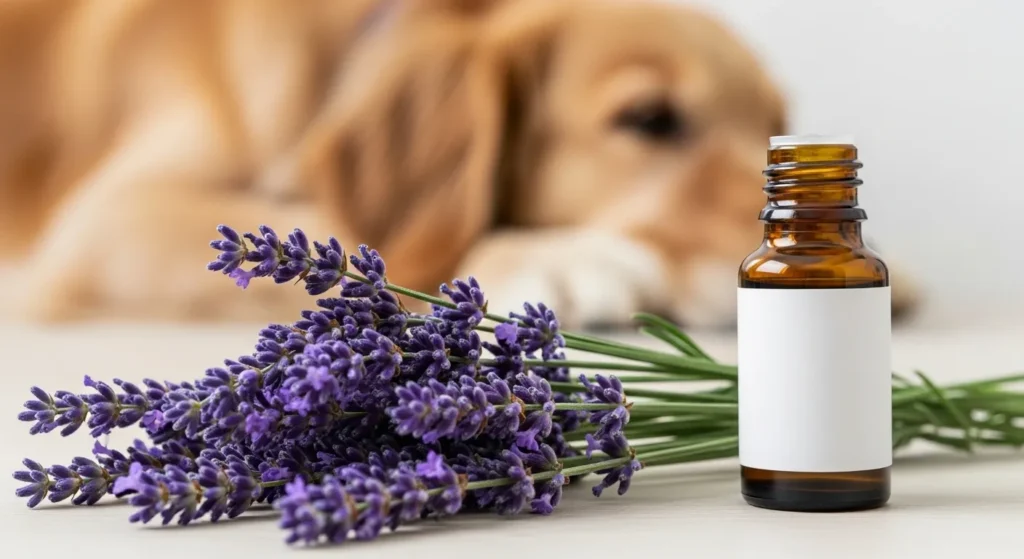
This is where the danger escalates sharply. Essential oils are distilled concentrates. It takes roughly 100–150 pounds of lavender plant material to produce just 1 pound of essential oil. That means the linalool concentration in an essential oil is anywhere from 25% to 45% — compared to trace amounts in the raw plant.
Dogs can’t metabolize linalool efficiently. Their livers lack sufficient glucuronyl transferase enzymes to process it the way humans do. When linalool builds up in a dog’s system, it causes CNS depression, liver stress, and GI distress. Even a few drops of undiluted essential oil on a dog’s skin or ingested can cause real harm, particularly in small breeds.
If you want a full breakdown of which essential oils carry the highest risk for your dog, read our guide on safe essential oils for dogs — it covers what to use, what to avoid, and at what concentrations. You might also want to check is peppermint oil safe for dogs, since it’s one of the most commonly diffused oils and one of the riskiest for pets.
Lavender-Scented Products (Shampoos, Sprays, Candles, Diffusers)
Most commercial pet shampoos and grooming sprays that list lavender as an ingredient use heavily diluted forms — often well below 1% concentration. Products formulated specifically for dogs and tested for veterinary safety are generally low risk.
The problem is products not made for dogs. Human skincare, candles, reed diffusers, and plug-in air fresheners can release linalool into the air at levels that irritate a dog’s respiratory tract. Dogs have up to 300 million olfactory receptors — compared to around 6 million in humans. A scent that’s mild to you can be overwhelming and irritating to them.
What Makes Lavender Toxic? The Linalool Problem
Linalool is the primary active compound in lavender. It’s also found in over 200 other plant species. In dogs, linalool is classified as a nervous system depressant. At low doses, the effect is mild sedation and GI irritation. At higher doses, it affects muscle coordination, liver function, and in severe cases, respiratory function.
Linalyl acetate, the secondary compound, breaks down into linalool after ingestion — so even though it appears separately on ingredient labels, it adds to the total linalool load in the dog’s body.
Dogs process linalool much more slowly than humans. A small dog with repeated low-level exposure — living in a home where a lavender diffuser runs daily, for example — could accumulate linalool over time. That chronic exposure risk is rarely discussed but is real.
If you’re also wondering whether other natural or food-based products are risky for your dog, our Pet Food Safety Checker lets you quickly look up ingredients before giving them to your pet.
How Much Lavender Is Dangerous for a Dog?
There’s no single universal threshold because body weight matters significantly. A 5-pound Chihuahua and an 80-pound Labrador face very different risks from the same exposure.
A few general reference points based on veterinary toxicology data:
- Plant ingestion: Most healthy adult dogs would need to consume a substantial portion of the plant (multiple stems and flower clusters) to move beyond mild GI symptoms. A few nibbles is typically low risk.
- Essential oil (undiluted): Even 1–2 drops on the skin of a small dog can cause symptoms. Ingestion of even a fraction of a teaspoon can be dangerous.
- Diluted essential oil (0.1%–1%): At proper veterinary dilution rates, lavender oil is used in some therapeutic contexts. Below 0.5% is considered lower risk by many integrative vets, but this should never be done without veterinary guidance.
If you don’t know how much your dog consumed, treat it as potentially significant and call a professional. You can also use our Pet Age Calculator to understand your dog’s life stage — puppies and seniors metabolize toxins very differently than healthy adult dogs, which directly affects their risk level.
Symptoms of Lavender Toxicity in Dogs
Symptoms vary based on how the exposure happened — ingestion, skin contact, or inhalation — and how much linalool entered the dog’s system.
Mild Symptoms
- Nausea
- Vomiting
- Diarrhea
- Excessive drooling
- Lethargy
- Loss of appetite
Moderate to Severe Symptoms
- Ataxia (loss of coordination, stumbling)
- Muscle weakness
- Tremors
- Difficulty breathing
- Pale or yellowish gums (indicating liver involvement)
- Excessive pawing at mouth or face (following skin or mucosal contact)
- Depression or unusual sedation
When to Call a Vet Immediately
Call your vet or the ASPCA Animal Poison Control Center at (888) 426-4435 right away if:
- Your dog ingested any amount of essential oil
- Your dog is showing neurological symptoms (stumbling, trembling, unresponsive)
- Symptoms don’t resolve within 1–2 hours
- Your dog is a puppy, elderly, or has existing liver or kidney issues
- You’re unsure of the amount consumed
Don’t wait to see if it gets better when neurological symptoms are present. If your dog is vomiting, our article on why is my dog vomiting can help you understand what the symptoms mean and when they warrant emergency care. If you need to act fast, also read how to make a dog throw up safely — but only do this after speaking with a vet or poison control first.
What to Do If Your Dog Is Exposed to Lavender
The action you take depends on how the exposure happened.
If Your Dog Ingested Lavender (Plant or Oil)
Don’t induce vomiting unless a vet specifically instructs you to. Call your vet or ASPCA Poison Control immediately. Have the product label ready if the exposure involved an oil or commercial product — the concentration matters. Tell them your dog’s weight, the estimated amount consumed, and when it happened.
If Lavender Oil Got on Your Dog’s Skin
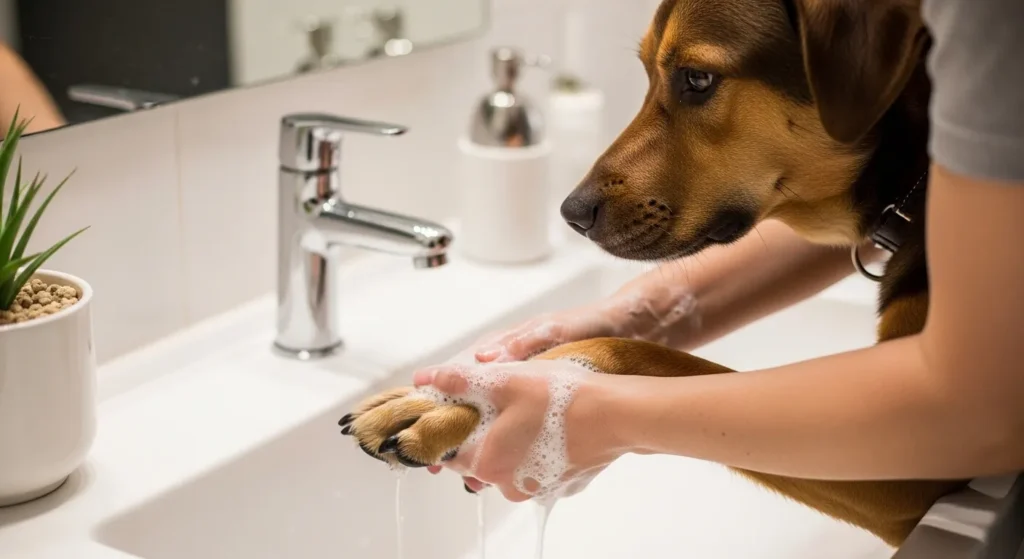
Move your dog away from the source. Wash the affected area with mild dish soap and lukewarm water — soap breaks down the oil. Don’t use hot water, which increases skin absorption. Rinse thoroughly. Watch for redness, irritation, or swelling. Contact your vet if irritation persists or spreads.
If Your Dog Was Exposed Through a Diffuser or Inhalation
Turn off the diffuser and move your dog to fresh air immediately. Open windows. Watch for coughing, wheezing, watery eyes, or nasal discharge. If respiratory symptoms don’t clear within 15–20 minutes in fresh air, call your vet.
Can Dogs Safely Smell Lavender?
Mild, passive exposure to lavender scent — like walking past a lavender plant outdoors — is not a meaningful risk for most dogs. The issue is intensity and duration. A closed room with an active essential oil diffuser running for hours is a different situation than a brief outdoor sniff.
Some dogs are also individually more sensitive than others. If your dog leaves the room when you diffuse lavender, take that as useful information. Dogs self-regulate away from scents that bother them when they can. Forcing them to stay in a heavily scented space removes that option.
Lavender is sometimes marketed as calming for dogs. There is limited evidence that lavender scent has a mild calming effect in some dogs, but it’s not a substitute for behavioral support or veterinary care for anxiety. If your dog struggles with stress or fear, our guide on how to calm a dog during a storm covers safer, vet-approved methods that don’t involve essential oils.
Lavender Products That Are Generally Lower Risk for Dogs
- Dog-specific shampoos with lavender — formulated at safe dilution levels for canine skin and tested accordingly
- Diluted sprays designed for pets — check that lavender or linalool is far down the ingredient list, indicating low concentration
- Dried lavender in sachets in areas dogs can’t access — low risk when the dog can’t chew or ingest them
- Brief, well-ventilated passive scent exposure outdoors or in large open spaces
Always look for products that explicitly state they are veterinarian-approved or tested for pet safety. “Natural” on a label means nothing in terms of safety. The same applies to other topical products — if you’re considering coconut oil for dogs, the same rule applies: natural doesn’t automatically mean safe.
Lavender Products to Avoid Around Dogs
- Undiluted lavender essential oil — never apply directly to skin or allow ingestion
- Human aromatherapy diffusers in enclosed spaces where dogs spend time
- Lavender-scented candles burned in small rooms with poor ventilation
- Human skincare or massage oils with lavender — concentrations are formulated for human skin, not dogs
- Lavender potpourri or loose dried lavender within reach of dogs who chew or eat everything
- Plug-in air fresheners with lavender fragrance — these run continuously and maintain constant linalool levels in the air
Lavender and Cats — A Related Risk Worth Knowing
If you share your home with both dogs and cats, it’s worth knowing that lavender is also toxic to cats — and cats are actually more sensitive to linalool than dogs because they have even fewer liver enzymes to process it. Our separate guide on is lavender safe for cats covers the specific risks and what multi-pet households need to know.
Frequently Asked Questions
Can I put lavender oil directly on my dog? No. Undiluted lavender essential oil should never go directly on a dog’s skin. Even diluted essential oils should only be used under veterinary guidance, with concentration levels appropriate for the dog’s size and health status.
Is dried lavender safe for dogs? In small incidental amounts, dried lavender is unlikely to cause serious harm in a healthy adult dog. It’s still technically toxic per the ASPCA classification, and dogs that eat larger quantities can develop GI symptoms. Keep dried lavender out of reach of dogs that chew or eat plants. If you’re unsure what your dog can and can’t eat safely, our Pet Food Safety Checker is a quick reference tool.
Can I diffuse lavender in a home with dogs? If you do, the room needs to be well-ventilated, the dog needs to be able to leave freely, and diffusion time should be limited. Don’t run a diffuser for hours in a closed room where a dog sleeps. Many vets recommend avoiding diffusers with dogs in the home altogether, particularly with young puppies or dogs with respiratory issues.
Is lavender safe for puppies? Puppies are at higher risk. Their livers are less developed, which makes metabolizing linalool even harder. Their smaller body weight also means a lower threshold for toxic effects. Avoid all lavender products around puppies unless specifically cleared by your vet. If you’re raising a young dog and want to understand their developmental stage, our Pet Age Calculator can help you track where they are in their growth.
My dog ate lavender from the garden — what do I do? If it was a small amount (a few flowers or stems) and your dog is acting normally, monitor for vomiting, diarrhea, or lethargy over the next few hours. If any symptoms appear, or if your dog ate a significant quantity, call your vet or ASPCA Poison Control at (888) 426-4435.
Is cinnamon similarly risky for dogs? Several common household spices and natural ingredients fall into the same “low risk in small amounts, dangerous in concentrated form” category. Our article on is cinnamon bad for dogs covers how that risk scales with the form and amount — worth reading if you cook at home with spices around your dog.
Final Takeaway
Lavender isn’t safe for dogs in the way that plain chicken or carrots are safe. It’s a plant that contains compounds dogs can’t process well, and in concentrated forms — especially essential oils — it’s a genuine toxicity risk.
The plant in a garden is a low-level concern. A bottle of essential oil within reach of a dog is not. Lavender-scented products designed for dogs sit in a middle ground — check the ingredients, choose veterinarian-tested options, and avoid anything with high linalool concentrations.
When in doubt, call your vet before exposure rather than after. The ASPCA Poison Control line — (888) 426-4435 — is available 24 hours a day. And if your dog is showing any unusual symptoms you can’t explain, our Pet Symptom Checker can help you decide whether it’s time to make that call.