


Dogs chase their tails for six main reasons: puppy curiosity, boredom, attention-seeking, skin irritation, anal gland discomfort, and compulsive disorder. Most cases are harmless. A small number signal a medical or psychological problem that needs a vet.
You’ve watched your dog spin in circles, snapping at its own tail, and you’re not sure whether to laugh or call someone. In most cases, you can relax. But there are specific signs that change the answer — and knowing the difference matters.
This guide breaks down every cause, which breeds are most vulnerable, and what you should actually do about it. If you’ve also wondered why dogs wag their tails, that piece covers the emotional signals behind tail movement in much more detail.
The 6 reasons dogs chase their tails
- 1Puppy curiosity — they don’t know it’s theirs yet.
Puppies under six months frequently chase their tails because they haven’t fully mapped their own body. The tail moves, catches light, and triggers prey drive. Most puppies grow out of it by 12 months without any intervention. If it continues past that point, something else is driving it. - 2Boredom and pent-up energy.
A dog that isn’t getting enough physical or mental stimulation will invent its own activity. Tail chasing burns energy and gives the brain something to focus on. High-drive breeds — herding dogs, working breeds, terriers — hit this threshold faster than low-energy dogs. If your dog chases its tail more on rest days, boredom is probably the cause. A useful reference: how much exercise dogs actually need daily — many owners are falling short without realizing it. - 3Attention-seeking behavior you accidentally trained.
The first time your dog spun around chasing its tail, you probably laughed, pointed, or said something. That reaction was a reward. Dogs repeat behaviors that produce a response from their owner. Even negative attention — “stop that!” — can reinforce it if the dog is bored and craving interaction. The fix isn’t discipline; it’s removing the reaction entirely. This same dynamic explains why some dogs bite their owners — the behavior gets rewarded unintentionally. - 4Fleas, mites, or skin irritation.
Flea allergy dermatitis commonly causes itching at the tail base. Dogs can’t scratch that area directly, so they spin and bite at it instead. Hot spots, mites, and contact allergies produce the same response. If you notice redness, hair loss, or broken skin near the base of the tail, this is the category to investigate first. - 5Anal gland discomfort.
Impacted or infected anal glands cause persistent discomfort around the rear end. Dogs may scoot, lick, or chase their tails as a way of responding to the pressure and irritation. Anal gland problems are easy for a vet to diagnose and usually straightforward to treat. If tail chasing is accompanied by scooting or licking of the hindquarters, this is the most likely medical cause. - 6Injury or pain at the tail base.
A nerve injury, spinal issue, or physical trauma near the tail base can cause a dog to investigate that area repeatedly. In these cases the dog isn’t playing — it’s responding to a sensation it can’t escape. You may notice the dog biting or chewing the tail itself rather than just chasing it. Localized hair loss or wounds at the tail tip are also indicators of pain-driven behavior.
When tail chasing becomes a disorder
What is Canine Compulsive Disorder (CCD)?
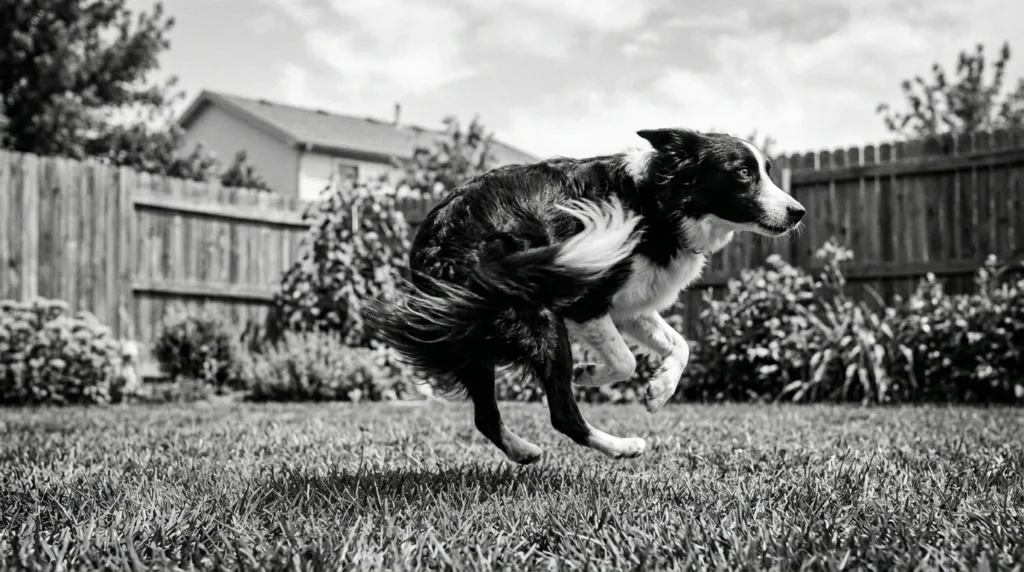
Canine Compulsive Disorder is the clinical term for repetitive behaviors in dogs that serve no functional purpose and continue despite negative consequences. Tail chasing is one of the most studied forms. Dogs with CCD don’t stop when they get tired — they stop only when they’re physically interrupted or too exhausted to continue. The behavior escalates over time without treatment.
CCD is driven by dysregulation in serotonin pathways, the same mechanism involved in OCD in humans. Chronic stress elevates cortisol, which disrupts serotonin regulation, which lowers the threshold for compulsive behavior. A highly stressed dog is significantly more likely to develop CCD than a calm one. If your dog also shows signs of anxiety during thunderstorms or loud events, those stress signals are related — read more about how to calm a dog during a storm, since reducing overall stress load can help manage compulsive tendencies too.
Breeds most affected
Tail chasing as a compulsive behavior shows clear breed predisposition. Bull Terriers and Staffordshire Bull Terriers have the highest documented rates. A study of Bull Terriers found that males were more than twice as likely to display compulsive tail chasing as females, and that episodes often began before 12 months of age. German Shepherds and Anatolian Shepherds also show elevated rates compared to the general dog population.
If you own one of these breeds and your dog is tail chasing frequently, compulsive disorder is a realistic explanation — not just boredom. If you’re still figuring out your dog’s breed makeup, the pet breed finder quiz can help you narrow it down — knowing your breed is useful context for any behavioral issue.
Episodic vs. chronic tail chasing
Episodic tail chasing happens occasionally, lasts a short time, and stops when the dog gets distracted. This is typical of behavioral causes — boredom, attention-seeking. Chronic tail chasing happens multiple times per day, lasts longer each time, and the dog resists being interrupted. Chronic is the pattern associated with CCD. The distinction matters because treatment is different: behavioral causes respond to exercise and environment changes; CCD often requires medication alongside behavior modification.
A rough threshold: if your dog chases its tail more than 3–4 times per day and cannot be easily redirected, that warrants a vet consultation.
Not sure if your dog’s symptoms point to something medical? Use the pet symptom checker to get a clearer picture before your vet visit.
Warning signs that need a vet visit
Contact your vet if you notice any of these
- Tail chasing 3 or more times daily, every day
- Unable to redirect the dog once it starts
- Biting or chewing the tail until it bleeds
- Hair loss or wounds at the tail base or tip
- Scooting, licking hindquarters, or foul odor near the rear
- Behavior started suddenly in an adult dog with no prior history
- Episodes are getting longer or more frequent over weeks
- Dog seems distressed, not playful, during the behavior
The last point is worth emphasizing. A playful puppy spinning and yipping is a completely different picture from an adult dog that looks agitated, tense, or unaware of its surroundings during episodes. The emotional state of the dog during the behavior is one of the clearest signals you have. If your dog is also shaking or trembling alongside the tail chasing, that combination suggests a pain or neurological issue that needs prompt evaluation.
Puppies vs. adult dogs — does age matter?
It does. Tail chasing in puppies under six months is almost always exploratory play. Their proprioception — the body’s sense of where its own parts are in space — is still developing. The tail is a moving target they haven’t fully claimed as their own yet.
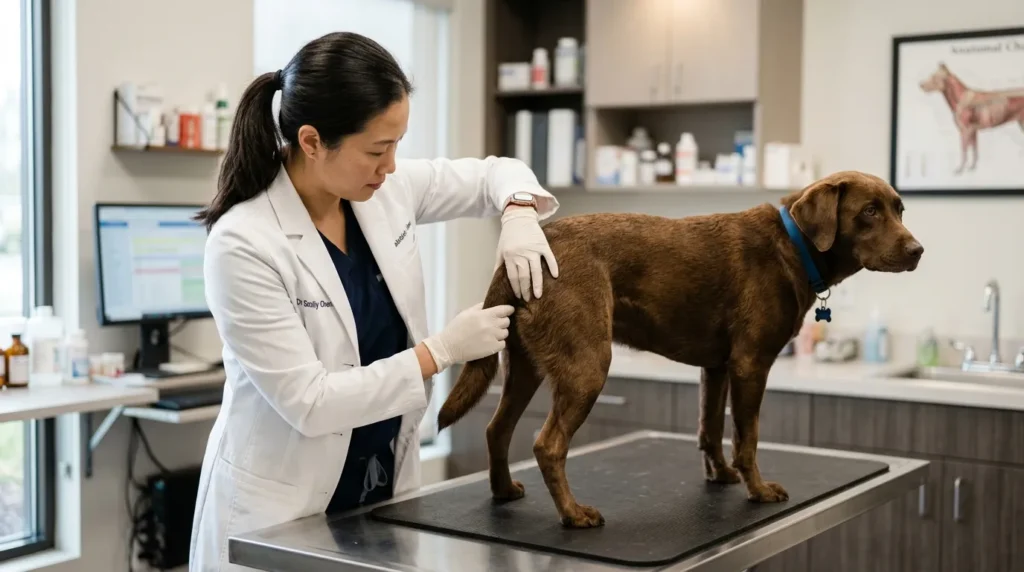
Tail chasing that starts in an adult dog with no prior history is more concerning. It can indicate a new medical problem (anal glands, injury, parasites) or a late-onset compulsive behavior triggered by stress. An adult dog that suddenly starts chasing its tail after a change in household routine, the arrival of a new pet, or a period of prolonged confinement should be evaluated. To understand your dog’s life stage more clearly, the pet age calculator converts dog years to human-equivalent age — helpful context when assessing whether a behavioral change is age-related.
How to stop a dog from chasing its tail
For behavioral causes (boredom, attention-seeking)
- Increase physical exercise — a tired dog doesn’t chase its tail
- Add mental stimulation: puzzle feeders, sniff work, training sessions
- Completely ignore the behavior when it happens — no eye contact, no talking, no reaction
- Reward heavily when the dog is calm and occupied with something appropriate
- High-drive breeds need at least 60–90 minutes of structured activity daily
If you’re not sure where to start with training, the guide on how to train your dog in simple steps covers the core techniques for redirecting unwanted behaviors without punishment.
For medical causes (parasites, anal glands, injury)
- Get the dog examined — a vet visit is the starting point, not the last resort
- Check for flea dirt at the tail base before your appointment
- Don’t apply topical treatments without a diagnosis — treating for fleas won’t fix a nerve injury
- Most medical causes resolve quickly once correctly identified
For Canine Compulsive Disorder
- A veterinary behaviorist is the right specialist for confirmed CCD
- Treatment usually combines SSRIs (fluoxetine or clomipramine) with behavior modification
- Punishment makes CCD worse — it increases stress, which worsens compulsive behavior
- Environmental enrichment reduces the cortisol load that fuels episodes
- Early intervention produces better outcomes — untreated CCD escalates to tail mutilation in severe cases
Worried something your dog ate might be contributing to skin irritation or discomfort? Run it through the pet food safety checker to rule out dietary triggers.
Frequently asked questions
Is it normal for dogs to chase their tails?
Yes, in most cases. Occasional tail chasing — especially in puppies — is normal exploratory behavior. It becomes a concern when it’s frequent, compulsive, or involves the dog injuring itself.
Why does my dog chase its tail in circles constantly?
Constant tail chasing points to one of three things: severe boredom from insufficient exercise, a medical problem causing discomfort at the tail base, or Canine Compulsive Disorder. If it’s happening daily and you can’t redirect the dog, see a vet.
Can tail chasing hurt my dog?
Yes. Dogs with compulsive tail chasing can bite through their own tail, causing wounds, infections, and in extreme cases requiring amputation. Any dog that bites its tail until it bleeds needs veterinary attention immediately.
Should I ignore my dog when it chases its tail?
If the cause is attention-seeking, yes — removing your reaction removes the reward. But ignoring a dog in distress or pain is harmful. Read the dog’s emotional state first. Playful and silly: ignore it. Agitated or self-injuring: intervene and get a vet assessment.
What breeds are most prone to compulsive tail chasing?
Bull Terriers and Staffordshire Bull Terriers have the highest documented rates. German Shepherds and Anatolian Shepherds also show elevated predisposition. If you own one of these breeds, take frequent tail chasing more seriously than you might otherwise. See our guide to dog breeds for new pet parents for an overview of which breeds need the most behavioral attention.
Is tail chasing related to how dogs communicate with their tails?
Indirectly. The tail is central to dog body language — tail wagging means something very specific depending on speed and position. Tail chasing is a separate behavior, but understanding tail signals overall helps you read whether chasing episodes are playful or distressed.
The bottom line
Most dogs that chase their tails are bored, playing, or going through a normal puppy phase. Those cases resolve with more exercise, less attention paid to the behavior, and time.
The cases worth taking seriously are the ones that look compulsive, involve self-injury, start suddenly in an adult dog, or accompany other physical symptoms like scooting or tail-base redness. In those situations, a vet visit is not overreacting — it’s the right call.
Watch the frequency, watch the dog’s emotional state during episodes, and watch for physical signs. Those three things will tell you which category you’re dealing with. If unusual dog behaviors keep coming up, our piece on why dogs eat grass and why dogs lick their paws cover two more common behaviors that owners often misjudge.