

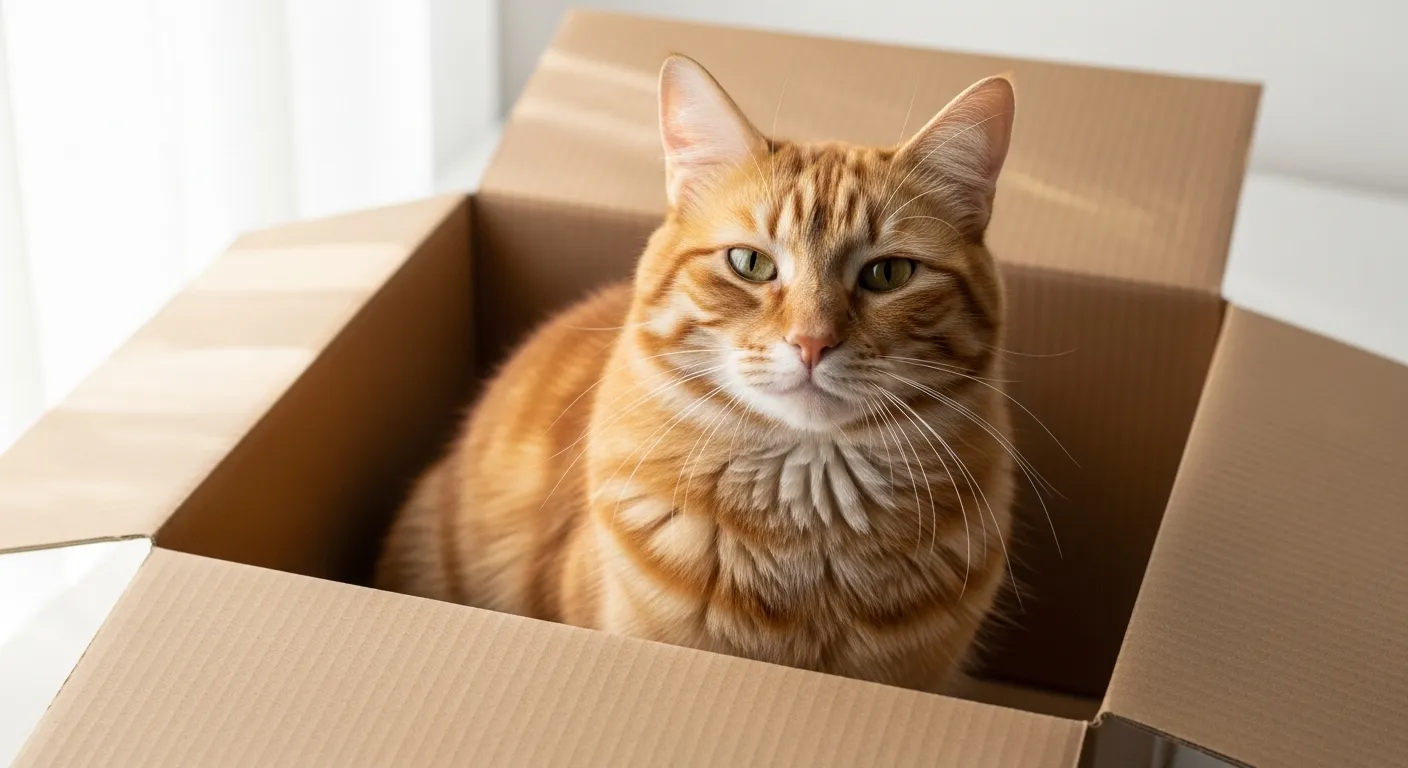
You spend $40 on a cat toy. Your cat ignores it and climbs into the shipping box. Every cat owner has been there. It’s not random behavior — there are real, documented reasons cats are drawn to boxes, and they go deeper than “cats are weird.”
Cats like boxes because enclosed spaces satisfy multiple biological needs at once: they trigger the predatory instinct to hide and ambush, help regulate body temperature, and lower stress hormones. A box isn’t a quirk. It’s a survival tool wearing a cardboard disguise.
The Quick Answer
Cats are solitary hunters descended from wild felids that spent their lives using cover to stalk prey and avoid threats. Enclosed spaces — boxes, bags, drawers, laundry baskets — tap directly into that wiring. Add the insulating warmth of cardboard and the comfort of feeling hidden on three sides, and a box becomes, from your cat’s perspective, close to perfect.
Cats Are Hardwired to Hide
Domestic cats share roughly 95% of their DNA with tigers. That stat gets repeated a lot, but what it actually means is that your cat’s brain operates on instincts built for open grasslands and scrubby terrain — not living rooms.
In the wild, small felids use dense cover to hunt. They don’t chase prey across open ground. They wait, hidden, and strike when prey walks close enough. That strategy is called ambush predation, and it’s baked into your cat’s nervous system whether they’ve ever been outside or not. It also explains why cats are largely nocturnal hunters — darkness gives them an edge when stalking.
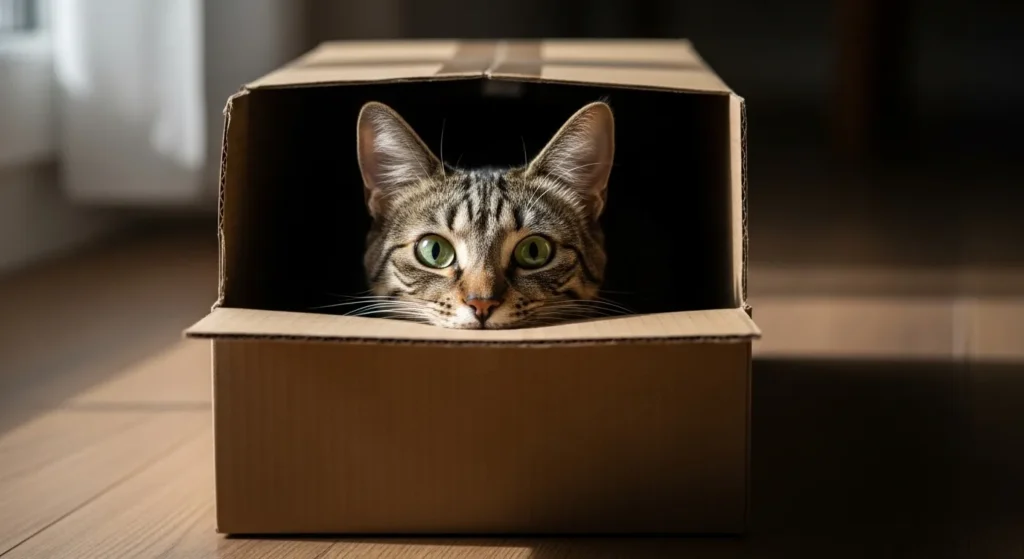
A box is cover. Sitting inside one, your cat can watch the room without being seen. They have clear sightlines out, walls on three sides, and one controlled entry point. That’s not a coincidence — that’s exactly the kind of position a wild cat would seek before a hunt or when it needed to rest without vulnerability.
This instinct connects to a lot of other comfort-seeking behaviors too. The same wiring that pulls cats toward boxes is behind why cats knead blankets and soft surfaces — both behaviors trace back to the need for warmth, safety, and physical reassurance.
Why Enclosed Spaces Feel Safe to Feline Brains
It’s not just about hunting. Cats are small enough to be prey themselves. In the wild, an unprotected cat resting in the open is a target. Enclosed, tight spaces eliminate that threat. The walls signal: nothing can approach from behind.
This is why cats don’t just sit near boxes — they sit inside them, often wedged in tightly even when there’s clearly more comfortable space available. The snugger the fit, the more surrounded they feel. That physical pressure has a measurable calming effect on the nervous system, similar to what researchers observe in other animals when confined spaces are used therapeutically.
Boxes Help Cats Regulate Body Temperature
Cats run warmer than humans. Their thermoneutral zone — the temperature range where their body doesn’t have to work to stay comfortable — sits between 86°F and 97°F (30°C–36°C). That’s according to a 2006 report from the National Research Council.
Most homes are kept around 68°F–72°F. That’s 14 to 29 degrees cooler than what a cat’s body actually prefers. Cats are constantly looking for ways to close that gap — sunny spots, warm laptops, piles of laundry fresh from the dryer. This also connects to how long cats sleep each day — up to 16 hours — because conserving energy is part of how they manage their thermal needs.
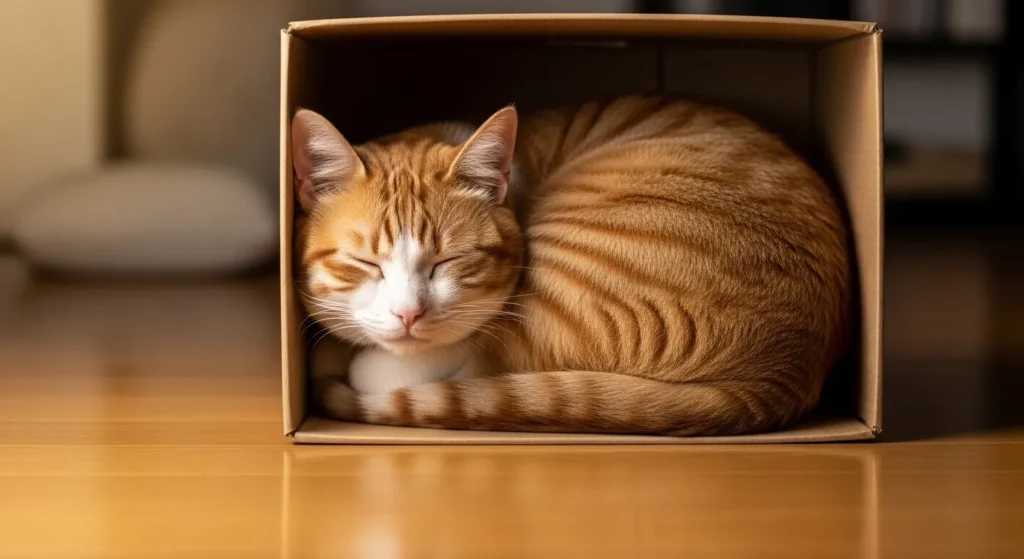
A cardboard box helps solve this. Cardboard is a poor conductor of heat, meaning it doesn’t absorb and carry away warmth. When a cat curls up inside one, their body heat stays trapped around them instead of dissipating into the surrounding air. The confined space also encourages the cat to curl into a ball, which minimizes exposed surface area and conserves even more heat.
Plastic bins, fabric baskets, and ceramic bowls don’t do this as well. Cardboard specifically has a structural advantage — the corrugated air pockets inside the walls act as insulation. This is part of why cats tend to prefer cardboard boxes over other similarly shaped containers.
Boxes Reduce Stress — A Real Study Proved It
In 2019, researchers at the University of Utrecht in the Netherlands ran a controlled study on newly arrived shelter cats. Half the cats got access to a cardboard box. Half didn’t.
The cats with boxes showed significantly lower stress scores within the first few days. They adapted to the shelter environment faster, recovered their appetite sooner, and were more willing to interact with humans. The cats without boxes took longer across every measure.
The researchers used a validated stress assessment tool called the Cat Stress Score (CSS), which scores behavioral and postural indicators of anxiety. The box group consistently rated lower — meaning calmer — in the critical early adjustment period.
This isn’t anecdotal. It’s a peer-reviewed finding published in Applied Animal Behaviour Science. For shelter cats, a cardboard box is a measurable mental health intervention.
For your cat at home, the mechanism is the same. When something stressful happens — a new person in the house, a loud noise, a change in routine — the box is where your cat goes to reset. It’s not hiding in a worried sense. It’s active stress regulation. Much like cat purring, retreating to a box is a self-soothing mechanism — the cat is actively managing its own emotional state.
Boxes Satisfy Feline Curiosity
Set any new object on the floor and your cat will approach it within minutes. This behavior has a name: neophilia, the attraction to novel stimuli. Cats display it consistently, and it serves an important function.
In the wild, new objects in familiar territory could be food, a threat, or a competitor. Ignoring them would be dangerous. So cats are neurologically primed to check new things out — sniff them, paw at them, sit in or on them to establish familiarity and ownership.
A new box is a multi-sensory event. It carries smells from wherever it’s been — a warehouse, a delivery truck, another building entirely. It has a texture cats can scratch and bite. It makes noise when they move around in it. Each of those things triggers the investigative system.
This same drive explains why your cat follows you everywhere — curiosity about your movements is just neophilia applied to a familiar subject. Once the novelty wears off, many cats lose interest in the box. That’s entirely normal — the investigation is complete.
Why Cardboard Specifically?
Cats will sit in a taped-off square on the floor. That’s been documented. So it isn’t just the material — the enclosed shape itself has pull. But cardboard specifically offers things other materials don’t.
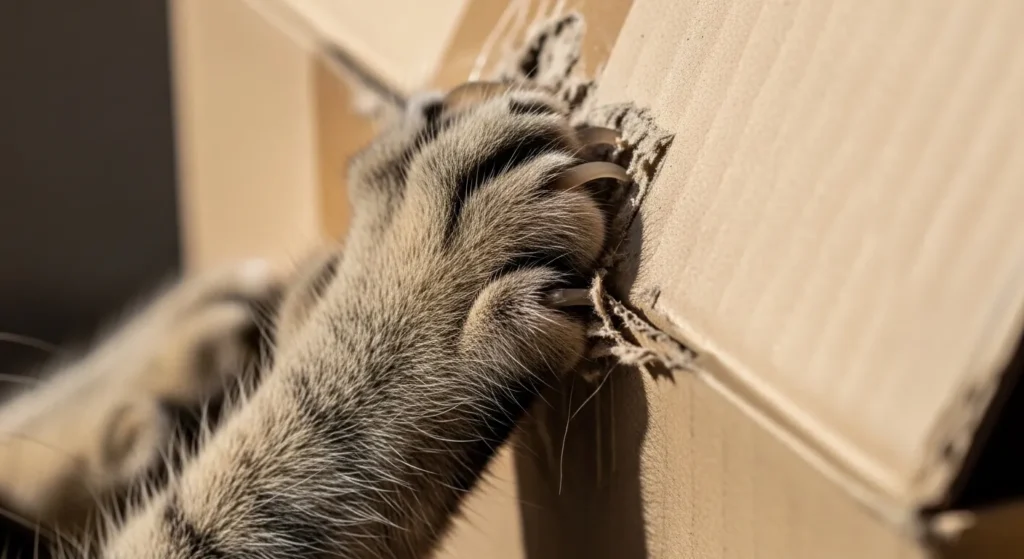
It’s scratchable. Cats scratch to mark territory, maintain their claws, and stretch muscles. Cardboard shreds in a satisfying way that other surfaces don’t replicate. It’s biteable without being hard. It absorbs scent, which helps cats mark and claim a space. And as covered above, it insulates heat better than plastic, metal, or most fabrics.
There’s also sound. Cardboard produces a low crinkle when pressed or moved. Cats respond to that frequency. It’s close enough to the sound of small animals moving through dry leaves that it activates prey-detection circuitry.
Put all of that together and cardboard boxes sit at an unusual intersection of instinctual triggers — thermal, territorial, sensory, and predatory — all in one object.
Could Box Obsession Signal Anxiety?
Usually, no. A cat that loves boxes is almost always just a normal cat using a normal coping tool.
But there’s a threshold worth knowing. A cat that only feels safe inside a box — that refuses to come out for food, avoids interaction entirely, or hides for more than 24 hours after a mild disruption — may be dealing with something beyond typical stress.
Signs the hiding has gone from healthy to concerning:
- Eating and drinking only when alone, declining food otherwise
- Hissing or striking out when approached in the box
- Hiding immediately after any minor change in environment
- Physical symptoms alongside hiding: weight loss, unkempt coat, changes in litter box use
Changes in tail posture and movement can also be an early stress signal — something worth watching alongside hiding patterns. And if your cat is biting more than usual when approached in their hiding spot, that’s a clearer sign something is off.
If those patterns appear, use the pet symptom checker as a starting point, then follow up with a veterinarian — ideally one with behavioral training. The box isn’t the problem in these cases. It’s pointing to an underlying anxiety issue.
How to Use Boxes to Enrich Your Cat’s Environment
Once you understand why boxes work, you can use that deliberately. A few practical applications:
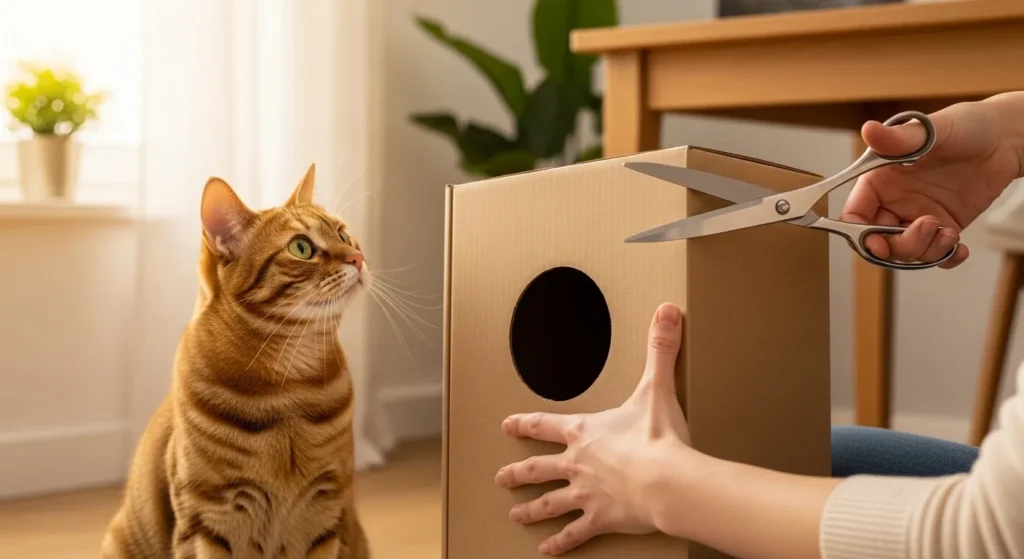
Turn it into a hunting station. Cut a hole in the side of a box and drop dry kibble or treats inside. Your cat has to reach in blind, which replicates the experience of reaching into a burrow or crevice for prey. Pair this with understanding what catnip does to your cat — a small pinch inside the box can make the enrichment experience even more stimulating.
Stack them. Cats value vertical space for the same reason they value enclosed spaces — elevation provides a surveillance advantage. A stack of two or three boxes with different entry points creates a small multi-level environment. This matters especially if you have a cat in a smaller apartment where floor space is limited.
Rotate them. Because cats respond to novelty, cycling boxes in and out keeps the enrichment fresh. An old box loses its neophilic appeal. A new one resets it.
Add a worn T-shirt. Your scent is reassuring to your cat. A piece of clothing placed inside a box converts it into a calm-down space for stressful days.
If you want to take enrichment further, training your cat to interact with specific objects — including boxes — is more achievable than most owners expect and builds a stronger bond at the same time.
Frequently Asked Questions
Why does my cat sit in a box that’s too small? The tighter the fit, the more enclosed the cat feels — which amplifies the calming effect. Cats will squeeze into boxes several sizes too small on purpose.
Do all cats like boxes? Most do, but individual cats vary. Personality, history, and early socialization all affect how strongly a cat responds to enclosed spaces. Some cats prefer elevated open perches instead.
Is it okay to leave my cat in a box? Yes, as long as the cat can get out freely and the box isn’t in a location with temperature or safety hazards. Never seal a cat in a box.
Why does my cat knock everything out of the box before getting in? Cats prep their space before settling. Removing objects is a nesting behavior — they’re making the environment match their preference before committing to rest.
Do kittens like boxes as much as adult cats? Kittens show box interest early, though it intensifies as they develop hunting instincts. By 8–12 weeks, most kittens will investigate and sit in boxes readily.
Why does my cat stare at me from inside the box? From inside the box, your cat feels safe enough to observe without feeling exposed. It’s a low-threat surveillance posture. Related: why cats stare at you is its own fascinating topic with several overlapping explanations.
Final Takeaway
Your cat isn’t being weird. Every time they choose the box over the expensive toy, they’re following millions of years of behavioral programming — staying warm, staying hidden, staying calm.
The box is safe cover. It’s a heat trap. It’s a stress buffer backed by peer-reviewed research. And it costs nothing.
Understanding why your cat does what they do makes you a better owner. Boxes are one piece of that — but cat behavior runs deep. If you want to keep going, why cats hate water follows the same pattern: a quirky behavior with a serious evolutionary explanation behind it.
Readability Score Estimate: Grade 6–7. Short paragraphs, plain vocabulary, active voice throughout. Technical terms (thermoneutral zone, neophilia, Cat Stress Score) each defined immediately on first use. Accessible to any adult reader without a science background.
