
Cats are not nocturnal. That is the short answer — and it surprises most cat owners who have been jolted awake at 3 a.m. by a flying pounce or a food demand delivered directly to their face.
The truth is more interesting than the myth. Cats belong to a different biological category entirely, and understanding it changes how you manage their sleep, their feeding, and your own sanity.
No — Cats Are Crepuscular, Not Nocturnal
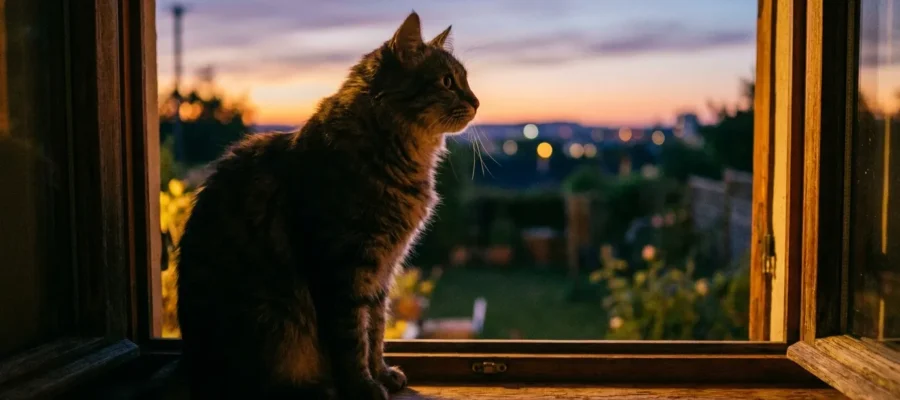
Cats are crepuscular animals. This means they are naturally most active at dawn and dusk — not in the middle of the night.
Nocturnal animals, like owls and raccoons, are built for full darkness. They hunt, move, and stay alert through the night, then rest during the day. Crepuscular animals operate in the narrow twilight windows on either side — the hour after sunrise and the hour before sunset.
Diurnal animals, including humans, do the opposite. They’re wired for daylight and sleep when it gets dark.
Cats sit between those two groups. They are not creatures of full night. They are creatures of the in-between.
Why Cats Evolved to Be Crepuscular
Their Prey Sets the Schedule
The reason comes down to hunting. Cats in the wild are predators, and their hunting schedule evolved to match the activity patterns of their prey.
Birds, mice, and small rodents are most active at dawn and dusk. That is when they forage, move between shelters, and are easier to locate. It made sense for cats to be active at the exact same time.
Twilight also offered protection. Large predators that threatened cats — hawks, for example — have reduced visual acuity during low light conditions. Hunting at dawn and dusk lowered the risk for cats while keeping their prey abundant.
What Your Cat’s Eyes Reveal
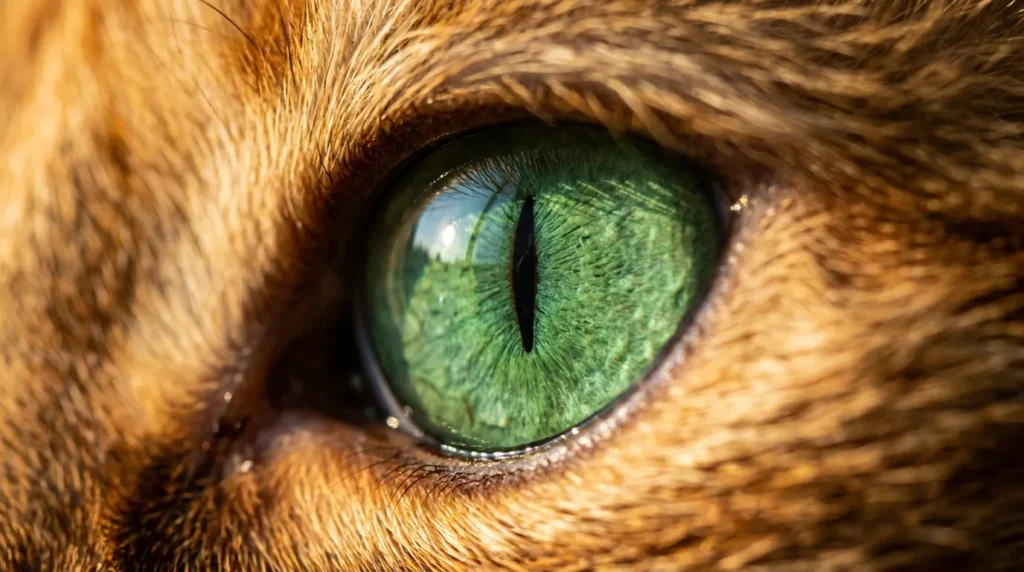
A 2015 study published in Science Advances looked at pupil shapes across hundreds of species and found something striking. Animals with vertical slit pupils are almost exclusively daytime hunters that also operate in low light — not purely nocturnal animals. Domestic cats have vertical slit pupils.
This means your cat’s eyes are built for a dual role: sharp vision in bright daylight and excellent low-light performance at dawn and dusk. If you want to understand more about how your cat actually sees the world, our guide on whether cats are color blind and what they see breaks it down clearly.
The vertical slit also makes cats exceptional ambush predators. It creates a wide field of focus across the ground — ideal for tracking movement in dim light without moving their head.
How Long and How Cats Actually Sleep
Hours by Life Stage
Most adult cats sleep 12 to 18 hours a day. That number shifts significantly with age.
Newborn kittens sleep about 22 hours a day. Their brains and bodies are developing fast, and sleep is where most of that growth happens. As they mature, sleep drops — but never by much.
Senior cats often return to sleeping around 20 hours a day. If your older cat is suddenly sleeping far more than usual, or far less, that warrants a vet visit. For a deeper look at normal sleep duration across every age, see our full breakdown of how long cats sleep.
Polyphasic Sleep — Not One Long Snooze
Cats do not sleep the way humans do. They do not have one consolidated block of rest.
Instead, cats follow a polyphasic sleep schedule. They cycle through many short naps across a 24-hour period, each lasting anywhere from 15 minutes to a couple of hours. Between naps, they eat, explore, groom, and return to rest. This is not laziness — it is an evolutionary adaptation that kept wild cats ready to respond to prey or predators at almost any moment.
Even while sleeping, cats do not fully switch off. They experience both REM and non-REM sleep, but they remain partially alert. A strange sound at the other end of the house can bring a sleeping cat from dead still to fully operational in under a second.
Do Indoor and Outdoor Cats Sleep Differently?
Most sleep research focuses on indoor cats, which live in controlled environments. Feral and free-roaming cats have a messier picture.
Outdoor cats deal with temperature extremes, food insecurity, and environmental threats — all of which disrupt sleep quality, just as they would for a human. Indoor cats generally sleep better, longer, and more safely. That said, indoor cats can also be under-stimulated, which causes them to sleep excessively out of boredom rather than biological need.
Why Your Cat Seems Nocturnal Anyway
Hunger and Feeding Gaps
Cats in the wild eat as many as 15 small meals in a day. Most indoor cats get two meals, 8 to 12 hours apart. That gap is long enough for real hunger to set in overnight.
A hungry cat will wake you up. It is not misbehavior — it is a survival signal. Adjusting your cat’s feeding routine to include a late-evening meal can reduce this significantly. If you are unsure how much to feed, our cat calorie calculator helps you figure out the right portions by weight and activity level. For more on meal types, our guide to how much wet food to feed your cat covers the specifics.
Boredom and Under-Stimulation
Cats that sleep all day have energy stored up. If nothing spent that energy during daylight hours, it comes out at night.
This is especially common in single-cat households where there is no other animal to play with. An indoor environment that never changes — same toys, same layout, same routine — loses its stimulation value fast. The cat checks out during the day and gets restless when the house quiets down at night.
The Broken Predatory Cycle
In the wild, a cat’s day follows a clear loop: hunt → catch → eat → groom → sleep → repeat. That predatory cycle is wired deep into feline behavior.
Indoor cats often experience only the eat → groom → sleep portion. There is no hunt. No build-up. No release of predatory energy. That missing piece does not disappear — it resurfaces as zoomies, midnight pouncing, or persistent attention-seeking when you are trying to sleep.
Mating Behavior
Unneutered cats are more vocal and more active at night. Females in heat yowl. Males respond. This is one of the most disruptive patterns in cat ownership and one of the most straightforward to resolve. If this is your situation, our article on how much it costs to spay a cat covers what to expect with the procedure.
Medical Causes — Do Not Ignore These
New nighttime behavior in a cat that previously slept well is a warning sign, not a quirk.
Several medical conditions cause restlessness, vocalizing, and nighttime activity:
Hyperthyroidism is common in cats over 10 years old. It elevates metabolism, raises energy levels, and disrupts sleep. Affected cats often lose weight while eating more.
Hypertension (high blood pressure) causes neurological symptoms including disorientation and restlessness, especially at night.
Feline cognitive dysfunction syndrome (CDS) is the cat equivalent of dementia. It typically appears in cats over 15 and causes confusion, yowling, and disorientation — most noticeably after dark when visual cues disappear.
Dental disease and arthritis both cause chronic pain. Cats in pain move more, settle less, and often vocalize.
If your cat’s nighttime behavior has changed suddenly — especially if paired with appetite changes, weight loss, or confusion — that combination points to a medical cause, not a behavioral one. You can use our pet symptom checker as a first step, then contact your vet.
If excessive nighttime meowing is the main issue, our full guide on why cats meow so much walks through every cause and what to do about each one.
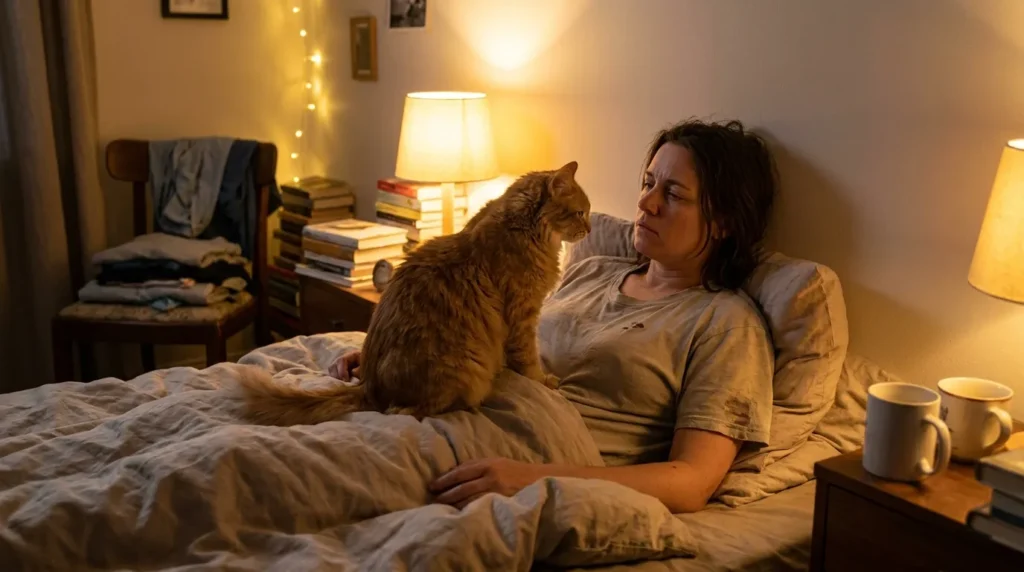
How to Stop Your Cat from Keeping You Up at Night
Reset the Feeding Schedule
Move the last meal of the day to just before your bedtime. A full stomach after physical activity is the most reliable way to get a cat to settle through the night.
If you are out during the day, an automatic feeder can deliver 4 to 6 small portions across the daytime hours so your cat is not saving its appetite for midnight.
Play Before Bed — The Predatory Cycle Fix
This is the single most effective strategy.
About an hour before bed, run a dedicated play session. Use a wand toy or laser pointer to simulate prey movement. Let your cat stalk, chase, and pounce. Aim for 10 to 15 minutes of active engagement, not gentle play.
After the session, serve the evening meal. This completes the predatory cycle: hunt → catch → eat → groom → sleep. Your cat’s brain gets the resolution it is built to expect, and the rest follows naturally.
Four interactive play sessions of 10 minutes each, spread across the day, is the expert-recommended target. If you want to make play and training work together, our guide on how to train a cat has approaches that use these same instincts productively.
Do Not Let Your Cat Sleep All Day
If your cat naps undisturbed from 9 a.m. to 5 p.m., there is nowhere for that energy to go except into your night.
Wake your cat up gently during the day. Engage them. Keep naps shorter by introducing activity. This does not have to be dramatic — even a five-minute play session every two hours shifts the sleep cycle meaningfully over a week.
Keep the Bedroom Off-Limits
This will not work for every household. But if you can commit to it, a closed bedroom door removes your cat’s ability to disturb you.
For this to succeed, the cat needs a comfortable alternative space. A heated bed, some toys, access to food and water, and a clean litter tray. Many cats adjust within a few days.
Be Consistent — Do Not Give In
This is where most cat owners fail.
If your cat yowls at 3 a.m. and you get up to feed them once, you have established a pattern. From that point, the cat knows that persistence works. The behavior will escalate before it improves.
Consistency means consistency. Every night. No exceptions during the training period.
When to See Your Vet
Go to your vet if your cat’s nighttime behavior is new, sudden, or paired with any of the following:
- Weight loss or gain
- Increased thirst or urination
- Changes in appetite
- Confusion or disorientation
- Persistent yowling, especially in cats over 12
These are not behavioral quirks. They are symptom clusters for treatable conditions. The sooner they are caught, the better the outcome.
FAQs
Are cats nocturnal or diurnal? Neither. Cats are crepuscular — most active at dawn and dusk.
Why is my cat so active at 3 a.m.? The most common causes are hunger, boredom, or an incomplete predatory cycle during the day. A late evening play session followed by a meal resolves this in most cases.
How many hours do cats sleep? Adult cats sleep 12 to 18 hours daily. Kittens sleep up to 22 hours. Senior cats often return to around 20 hours.
Can I change my cat’s sleep schedule? Yes. Cats adapt to human schedules faster than most owners expect. Consistent daytime engagement, a structured feeding routine, and a pre-bed play session typically shift the cycle within 1 to 2 weeks.
Do cats see well at night? Cats see better than humans in low light, but they cannot see in total darkness. Their eyes are optimized for twilight — the same hours when they are most naturally active.
The Bottom Line
Cats are not nocturnal. They are crepuscular — wired for dawn and dusk by millions of years of evolution. When your cat is active at 2 a.m., something is off: usually hunger, under-stimulation, or a behavioral loop that needs resetting.
The fixes are not complicated. Feed later. Play harder before bed. Keep naps shorter during the day. Stay consistent.
And if the nighttime behavior is new and comes with other symptoms, skip the behavioral fixes and go straight to your vet. What looks like a sleep problem can sometimes be the first sign of something medical.