

Calico cats are not always female — but nearly. About 99.9% of calico cats are female. The rare exception exists, and the reason comes down to chromosomes. Understanding why requires a quick look at how coat color is inherited in cats, and why the genetics almost always produce a female.
What Makes a Cat “Calico”?
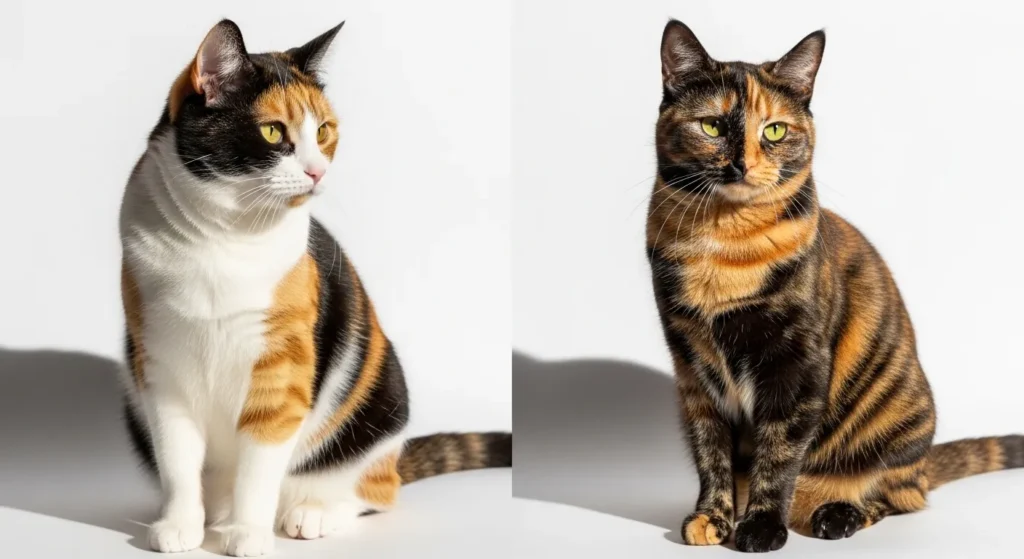
A calico cat has three colors in its coat: orange, black, and white. That’s the defining feature. No breed requirement — calico describes a color pattern, not a breed. You’ll find it in domestic shorthairs, Maine Coons, Japanese Bobtails, and others.
People often confuse calico with tortoiseshell. They’re related but not the same. A tortoiseshell cat has the orange-and-black patchwork without the white. A calico has all three colors, with white usually covering the belly, chest, or paws. The white patches come from a separate gene — the white spotting gene — that acts independently of the color mechanism.
There’s also the dilute calico. Instead of bold orange and black, the colors appear as cream and gray (sometimes called blue). Same genetic rules apply — just softer pigmentation. If you’re curious how coat patterns connect to breed traits, the pet breed finder quiz can help you identify your cat’s likely breed based on appearance and personality.
Why Are Almost All Calico Cats Female?
The Orange Gene Lives on the X Chromosome
Cats have two sex chromosomes, just like humans. Females are XX. Males are XY. The gene responsible for orange coat color — called the O gene — sits on the X chromosome.
Here’s where it gets important. The O gene comes in two versions: one produces orange pigment, the other produces black. To display both orange and black in the coat at the same time, a cat needs two X chromosomes — one carrying each version of the gene.
Males only have one X chromosome. That means a male cat can be orange or black, but not both at once. Since you need both to produce a calico pattern, males are almost automatically excluded.
Females, with two X chromosomes, can carry one version on each. That’s the setup that makes calico coloring possible. This same principle applies to tortoiseshell cats — if you’ve ever wondered what a tabby cat is and how tabby patterns differ from calico, the distinction also comes down to specific gene expressions rather than sex-linked inheritance.
X-Inactivation — How the Patchwork Forms
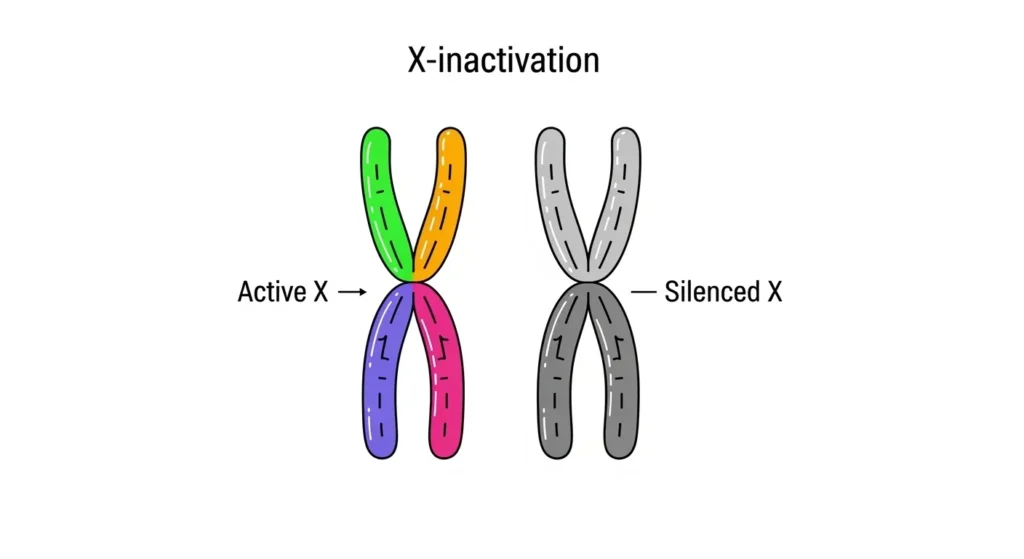
Having two X chromosomes with different color instructions doesn’t automatically explain the patches. That comes from a process called X-inactivation, first described by British geneticist Mary Lyon in 1961. It’s sometimes called the Lyon hypothesis.
Early in fetal development, each cell in a female’s body randomly switches off one of its two X chromosomes. Some cells silence the maternal X. Others silence the paternal X. Once a cell makes that choice, all cells that descend from it follow the same rule.
The result: clusters of cells expressing orange pigment next to clusters expressing black. That’s what creates the distinct patchwork. No two calico cats have the same pattern — it’s determined by which cells happened to silence which chromosome, and that’s random every time.
The silenced chromosome compacts into a structure called a Barr body. It’s essentially the inactivated X chromosome in a dormant state. Female cats have one Barr body per cell. Males normally have none. XXY males — more on that shortly — have one, which is part of why they can express two color types.
Can Male Cats Be Calico?
Yes. It’s rare, but it happens. Two biological explanations account for most cases.
Klinefelter Syndrome — XXY Males
The most common cause of a male calico is a chromosomal abnormality called Klinefelter syndrome. These cats are born with two X chromosomes and one Y chromosome — XXY instead of the standard XY.
With two X chromosomes, an XXY male can carry the orange gene on one X and the black gene on the other. X-inactivation then proceeds the same way it does in females, producing the orange-and-black patchwork. Add the white spotting gene, and you get a calico coat on a genetically male cat.
This occurs in roughly 1 in 3,000 calico cats. That’s the most-cited estimate in veterinary genetics literature, though exact figures vary by study.
Chimeric Cats — The Other Explanation
Less commonly, a male calico results from chimerism. A chimeric cat develops when two fertilized eggs fuse very early in embryonic development — essentially two embryos that merge into one animal.
If those two embryos had different genetic makeups — say, one with an orange X gene and one with a black X gene — the resulting cat can express both colors even with a standard XY chromosomal structure. The cat carries two distinct cell populations with different DNA.
Chimerism is harder to detect without genetic testing. A cat can look calico and test as chromosomally normal male (XY), and chimerism may be the explanation. It’s rare, but documented.
If you notice anything unusual about your cat’s physical development or behavior, the pet symptom checker is a useful starting point before a vet visit.
Are Male Calico Cats Sterile?
Almost always. XXY male cats — the Klinefelter cases — are sterile in the vast majority of instances. The extra X chromosome disrupts normal testicular development. Sperm production either doesn’t occur or is severely impaired.
Beyond fertility, XXY male cats can have other health complications. These include higher rates of joint problems, lower muscle tone, and potential behavioral differences. They’re not necessarily unhealthy cats, but they do carry elevated risk for certain conditions compared to standard XY males.
Chimeric males may retain normal fertility if their reproductive cells carry the standard XY genotype, but that depends on which cell population dominates in the gonads.
It’s also worth knowing that how often cats go into heat and other reproductive behaviors won’t apply to a male calico the same way they do to a standard female — another reason confirming sex and chromosomal status matters for owners.
What’s the Difference Between Calico and Tortoiseshell?
The genetics are nearly identical. Both patterns rely on X-linked color inheritance and X-inactivation to produce orange and black patches. The difference is the white.
Calico cats carry the white spotting gene (also called the piebald gene), which blocks pigment in certain areas. That creates the white sections in the coat. Tortoiseshell cats lack this gene — or express it minimally — so they show only the orange-and-black mix with little to no white.
Both patterns are female-dominant for the same reason. Male tortoiseshells exist under the same rare conditions as male calicos — XXY chromosomes or chimerism.
If you’re interested in other cat breeds with distinctive looks and personalities, the guides on Ragdoll cat personality, Siamese cat characteristics, and Sphynx cat grooming needs are worth exploring.
Key Facts About Calico Cats
- Approximately 99.9% of calico cats are female.
- Male calicos occur in roughly 1 in 3,000 calico cats.
- The most common cause of male calico coloring is Klinefelter syndrome (XXY chromosomes).
- X-inactivation was first described by Mary Lyon in 1961.
- No two calico cats have the same coat pattern — the arrangement is random every time.
- Male calico cats are almost always sterile due to disrupted testicular development.
- Calico is a color pattern, not a breed — it appears across dozens of cat breeds.
- A dilute calico shows cream and gray instead of orange and black, caused by a separate dilution gene.

What This Means If You Own or Adopt a Calico
If you have a calico cat, it’s almost certainly female. That’s not a guess — it’s a near-certainty based on the underlying genetics.
If you’ve been told your calico is male, it’s worth confirming with a vet. A physical exam can establish sex. If the cat does appear to be male, a chromosomal test can determine whether it’s an XXY Klinefelter case or something rarer like chimerism.
Male calicos carry real value in the cat fancy and genetics communities because of how uncommon they are. They’re sometimes called “money cats” in certain cultures — considered lucky. But they’re also cats with specific health considerations. An XXY male cat should be monitored for associated health conditions, and fertility should not be assumed.
Regardless of sex, calico cats — like all cats — benefit from attentive daily care. Knowing how much wet food to feed your cat and keeping up with basics like trimming cat nails safely will keep your cat healthy long-term. If you ever notice your cat acting off, the pet symptom checker can help you decide whether it warrants a vet call.
For most calico owners, the practical takeaway is simple: your tri-colored cat is almost certainly female, and the reason traces back to one gene on one chromosome.
Conclusion
Calico cats are almost always female — but not because of some rule of nature. It’s because of a specific gene on the X chromosome, and the fact that expressing both orange and black pigment simultaneously requires two X chromosomes. Males, with only one X, can’t normally do that.
The exceptions — XXY males and chimeric cats — exist, but they’re genuinely rare. About 1 in 3,000 calicos is male, and most of those are sterile. So the short answer holds: calico cats are female in all but the most unusual genetic circumstances.
If you’re still curious about cat biology and behavior, the guides on why cats wag their tails, why cats knead, and whether cats are color blind offer more insight into how these animals work.