

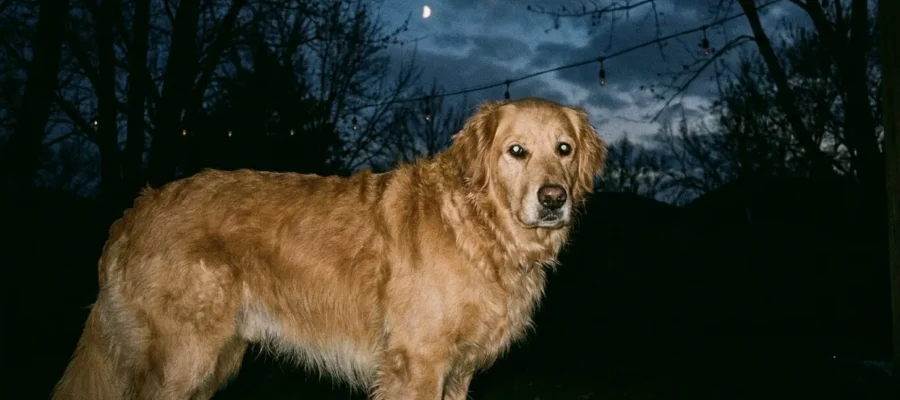
Dogs can see in the dark — and they do it much better than you can. It’s not a superpower. It’s anatomy. A few specific features of the canine eye give dogs a clear edge in low-light conditions that humans simply don’t have. Here’s exactly what those features are, what they do, and where your dog’s night vision still has limits.
Do Dogs Have Night Vision?
Yes. Dogs can detect shapes, movement, and objects in lighting conditions where most humans would see very little. But it’s not the same as the amplified, green-hued clarity of military night-vision goggles. Dogs still need some available light to see. In complete darkness, their vision drops off considerably — they just don’t lose it as fast as we do.
The short answer: dogs have genuine low-light vision, but not infinite darkness vision.
Why Dogs Can See in the Dark — The Anatomy Behind It
Four anatomical features work together to give dogs their night-vision advantage.
The Tapetum Lucidum
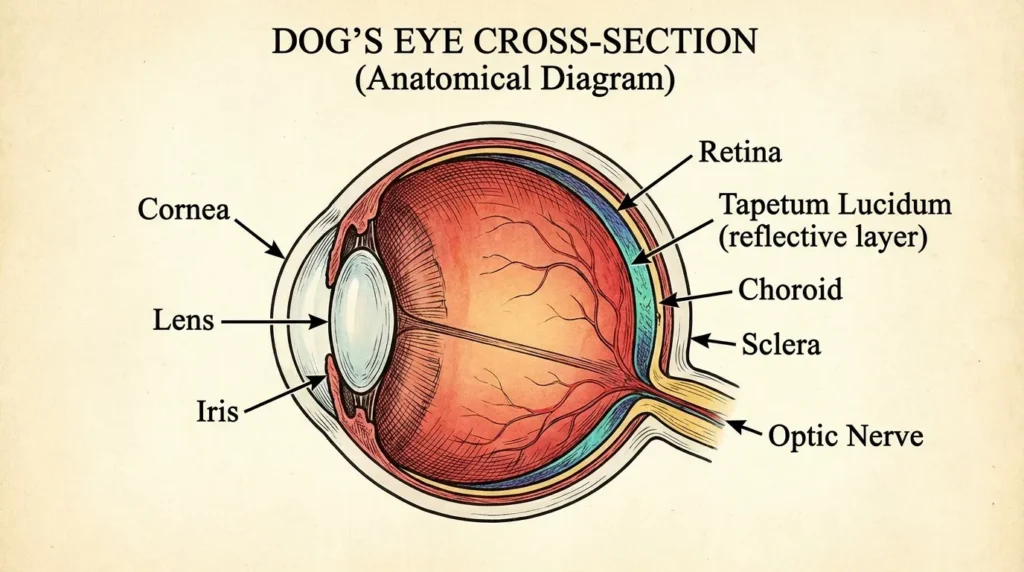
This is the most important factor. The tapetum lucidum is a reflective tissue layer positioned just behind the retina. When light enters the eye and passes through the retina, the tapetum reflects it back again — giving the photoreceptor cells a second pass at detecting the same light signal. It essentially doubles the eye’s efficiency in low-light conditions.
Humans don’t have a tapetum lucidum at all. That difference alone explains most of the gap between human and canine night vision.
The tapetum is also responsible for the eerie greenish-yellow glow you see in photos of your dog or when headlights catch their eyes at night. That’s the reflected light coming back out of the eye.
Rod-Dominated Retina
The retina contains two types of photoreceptors: rods and cones. Cones handle color and fine detail in bright light. Rods detect light intensity and motion in dim conditions. Dogs have significantly more rods relative to cones than humans do. Once the light drops, rods are almost entirely responsible for what you see — and dogs have far more of them to work with.
This is also why dogs can spot a moving object across a dark yard before you’ve even registered anything is there.
Larger Pupil Size
A dog’s pupils are larger than most humans’. In low light, pupils dilate to maximize the amount of light entering the eye. A bigger starting size means more light intake across the board. Combined with the tapetum and the rod-heavy retina, even a small amount of ambient light goes a long way for a dog.
Critical Flicker-Fusion Frequency (CFF)
This is the least discussed of the four factors. CFF is the speed at which the brain interprets flickering light as a continuous, stable image. Dogs have a higher CFF than humans — meaning their visual system processes light signals faster. In practical terms, a dog can detect very quick, subtle movements in dim light that a human eye would register as nothing. This trait almost certainly evolved from their ancestors’ need to track fast-moving prey at dusk.
Dog Night Vision vs Human Night Vision
Dogs have around 20/75 visual acuity, making them nearsighted compared to humans with normal vision. They also see a narrower color spectrum — mostly yellows and blues — which is worth understanding if you’re curious about how cats see color and how dog vision compares on that scale too.
Those tradeoffs come with a payoff, though. Motion detection in low light is sharper in dogs than in humans by a significant margin. Where you’re squinting to identify a shape in the shadows, your dog has already seen it, categorized its movement, and decided whether it’s interesting.
Can Dogs See Better Than Cats at Night?
Not quite. Cats edge out dogs for pure nighttime vision. A cat’s vertical slit pupil can expand much wider relative to its eye size than a dog’s round pupil — letting in more light overall. Cats also have a denser rod population in the retina and a more efficient tapetum. Dogs are very capable in low light, but cats are the stronger night-vision animal of the two.
That said, whether cats actually use this advantage the way most people assume is a separate question. If you want to understand their habits better, it’s worth reading about whether cats are truly nocturnal — the reality is more nuanced than the stereotype. If you’re thinking of keeping both pets, knowing how they perceive the world differently can also help when you’re introducing a dog to a cat for the first time.
Why Do Dogs’ Eyes Glow in the Dark?
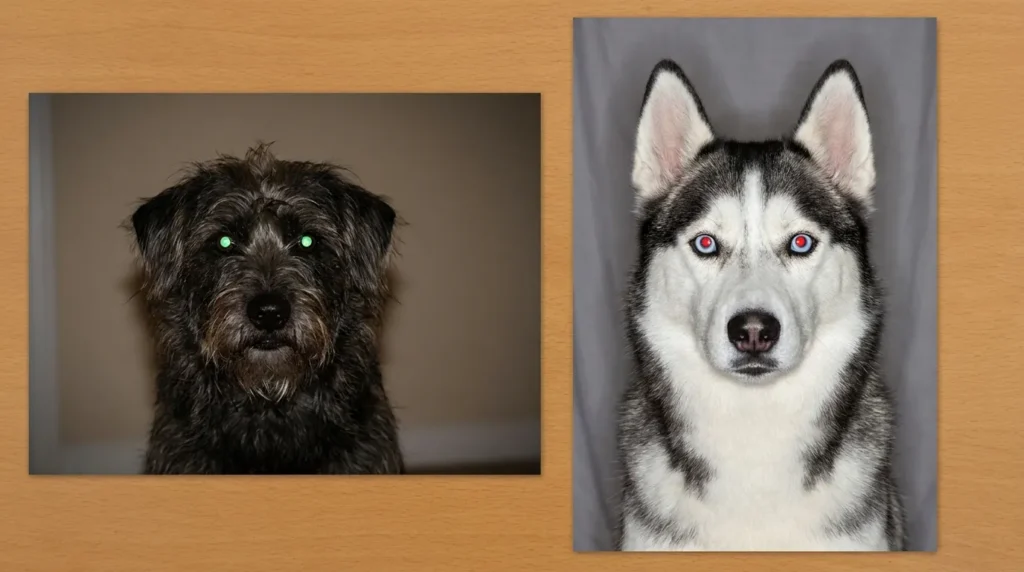
The glow comes entirely from the tapetum lucidum. When light hits a dog’s eyes — from headlights, a flashlight, or a camera flash — the tapetum reflects it back toward the source. The color varies by dog: greenish-yellow is most common, but it can appear blue, orange, or even red depending on the individual. Puppies’ tapetum color can shift during the first three months of life as the tissue matures.
Some dogs don’t glow at all. Dogs with blue eyes — particularly some Siberian Huskies — often lack a tapetum lucidum. In photos, their eyes show a red reflection instead, caused by light bouncing off the blood vessels at the back of the eye. The same effect you’d see in a human with red-eye in flash photography.
Can Dogs See in Complete Darkness?
No. Total darkness is a hard limit for dogs too. The tapetum lucidum amplifies available light — it does not generate it. Photoreceptor cells need light photons to fire at all. With zero light entering the eye, neither rods nor cones can produce a signal, and vision stops entirely.
In complete darkness, dogs shift to their other senses. Their hearing range extends far beyond human limits, and their sense of smell is anywhere from 10,000 to 100,000 times more sensitive than ours. Total darkness doesn’t disable a dog — it just means they’re navigating with different tools.
Signs Your Dog Has Poor Night Vision
Some dogs struggle to see at night, and the signs are easy to miss during the day. Watch for:
- Bumping into furniture, walls, or door frames after dark
- Hesitating at the top or bottom of stairs in low light
- Reluctance to go outside at night when they’re normally eager
- Startling at familiar objects that haven’t moved
- Increased anxiety or clinginess when the lights go off
These can be early indicators of progressive retinal atrophy (PRA), cataracts, or other conditions that impair the retina’s ability to function in dim light. Both PRA and early cataracts often show up in low-light settings long before daytime vision becomes noticeably affected. A vet exam is the right step if you notice a pattern. You can also use the pet symptom checker to log your observations before the appointment.
Does Breed Affect Night Vision?
To some degree, yes. Working breeds developed for hunting, tracking, or field work — Labrador Retrievers, German Shepherds, Belgian Malinois — tend to have well-suited visual systems for detecting motion in low light. Their eye placement is also typically more forward-facing, which improves depth perception.
Brachycephalic breeds — Bulldogs, Pugs, Shih Tzus — have shallower eye sockets and structural differences that can affect overall visual quality. They’re also more prone to corneal issues that indirectly reduce light transmission.
Eye placement matters too. Breeds with eyes set wide on the sides of the head gain a broader peripheral field of view, which helps them detect movement in low-light peripheral areas even if central acuity is lower.
How Age Affects Your Dog’s Night Vision
A newborn puppy is essentially blind. Their eyes open around 10–14 days after birth, but vision develops gradually over the following weeks. The tapetum lucidum isn’t fully active until a few months in — which is one reason young puppies seem more hesitant in dim environments. For a fuller picture of physical development timelines, the when do dogs stop growing guide covers those early-to-adult transitions in detail.
On the other end, aging dogs often experience reduced night vision as the lens becomes less transparent and retinal cells deteriorate with time. It’s one of the quieter signs of a dog getting older. If your dog is in its senior years and seems less confident in dim light than they used to be, that’s worth noting. Use the dog age calculator to see where your dog falls in terms of life stage, which can help contextualize any visual changes you’re noticing.
Should I Leave a Light On for My Dog?
In most situations, a dim night light is enough. Dogs don’t need a fully lit room to feel secure, but a small amount of ambient light — a hallway plug-in, a low-wattage lamp — helps dogs with aging eyes or anxiety navigate their space comfortably.
Complete darkness isn’t ideal, especially for older dogs or dogs adjusting to a new home. If your dog shows nighttime restlessness or hesitation, a night light is a low-effort solution worth trying before assuming it’s behavioral.
Nighttime Safety Tips for Dog Owners
Your dog’s eyes handle low light well. Yours don’t — and neither do the drivers on your street.
- Clip an LED light or blinker to your dog’s collar on evening walks
- Stick to familiar routes after dark; your dog knows them, but obstacles can change
- Avoid off-leash areas at night unless they’re fully fenced
- Keep your dog’s sleeping area and regular paths free of new furniture or obstacles, especially for older dogs
- Make sure your dog is getting enough daily exercise — a well-exercised dog is calmer, less reactive to shadows, and tends to sleep more soundly at night
Frequently Asked Questions
Can puppies see in the dark? Not initially. Newborns are blind at birth. Their eyes open around 10–14 days, but full visual capability — including night vision — develops over the first few months as the tapetum matures and the retina strengthens.
What exactly is the tapetum lucidum? It’s a reflective tissue layer behind the retina that bounces incoming light back across the photoreceptors a second time, effectively doubling the eye’s light-gathering ability in dim conditions. It’s also why a dog’s eyes glow in photos.
Do dogs see better in the dark than humans? Yes — noticeably better. Their rod-heavy retinas, larger pupils, and tapetum lucidum combine to give them a clear low-light advantage. They can detect motion in conditions where humans see only general shapes or nothing at all.
Can a dog with cataracts see in the dark? Poorly. Cataracts cloud the lens and reduce light transmission — exactly the thing that matters most in low-light conditions. Night vision is usually the first thing affected, often well before daytime vision shows obvious problems.
Do all dogs have the tapetum lucidum? Most do, but not all. Some dogs — particularly those with blue eyes — lack the tapetum entirely. These dogs have somewhat reduced low-light vision and produce red-eye in flash photos instead of the typical green-yellow glow.