
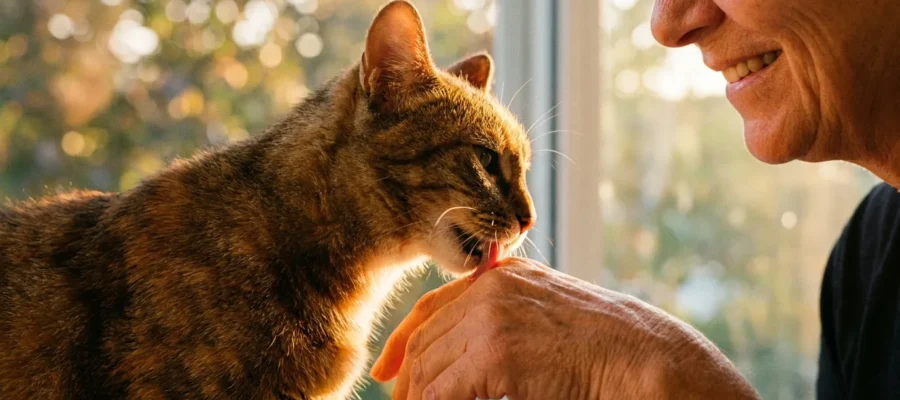
If your cat gives you the occasional uninvited tongue bath, you’re not alone. Cat licking is one of the most common behaviors owners ask about — and one of the most misunderstood.
Most of the time, when your cat licks you, it’s a sign of trust, affection, or social bonding. Cats groom each other to strengthen relationships, and when they extend that to you, it means you’ve been accepted into their social group. But licking can also signal stress, attention-seeking, or even a medical problem — depending on the context.
Here’s what the science and veterinary behavior research actually say.
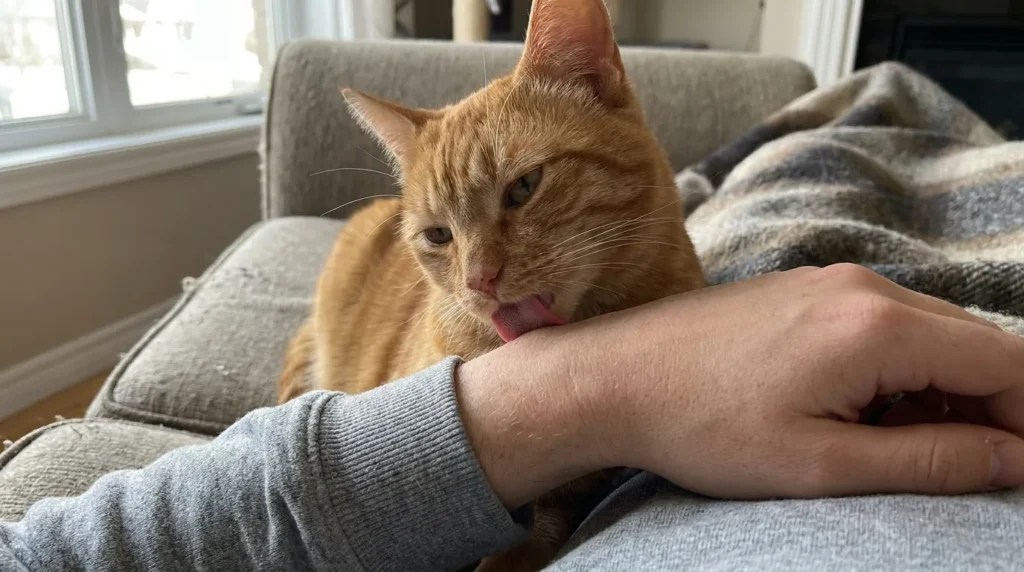
7 Reasons Your Cat Licks You
1. Affection and Social Bonding
Cats show affection differently than dogs. Licking is one of their most direct expressions of it. Research published in Applied Animal Behaviour Science (Eckstein & Hart, 2000) confirms that grooming is a core social behavior in cats — it helps maintain relationships and reduce tension between individuals in the same group.
When your cat gives you a quick lick on the hand or forearm, they’re expressing comfort and closeness. If they’re also purring while doing it, that’s an even clearer signal — purring combined with licking almost always indicates contentment.
2. Allogrooming — They’re Treating You Like Family
Mutual grooming between socially bonded cats is called allogrooming. Mother cats do it with kittens from birth. Bonded adult cats do it with each other. It’s one of the strongest social rituals in feline behavior.
When your cat licks your head, neck, or arm, they’re treating you exactly as they’d treat a cat they trust. You’re not just a human to them — you’re a member of their group. It’s one of the highest forms of feline acceptance.
3. Scent Marking — You’re Part of Their Group
Cats use scent constantly to communicate. Licking transfers saliva, which carries their unique pheromone signature. By licking you, your cat is marking you as part of their social circle — a signal to themselves and other cats that you belong together.
This is entirely different from territorial spraying. Licking-as-marking is gentle, targeted at beings they’re bonded to, and completely normal.
4. Attention-Seeking Behavior
Cats are fast learners. If you’ve ever talked to, petted, or even looked at your cat when they started licking you, you’ve accidentally taught them that licking gets results.
This is learned behavior. Your cat noticed the connection between licking and your response, and kept repeating it. If the licking happens right before meals, when you’re on your phone, or at specific times of day, this is almost certainly what’s happening.
5. Comfort from Early Weaning
Kittens weaned before 8 weeks sometimes carry oral comfort behaviors into adulthood. Licking, combined with kneading, gives them the same soothing sensation they had during nursing. It’s a self-calming behavior rooted in early development — not misbehavior.
These cats aren’t acting out. They’re working through a sensory need that never fully resolved.
6. Stress or Anxiety
Not all licking is warm and affectionate. Under stress, cats sometimes redirect grooming outward — toward you, objects, or surfaces. This is called a displacement behavior: a repetitive, calming action that gives the nervous system something predictable to focus on.
Common triggers include new pets in the home, changes in routine, moving, loud environments, or conflict between household cats. If the licking started around a specific change and feels frantic rather than calm, check for other stress signals: hiding, reduced appetite, or excessive vocalization.
7. Underlying Medical Issue
In some cases, licking is driven by nausea, pain, or an internal condition. Cats experiencing gastrointestinal discomfort or hyperthyroidism sometimes lick people and objects compulsively. It’s the feline equivalent of fidgeting when something feels wrong.
If the licking started suddenly with no obvious trigger, take it seriously. This is especially true if your cat is also lethargic, losing weight, drooling more than usual, or showing any other out-of-character signs.
Why Does My Cat Lick Me When I Wake Up?
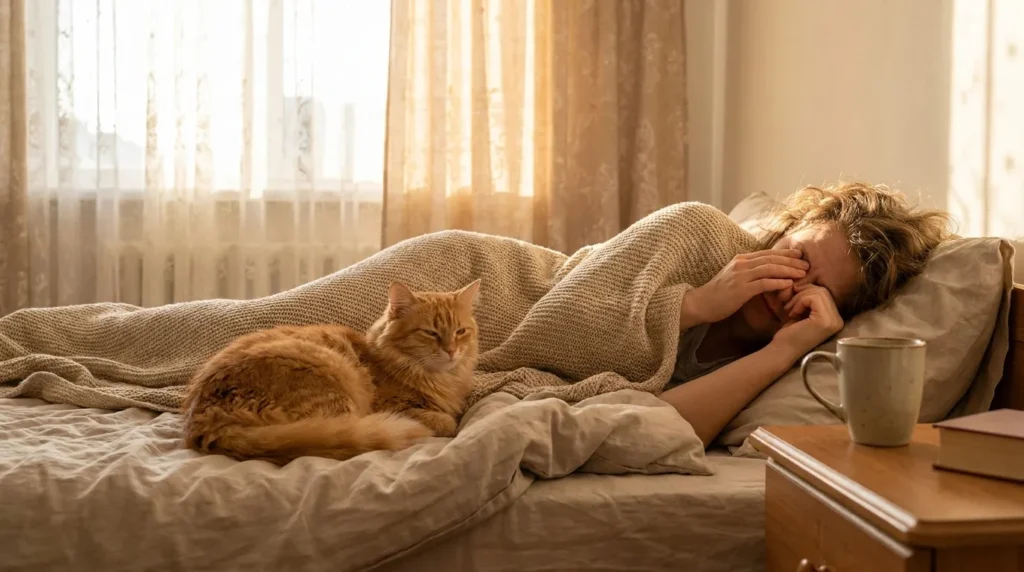
Morning licking is one of the most commonly reported variations — and one that most articles skip entirely.
There are two main explanations. First, your cat has likely been awake for hours while you slept. The moment you stir, they’re greeting you. Licking right after you wake up is a social hello — the same impulse that makes them chirp or push their head against you.
Second, your skin holds more salt, natural oils, and body heat after sleep. Cats are drawn to these tastes and scents. If the licking targets your face, neck, or arms specifically, sensory curiosity is part of the mix.
Neither explanation is a problem. It’s one of the more endearing routines cats develop with their owners.
Why Does My Cat Lick Specific Body Parts?
Face
Face licking is intimate. It mirrors how bonded cats groom each other around the head and neck — areas they physically can’t clean themselves. If your cat licks your face, you have their full trust. That said, avoid letting them lick your eyes, nose, or open mouth — cat saliva carries bacteria that can cause infection on mucous membranes.
Hair
Cats are drawn to the texture and scent of human hair. It resembles fur in both feel and density. They may also be reacting to your shampoo or conditioner. Hair licking is usually harmless but worth discouraging — certain hair products and loose strands can be harmful if swallowed.
Hands and Fingers
Your hands do the most interaction with your cat — feeding, petting, playing. Licking your hands is affection, scent investigation, or taste curiosity, especially if you’ve recently handled food or another animal.
Feet and Legs
Feet carry the strongest concentration of human scent. Cats find this information-rich. Leg and foot licking often happens after you’ve been outside or worn shoes. They’re essentially reading a map of where you’ve been.
Why Does My Cat’s Tongue Feel Like Sandpaper?
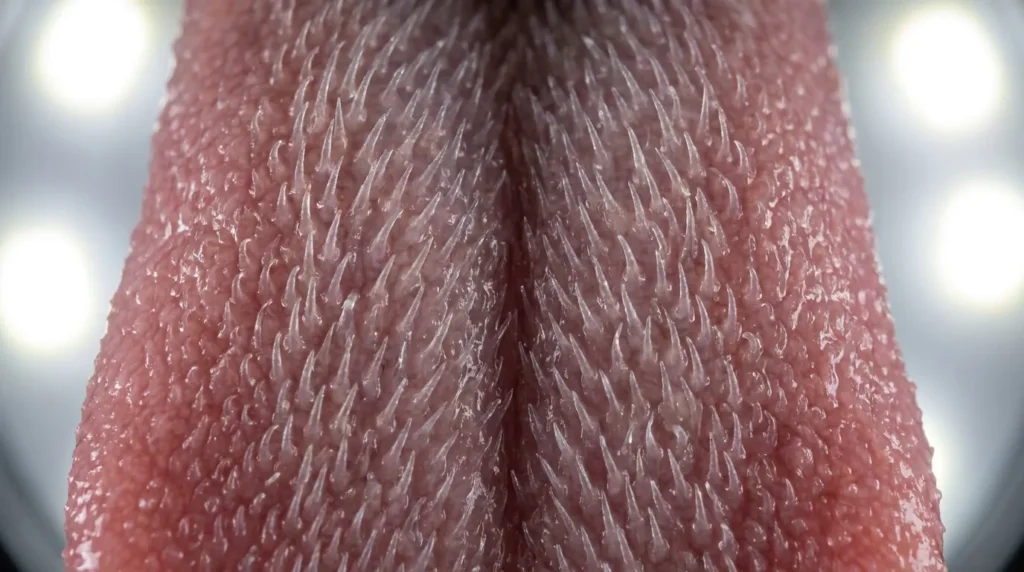
A cat’s tongue is covered in hundreds of small, hollow, backward-facing spines called papillae — made of keratin, the same material as human fingernails.
Research by Noel and Hu (2018), published in the Proceedings of the National Academy of Sciences, found these spines work like tiny funnels, pulling saliva deep into the fur coat for cleaning and temperature regulation. When that tongue makes contact with your skin, those stiff spines drag against it — creating the sandpaper sensation cat owners know well.
It’s not aggression or roughness for its own sake. It’s an extremely efficient biological tool being used on the wrong surface.
Is It Safe to Let Your Cat Lick You?
For most healthy adults, occasional cat licking is harmless. There are three situations where it’s not:
Open wounds or broken skin. Cat saliva contains Pasteurella multocida and other bacteria. On intact skin this rarely causes problems. On a cut, scratch, or open wound, it can lead to a localized infection — sometimes a serious one.
Immunocompromised individuals. If you’re undergoing chemotherapy, managing an autoimmune condition, or taking immunosuppressants, bacterial transmission risk is meaningfully higher. Check with your doctor about appropriate precautions.
Topical products on your skin. This is underreported and genuinely important. If you’ve recently applied sunscreen, lotion, hydrocortisone cream, or any medicated topical — don’t let your cat lick that area. Many contain ingredients that are toxic to cats. This especially applies to permethrin-based flea products designed for humans, which are seriously dangerous to cats.
Why Does My Cat Lick Then Bite Me?
This confuses a lot of owners, but it follows a clear pattern.
Cats have a relatively low overstimulation threshold. During grooming or close contact, sensory input accumulates fast. When it exceeds their tolerance, the bite is a signal: enough now. It’s communication, not aggression.
The key is watching body language before the bite arrives. Tail flicking, backward ear rotation, skin twitching along the back, or a sudden freezing of the body — these show up in the seconds before the bite. Learn to read these signals and you can end the interaction before it escalates.
If the bite is gentle and during play, it’s play biting — normal and easily redirected. If it’s sharp and comes out of nowhere, overstimulation is almost certainly the cause.
Normal Licking vs. Compulsive Licking — Know the Difference
Normal licking is brief, context-driven, and part of an interaction. Your cat licks you for a few seconds, then moves on to something else.
Compulsive licking looks different:
- It continues for minutes without stopping
- It happens regardless of context — when your cat is distressed or alone
- It’s difficult to interrupt once started
- It leaves your skin red or irritated
- It appears alongside other compulsive patterns: over-grooming, hair loss, or constant vocalization
Compulsive licking often points to chronic anxiety, obsessive-compulsive disorder (which cats can develop), or an untreated physical condition. If you’re seeing these signs, the pet symptom checker can help you log what you’re observing before a vet visit — it gives your vet a clearer picture of frequency, context, and severity.
How to Stop Your Cat From Licking You (Without Damaging the Bond)
Never punish licking. Pushing your cat away, squirting water, or reacting loudly will generate anxiety — which makes licking worse, not better. Punishment doesn’t teach cats what to do instead; it just adds stress.
What actually works:
Neutral disengagement. The moment licking starts, stand up calmly and move away. No talking, no eye contact, no reaction. You’re signaling that licking ends the interaction.
Immediate redirection. Offer a toy or puzzle feeder the instant licking begins. If your cat engages with it, leave the room quietly. Over time, they learn that licking leads to you leaving, while calm interaction leads to good things.
Don’t accidentally reward it. Even looking at your cat when they lick reinforces the behavior. Neutral, consistent disengagement is more effective than any response.
Increase stimulation. Many cats that lick excessively are understimulated. Add interactive play sessions — at least 15 minutes, twice daily. Rotate toys every few days to keep novelty high. Provide climbing structures and window access. A mentally active cat needs less self-soothing.
For persistent cases, positive reinforcement training can systematically reshape the behavior without damaging your relationship.
When to Call Your Vet About Cat Licking
Contact your vet if any of the following apply:
- Licking started suddenly with no clear environmental trigger
- It’s accompanied by drooling, weight loss, or lethargy
- Your cat is also over-grooming themselves and developing bald patches or skin irritation
- The behavior escalates despite consistent redirection over two weeks
- Your cat is licking non-food objects or surfaces compulsively
Anxiety-driven licking that goes unaddressed for several months can become a fixed compulsive behavior that’s much harder to treat. Early intervention gives you better options.
Frequently Asked Questions
What does it mean when a cat licks you? It typically means affection, allogrooming, or scent marking. Less commonly, it signals stress or a health issue. Brief, occasional licking during calm interactions is almost always positive.
Why does my cat lick me so much? High-frequency licking is usually learned behavior (your past reactions rewarded it), stress-related, or linked to early weaning. If it’s compulsive and hard to interrupt, a vet evaluation is the right next step.
Do cats lick to show affection? Yes. Licking is one of the primary ways cats express trust and closeness — especially through allogrooming, the social grooming behavior cats share with bonded companions.
Why does my cat lick me and no one else? Cats form primary attachments to specific individuals. If you’re the one who feeds, plays with, and spends the most time with your cat, you’re their primary bond figure. Licking you exclusively reflects that attachment directly — the same reason they might follow you everywhere while ignoring everyone else in the room.