
Introduction
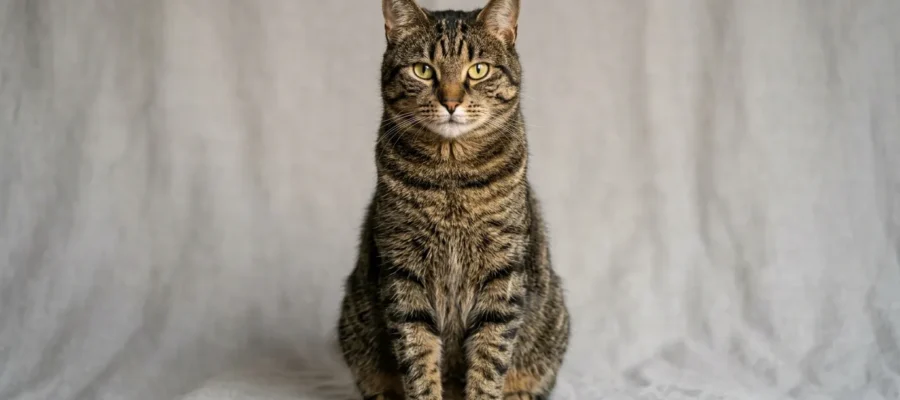
A tabby cat is not a breed. It’s a coat pattern — and it’s the most common coat pattern in the entire domestic cat population.
If you’ve ever seen a cat with stripes, swirls, spots, or a distinctive M-shape on its forehead, you’ve seen a tabby. That covers a lot of cats. In fact, the tabby pattern is so deeply embedded in cat genetics that nearly every domestic cat carries the gene for it, even cats that look completely solid-colored.
This guide covers everything: the four pattern types, colors, genetics, personality, lifespan, care, and the surprisingly interesting history behind the word “tabby” itself.
Tabby Is a Coat Pattern, Not a Breed
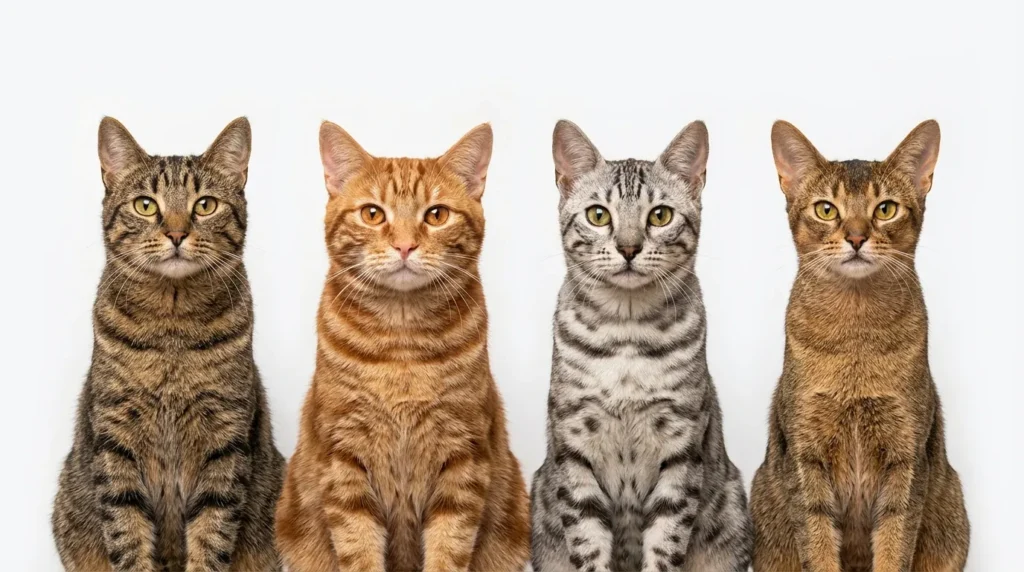
This is the most common misconception about tabbies. People hear “tabby cat” and assume it refers to a specific breed. It doesn’t.
“Tabby” describes a coat pattern. Any cat — purebred or mixed — can be a tabby if it has that characteristic striped or swirled coat. A Maine Coon can be a tabby. So can a Bengal, a Scottish Fold, or your neighbor’s rescue cat with no documented pedigree at all.
Think of it this way: “tabby” is to cats what “plaid” is to fabric. Plaid isn’t a type of fabric — it’s a pattern that appears on many different fabrics. Same logic applies here.
The tabby pattern exists because domestic cats (Felis catus) descended from wild ancestors — specifically the African wildcat (Felis lybica lybica), the European wildcat (Felis silvestris), and the Asiatic wildcat (Felis lybica ornata). All three have similar striped coats. That patterning was passed down and it never fully left the gene pool.
Not sure what breed your cat actually is? Try the Pet Breed Finder Quiz — it narrows down likely breeds based on your cat’s physical traits and behavior.
The One Feature Every Tabby Shares: The M Marking
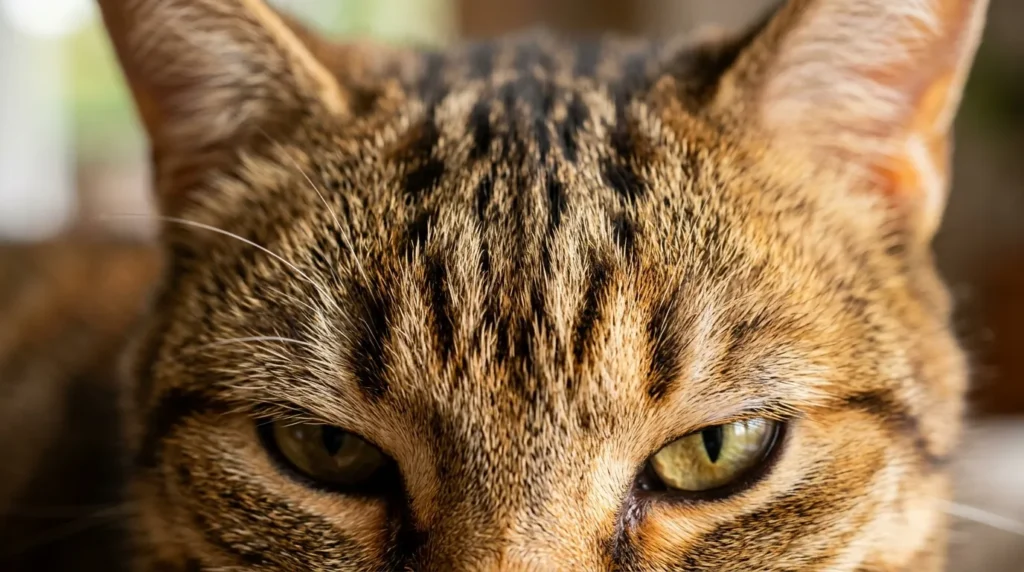
Every tabby cat has an M-shaped marking on its forehead. Every single one. That M is the single defining feature that unites all tabbies across every pattern type and color.
The M appears as a series of dark lines that converge above the eyes into the shape of the letter M. It’s present regardless of whether the rest of the cat is striped, spotted, swirled, or ticked.
Two popular legends explain the M. One says the Prophet Muhammad loved cats so deeply that the M was placed on tabbies as a mark of his blessing — his name begins with M in Arabic. Another claims the Virgin Mary pressed her hand to a tabby’s forehead, leaving the mark as a symbol of blessing.
Neither is backed by history. The M is genetic. But the legends stuck because the marking genuinely does look deliberate.
The 4 Tabby Coat Patterns (Plus One More)
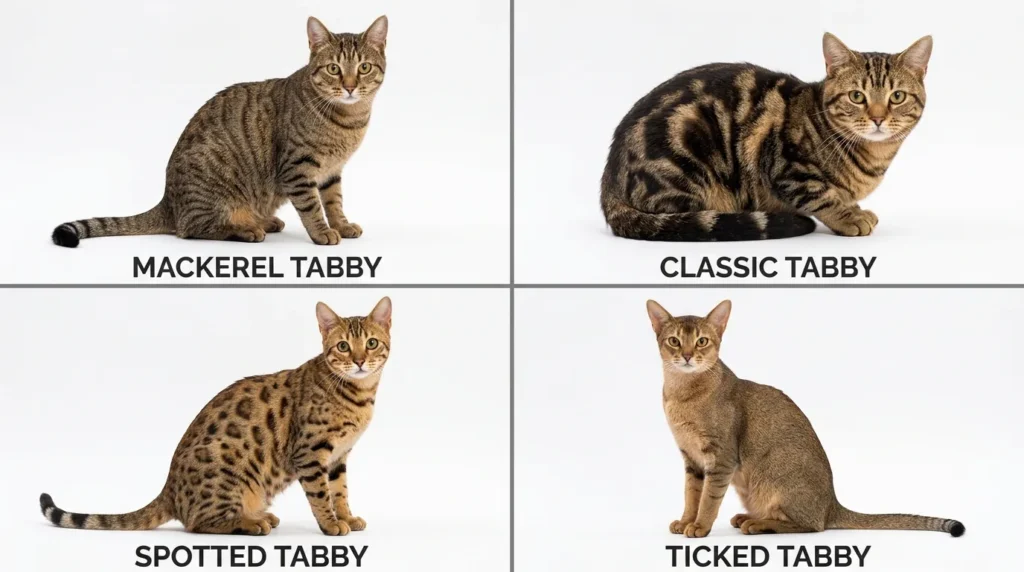
There are four recognized tabby patterns. Each comes from a distinct genetic mechanism.
1. Mackerel Tabby
This is the most common pattern. Mackerel tabbies have thin, vertical stripes running down their sides — parallel lines that curve gently along the body. The stripes can be continuous or broken into shorter segments. The name comes from the mackerel fish, whose bones resemble the stripe layout when viewed from above.
Mackerel is considered the “wild-type” pattern, meaning it’s closest to what feral and wild cats naturally carry.
2. Classic Tabby (Blotched)
Classic tabbies swap the thin stripes for thick, swirling bands. The most recognizable feature is a bullseye-shaped marking on each side of the body. Classic tabbies also have a “butterfly” pattern across the shoulders and three distinct stripes running down the spine.
About 80% of modern domestic cats carry the recessive allele responsible for this pattern. Many American Shorthair cats are classic tabbies.
3. Spotted Tabby
Spotted tabbies have — as the name says — spots instead of stripes. Those spots are actually broken mackerel stripes. A modifier gene interrupts the stripe formation, causing the lines to fragment into ovals or round dots.
You’ll see this pattern frequently in Bengal cats, Egyptian Mau cats, and Ocicat breeds.
4. Ticked Tabby
The ticked tabby is the most subtle. Instead of obvious stripes or spots, each individual hair has alternating bands of light and dark color. This is called agouti banding. From a distance, the coat looks sandy or salt-and-pepper rather than patterned.
Look closely at a ticked tabby’s legs and face — faint ghost striping usually appears there. The forehead M is still present.
The Abyssinian is the most well-known ticked tabby breed.
Bonus: The Patched Tabby (Torbie and Caliby)
A fifth unofficial pattern occurs when any of the four patterns above combines with tortoiseshell (torbie) or calico (caliby) coloring. These cats have tabby markings within their patches of color. If you’ve been wondering whether calico cats are always female, the genetics behind caliby cats follows the same X-chromosome rules — well worth reading alongside this section.
Tabby Cat Colors
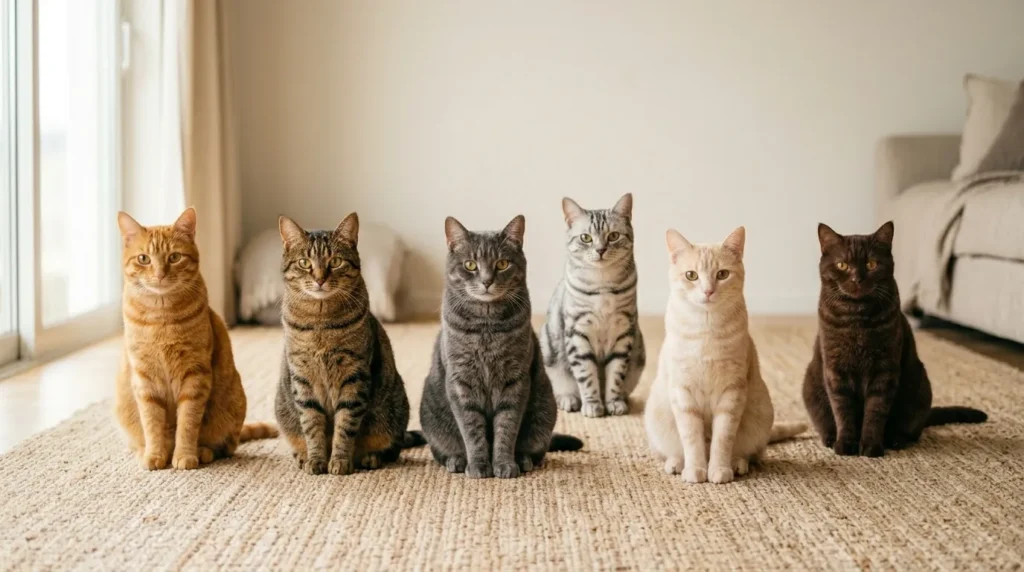
The tabby pattern appears in a wide range of base colors. The pattern itself stays consistent — what changes is the pigmentation underneath it.
Orange (Ginger) Tabby — The most iconic. Orange tabbies get their color from pheomelanin, a pigment that produces red and yellow tones. The orange can range from pale apricot to deep rust.
Brown Tabby — The classic “tiger cat” look. Dark brown or black stripes on a warm brown base. Very common in Domestic Shorthairs.
Gray (Blue) Tabby — Soft, cool-toned gray stripes on a lighter gray base. In cat genetics, this is technically called “blue,” not gray.
Silver Tabby — Striking and high-contrast. Dark markings on a pale, almost white base. Common in American Shorthairs and British Shorthairs.
Cream Tabby — A dilute version of orange. Pale peachy-cream tones with faint markings.
Chocolate and Cinnamon Tabbies — Warm brown variations less common in random-bred cats, but present in certain breeds like the Abyssinian.
The Genetics Behind the Tabby Pattern
Here’s something most cat owners don’t know: every domestic cat has the tabby gene. Even solid-black and pure-white cats carry it. The tabby pattern is genetically suppressed in non-tabby-looking cats — but it’s still there.
The Agouti Gene
The primary controller is the agouti gene (ASIP). When this gene is active, it produces banded hairs — the agouti hairs that create ticking and visible pattern markings. When a cat has two copies of the recessive non-agouti allele, the agouti banding is suppressed and the coat appears solid.
This is why some black cats, when seen in bright light, show faint tabby markings. That’s called ghost striping — the underlying pattern bleeding through despite the suppressor gene.
The Taqpep Gene
Researchers identified a second gene, Taqpep, that controls which specific tabby pattern appears. Cats with at least one dominant Taqpep allele develop mackerel stripes. Cats with two recessive copies get the classic blotched pattern.
Why Orange Tabbies Are Usually Male
Around 80% of orange tabbies are male. This is genetics, not coincidence.
The gene for orange coloring sits on the X chromosome. Male cats have one X chromosome and one Y. If that single X carries the orange gene, the cat is orange. Female cats have two X chromosomes — both need to carry the orange gene for the cat to be fully orange. If only one X carries it, the result is a tortoiseshell or calico pattern instead.
Males need to “win” only once. Females need both chromosomes to cooperate. That’s why fully orange females are rare, and fully orange males are the norm. The same X-chromosome logic is why calico cats are almost always female — it’s two sides of the same genetic coin.
Where Does the Word “Tabby” Come From?
The word “tabby” has nothing to do with cats originally.
It comes from the French word tabis, which referred to a type of striped silk fabric. That word traces back to Middle French atabis (14th century), which came from the Arabic ʿattābiyya. That Arabic term referenced the Attabiy district of Baghdad — a neighborhood famous for its striped silk cloth, named after Umayyad governor Attab ibn Asid.
Striped silk became fashionable across the Muslim world and eventually reached England. English speakers started using “tabby” to describe the fabric in the 17th century.
By the 1690s, “tabby cat” was being used to describe striped cats — because the coat resembled the fabric pattern. By 1774, it had been shortened simply to “tabby.”
So when you call your cat a tabby, you’re unknowingly referencing a medieval silk trade district in Baghdad.
Cat Breeds That Commonly Show Tabby Patterns
Tabby patterns appear across dozens of cat breeds. These are the most common:
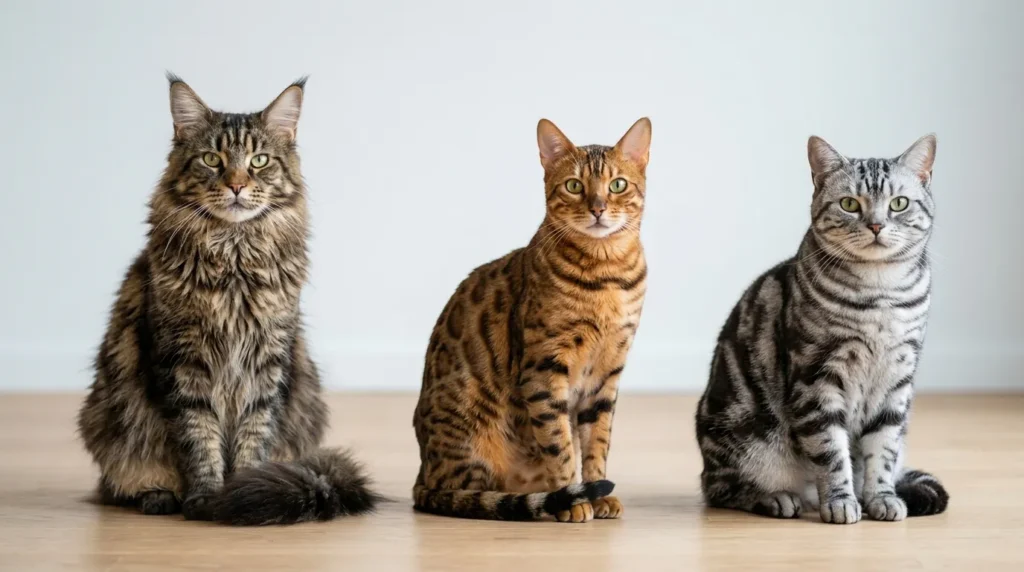
Domestic Shorthair / Domestic Longhair — The most common tabby you’ll ever encounter. Not a formal breed — just the mixed-breed house cat. Most shelter cats fall into this category.
Maine Coon — Large, tufted-eared cats that frequently carry mackerel or classic tabby patterns. One of the most popular breeds in the U.S. If you’re curious about their size, the Maine Coon size guide covers exactly what to expect as they grow — these cats can reach 20 lbs or more.
Bengal — Known for spotted or marbled tabby patterns that resemble wild cat coats. Bengals carry some genes from the Asian leopard cat (Prionailurus bengalensis).
American Shorthair — The silver classic tabby is almost a signature look for this breed. Dense, muscular, and calm.
Abyssinian — Almost exclusively ticked tabbies. One of the oldest recognized cat breeds.
Scottish Fold — Round-faced cats with folded ears. Tabby patterns are common across this breed.
British Shorthair — Stocky, dense-coated cats that carry tabby patterns in brown, silver, and blue colorways.
Ocicat — Bred to look wild while being fully domestic. Spotted tabby pattern throughout.
Looking for a tabby-friendly apartment breed? The guide to cute cat breeds for small apartments includes several that commonly carry tabby coats.
Tabby Cat Personality
Here’s an important point: the tabby pattern does not determine personality. Coat pattern and temperament are controlled by completely different genes.
What shapes a tabby cat’s personality is breed, early socialization, environment, and individual variation — not whether it has stripes or spots.
That said, certain personality traits do show up frequently across tabby-patterned cats — largely because those traits are common in the breeds where tabbies are most prevalent.
Common traits reported in tabby cats:
- Curious and alert
- Sociable with familiar people
- Playful, especially in younger years
- Moderately vocal
- Adaptable to home environments
- Tolerant of children and other pets with proper introductions
If you’re bringing a tabby into a home with dogs, the cat-to-dog introduction guide walks through the safest way to make that transition. Tabbies — especially Domestic Shorthairs — tend to adapt reasonably well when introductions are done correctly.
You might also notice your tabby kneading, purring loudly, or following you from room to room. These are common cat behaviors, not tabby-specific ones. The guides on why cats knead and what cat purring actually means explain what’s behind those habits.
If you want to compare tabby personality against specific breed temperaments, the Ragdoll cat personality guide and Siamese cat characteristics are good benchmarks — both are known for being strongly people-oriented.
Are Orange Tabbies Really More Friendly?
Many owners swear orange tabbies have bolder, more affectionate personalities than other cats. There’s limited scientific evidence for this — but it’s a persistent observation.
One possible explanation: most orange tabbies are male, and male cats are often observed to be slightly more socially forward than females, particularly neutered males. So the “friendly orange tabby” reputation may partly reflect sex-linked behavior rather than color-linked behavior.
Tabby Cat Size, Lifespan, and Health
Because “tabby” covers so many breeds, size and weight vary significantly. A ticked Abyssinian typically weighs 8–12 lbs. A mackerel-patterned Maine Coon can reach 20 lbs or more.
For mixed-breed Domestic Shorthair tabbies — the most common type — average adult weight runs 8–12 lbs for females and 10–15 lbs for males. Wondering when your tabby is fully grown? The when do cats stop growing guide breaks down the timeline by breed size.
Average lifespan: 12–18 years for mixed-breed tabbies with good care. Some reach 20 years. Indoor cats consistently outlive outdoor cats. Use the Pet Age Calculator to convert your cat’s age into human years — it’s a useful way to track where your cat is in its life stages.
Common health issues to watch for:
- Obesity (especially in low-activity indoor cats)
- Dental disease
- Hyperthyroidism (in cats over 10)
- Kidney disease (common in senior cats generally)
- Urinary tract issues
None of these are tabby-specific. They’re common in domestic cats broadly. Routine vet visits — at minimum once a year, twice a year after age 10 — catch most of these early. If your cat develops any unusual symptoms, the Pet Symptom Checker can help you identify whether a vet visit is warranted.
Tabby Cat Care Basics
Diet
Tabbies don’t require a special diet. High-protein food with named meat as the first ingredient — chicken, turkey, salmon — is the baseline. Avoid foods with corn syrup, artificial preservatives, or “meat by-products” as primary ingredients.
Wet food is generally recommended for hydration, especially in male cats prone to urinary issues. The how much wet food to feed your cat guide gives clear portion guidance by weight. If you prefer homemade options, check out these high-protein cat recipes for active cats. Not sure if a specific food ingredient is safe? Run it through the Pet Food Safety Checker before serving it.
Exercise and Enrichment
Most tabbies are moderately active. Without stimulation, they get bored and sedentary. Interactive toys, puzzle feeders, window perches, and cat trees help. Aim for two 10–15 minute active play sessions per day.
Learning how to train a cat to respond to commands or use enrichment games is one of the best ways to keep a tabby mentally engaged — especially indoor cats that don’t have outdoor stimulation.
Grooming
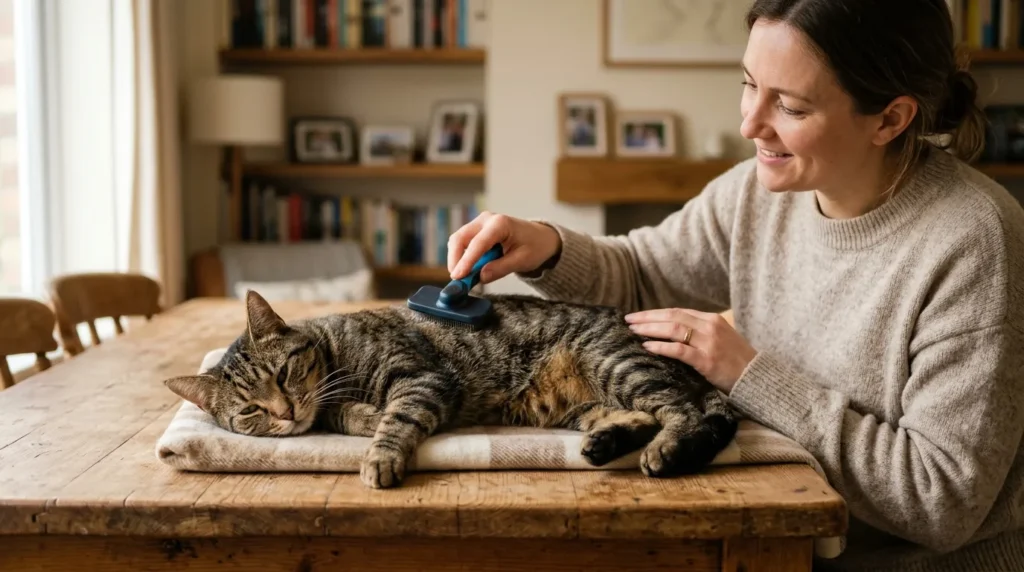
Short-haired tabbies need minimal grooming — weekly brushing is enough to manage shedding. Long-haired tabbies need 2–3 brushings per week to prevent matting.
All cats benefit from monthly nail trims and regular ear checks. The how to trim cat nails safely guide covers the full process step by step — including how to handle cats that resist. For general coat and cleanup maintenance, 13 genius cleaning hacks for cat owners covers fur management, litter tracking, and odor control.
6 Facts About Tabby Cats Most People Don’t Know
- Every cat carries the tabby gene — even solid-colored cats. The pattern is suppressed, not absent.
- Tabby patterns are visible in fetal cats — the markings form in skin cells before birth, even before the fur grows in.
- “Mackerel” tabbies are named after the fish — the parallel stripes resemble fish bones.
- Ghost striping is real — solid black cats sometimes show tabby markings in bright sunlight due to the suppressed agouti gene.
- The word “tabby” comes from a medieval silk trade district in Baghdad — routed through Arabic, Middle French, and then English.
- Orange tabbies are about 80% male — due to the X-chromosome location of the orange gene.
Frequently Asked Questions
Is a tabby cat a breed? No. Tabby describes a coat pattern, not a breed. Any cat — purebred or mixed — can be a tabby if it has the characteristic markings.
What makes a cat a tabby? The M-shaped marking on the forehead, combined with a coat showing stripes, swirls, spots, or ticked banding. The agouti gene controls this pattern.
Are all orange cats tabbies? Yes. All orange cats are tabbies. The orange pigment (pheomelanin) always expresses alongside the tabby pattern gene. You may see faint or very light tabby markings, but they’re always there.
What is the rarest tabby pattern? The ticked tabby is the least visually obvious and least commonly recognized. Among colors, cinnamon and chocolate tabbies are rare in random-bred cat populations.
How long do tabby cats live? Mixed-breed tabbies typically live 12–18 years. With consistent veterinary care and indoor living, some reach 20 years.
What breed is my tabby cat? Without documentation or a DNA test, you likely have a Domestic Shorthair or Domestic Longhair — the most common “breed” of cat in the world. The Pet Breed Finder Quiz can help narrow down your cat’s likely ancestry based on physical traits and behavior patterns.
Conclusion
A tabby cat is any domestic cat with a specific coat pattern defined by the agouti gene. The pattern comes in four forms — mackerel, classic, spotted, and ticked — and can appear in dozens of colors across hundreds of breeds.
Tabby isn’t a breed. It’s an ancient pattern, one that traces back to the wild ancestors of domestic cats and has persisted because it was never bred out. Almost every domestic cat you meet carries some version of that gene.
Personality, health, and lifespan depend far more on breed, care quality, and individual genetics than on coat pattern. What you can count on: the M on the forehead, the pattern in the coat, and a cat whose appearance links back to wildcats that lived long before anyone called them tabbies.