
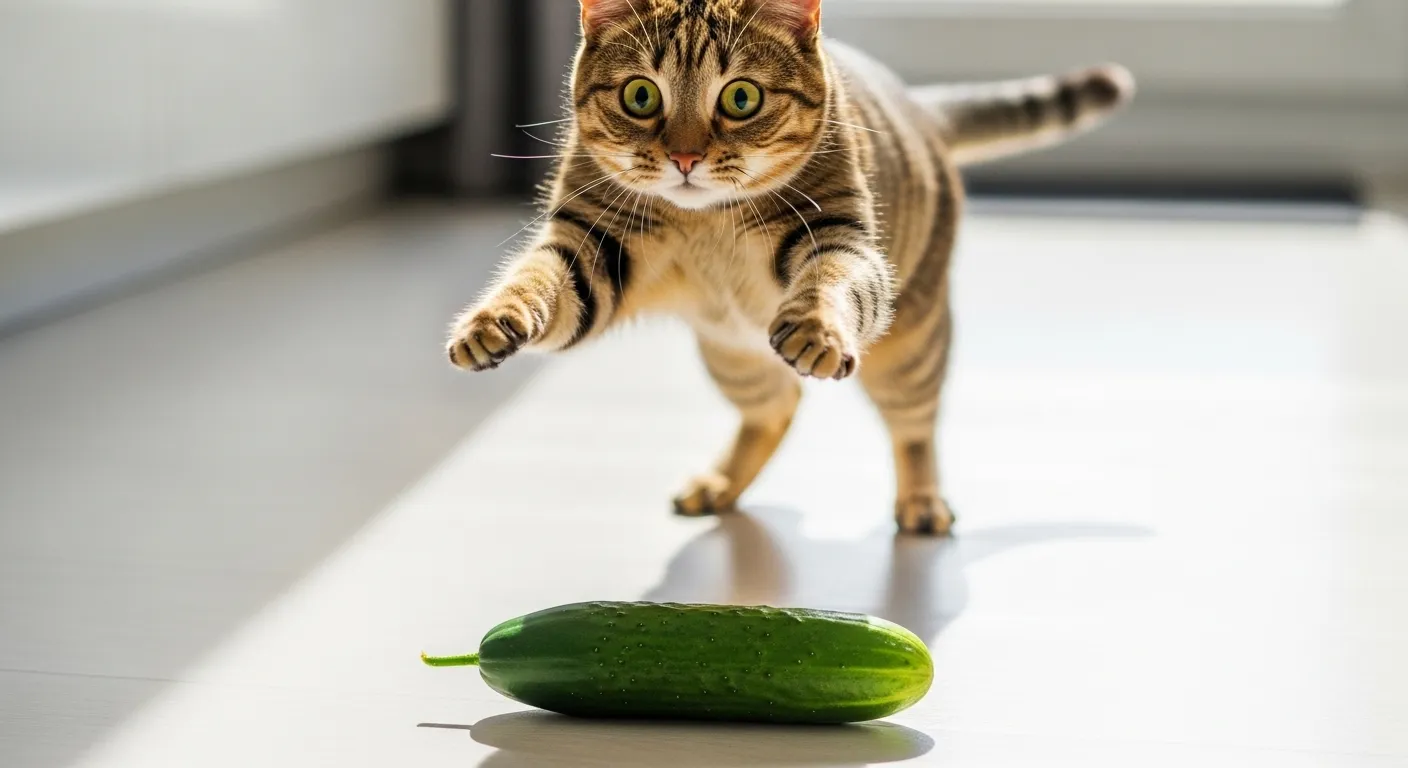
Cats are afraid of cucumbers primarily because of the startle response — not because they hate vegetables. When a cucumber appears silently behind a cat, it triggers a hardwired fear reaction tied to survival instincts that domestic cats still carry. Here’s what’s actually happening, and why repeating the prank is a worse idea than most people think.
The Short Answer
Cats aren’t specifically afraid of cucumbers. They’re afraid of unexpected objects appearing in their space — and cucumbers happen to be the right size and shape to trigger a secondary fear: snakes.
Place any unfamiliar object silently behind a cat while it’s eating and you’ll likely get the same jump. The cucumber just photographs well.
How a Cat’s Fear Response Works
Cats are not apex predators. They sit in the middle of the food chain — hunting small mammals and birds, but also vulnerable to larger predators. That dual position shaped a nervous system built for fast threat detection. If you’re curious about whether cats are nocturnal, that same evolved biology explains why their senses stay sharp around the clock.
When a cat spots something unexpected, its sympathetic nervous system fires in under a second. Heart rate jumps. Muscles load with tension. The cat either bolts, freezes, or attacks. This is the fight-or-flight response, and it runs automatically — no conscious decision involved.
The Startle Reflex
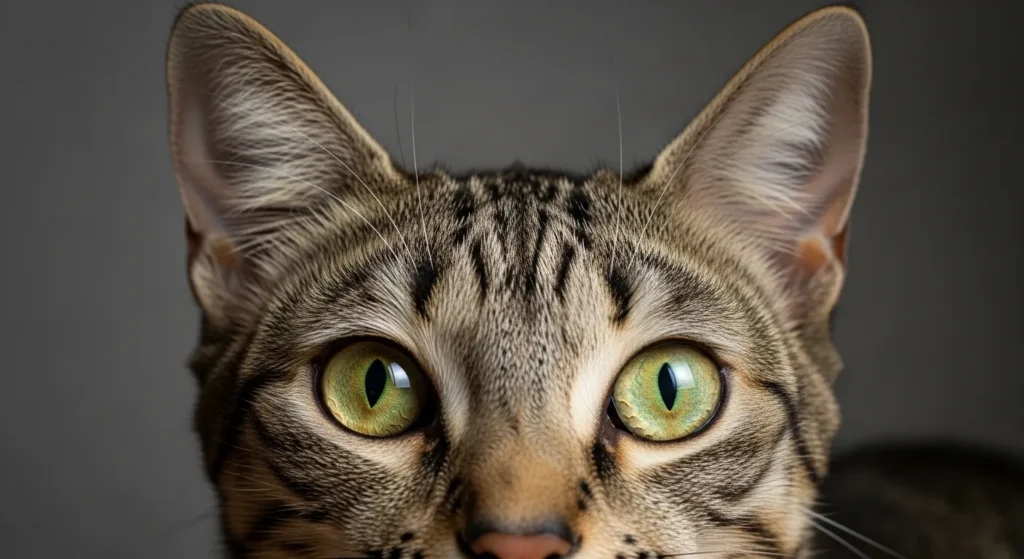
The startle reflex is involuntary. It happens before the brain has time to identify what triggered it. A loud noise, a sudden touch, an object that wasn’t there a moment ago — all of it produces the same initial reaction. Identification comes after the jump, not before.
This is why the cat leaps first and then slowly circles back to sniff the cucumber. The reflex fires, the cat lands, then the rational brain catches up and investigates.
Fight-or-Flight in Domestic Cats
Thousands of years of domestication softened a lot of feline behaviors. Not this one. The threat-detection system in domestic cats is functionally identical to that of wild cats. It wasn’t bred out because it had no downside in a safe home environment — it just gets triggered by different things now. Vacuums. Plastic bags. Cucumbers.
Understanding what smells do cats hate follows the same logic — cats have sensory tripwires built for survival that now misfire constantly in domestic life.
Theory 1 — It’s the Surprise, Not the Cucumber
The leading explanation among veterinary behaviorists is simple: it’s not the cucumber, it’s the sudden appearance. The object is irrelevant. The cat’s brain flags an unknown thing that appeared without warning in a space the cat considered safe.
Dr. Jill Goldman, a certified applied animal behaviorist based in California, has pointed to this exact mechanism. The cucumber represents a novel stimulus introduced without context. The cat had no sensory warning — no sound, no smell carried over distance, no visual approach. It just appeared. That pattern matches a real threat in the wild.
Put a banana behind a cat the same way. Same reaction. A zucchini works too. The vegetable isn’t special.
Why the Food Bowl Location Makes It Worse
Cats are most vulnerable when eating. In the wild, a distracted feeding animal is an easy target. Domestic cats retain that awareness. Eating triggers a period of heightened alertness to what’s behind them. When they turn from their bowl and find something there that wasn’t there before, the threat signal is amplified. It’s not just a surprise — it’s a surprise in the one spot the cat was already monitoring for threats.
Remove the food bowl from the equation and the reaction is typically weaker.
Theory 2 — Cucumbers Look Like Snakes
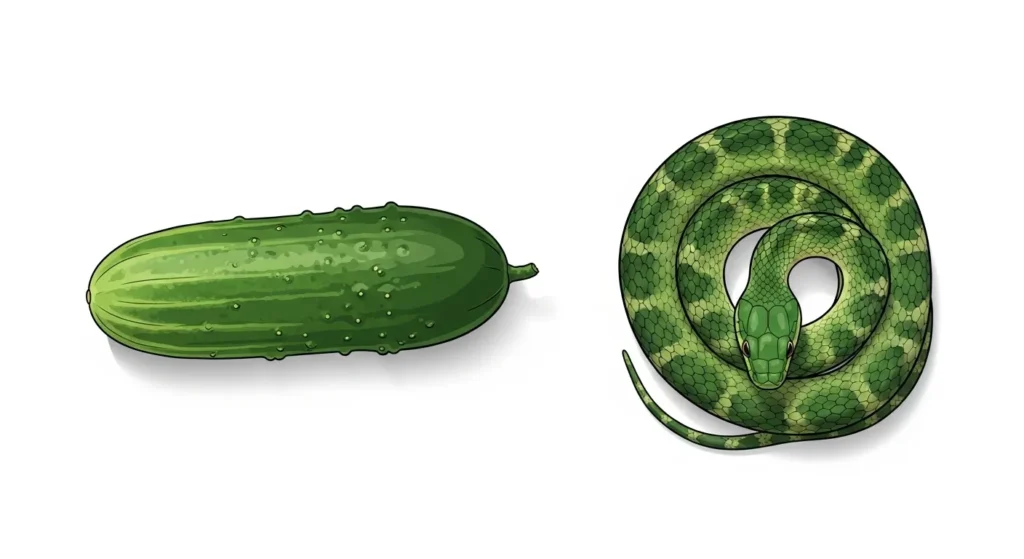
The second theory has real biological grounding. Snakes are ancient predators of small mammals. The visual pattern — long, narrow, green or patterned body — is processed as high-priority threat information in many species, including cats.
Cucumbers are 7 to 12 inches long on average. They’re cylindrical. They’re green. Lying flat on a kitchen floor, they share enough visual characteristics with a coiled or resting snake to activate the same neural pathway.
What the Research Says About Cats and Snakes
Cats and snakes have a complicated relationship. Cats will hunt and kill small snakes. But larger snakes — pythons, rat snakes, king snakes — can and do prey on cats, particularly kittens. The threat is bidirectional. That means cats didn’t evolve a simple “snakes are prey” response. They evolved caution. Size matters. An unknown snake-shaped object on the floor trips the caution wire, not the predator wire.
This same instinct-driven caution explains a lot about why cats hate water — water historically hid predators and limited a cat’s mobility, making avoidance the safer evolutionary bet.
Genetic Hardwiring vs. Learned Fear
This is where most articles get sloppy. There’s a difference between a genetically encoded response and a learned one.
A genetically hardwired response means the brain recognizes snake-like shapes as threatening without any prior experience with snakes. Research in primates shows this kind of hardwired snake detection exists — the visual cortex flags elongated, patterned shapes faster than other shapes. It’s plausible the same pathway exists in cats, but it hasn’t been directly studied in felines.
A learned response means the individual cat encountered a snake, had a bad experience, and now reacts to similar stimuli.
Most indoor cats have never seen a snake. Yet they still jump. That points toward hardwiring — but the evidence is indirect. The honest answer is that we don’t have a controlled study on this specific question in cats. What we know is that the reaction is consistent, fast, and occurs in cats with no snake exposure. That pattern fits genetic programming better than learned behavior.
Not All Cats React the Same Way
Watch enough cucumber videos and you’ll notice some cats barely flinch. That’s real, and it matters.
Cat personality research — particularly work done by Dr. Judith Stella at Purdue University — identifies clear phenotypic variation between bold and timid cats. Bold cats approach novel stimuli. Timid cats avoid them. This personality dimension is partially genetic and partially shaped by early socialization between 2 and 7 weeks of age.
A well-socialized, confident cat raised in a stimulating environment is more likely to sniff the cucumber than jump over it. A cat with a history of unpredictable environments will likely react more intensely. The cucumber prank says as much about the cat’s background as it does about cucumbers.
If you’re wondering what kind of personality your cat has, understanding breeds helps too — Ragdoll cat personalities, for example, skew significantly toward bold and calm, while other breeds sit much further toward the anxious end.
Is the Cucumber Prank Harmful?
Yes — more than most people assume.
Short-Term Effects
A single startle event causes an acute stress response. Cortisol and adrenaline spike. The cat may hide for minutes to hours. Some cats redirect aggression onto nearby pets or people immediately after — the same impulse behind why cats sometimes bite without obvious warning. Others knock things over in the scramble and injure themselves. A hard landing after a high jump can strain a joint or worse, particularly in older cats.
Long-Term Behavioral Consequences
Repeated stress events accumulate. Veterinary behaviorists link chronic low-grade stress in cats to a specific cluster of problems: over-grooming, redirected aggression, litter box avoidance, decreased appetite, and increased hiding. These aren’t rare — they’re among the top reasons cats are surrendered to shelters.
Chronic stress can also contribute to digestive upset. If you’ve noticed your cat throwing up frequently, persistent anxiety is one of the less obvious triggers worth discussing with your vet.
There’s also a trust problem. The prank almost always happens at the food bowl. The cat begins to associate eating — one of its most fundamental routines — with unpredictable threats. Some cats develop food anxiety. They eat less, eat faster, or stop eating in that location entirely. Fixing that association takes weeks of systematic counter-conditioning.
One prank for a 30-second video is rarely worth any of that.
Signs Your Cat Is Stressed or Scared
After any frightening event, watch for these signs over the following 24 to 48 hours. If you’re unsure whether what you’re seeing is stress-related, the pet symptom checker can help you triage before calling your vet.
- Hiding in unusual spots or refusing to come out
- Flattened ears or wide, dilated pupils at rest
- Tail tucked low or puffed up — how your cat wags or holds its tail tells you a lot about its emotional state
- Excessive grooming, especially in one spot
- Hissing or swatting at people it normally tolerates
- Eating less or skipping meals
- Using the floor near (not in) the litter box
Any of these lasting more than two days warrants a call to your vet. Acute stress can tip into chronic anxiety quickly in cats that are already on the sensitive end of the spectrum.
How to Help an Anxious Cat
If your cat had a bad scare — from a cucumber or anything else — the recovery approach is straightforward.
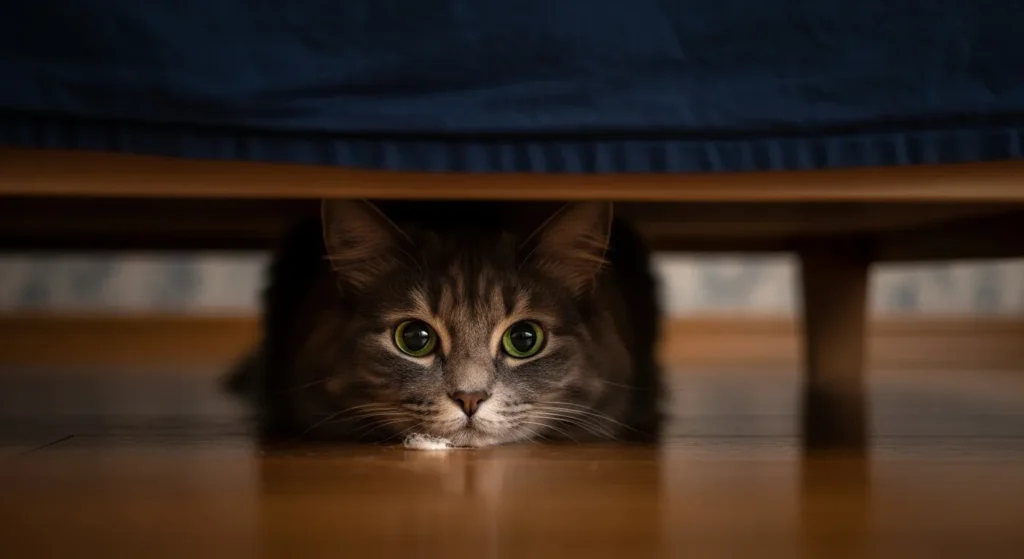
Give it space first. Don’t pick the cat up or try to comfort it immediately. Forced interaction after a fright adds more arousal to an already activated nervous system. Let the cat come out on its own timeline.
Once it’s calm, return to normal routines. Consistent feeding times, predictable handling, and familiar smells all help reset the baseline. If the cat seems reluctant to eat at its usual bowl location, move the bowl somewhere new for a few days. Reconnecting eating with safety matters more than keeping the bowl in the same corner.
Learning how to train a cat using positive reinforcement is one of the most effective long-term tools for reducing baseline anxiety. Short, reward-based sessions build confidence and trust simultaneously. Pair that with consistent discipline methods that rely on redirection rather than punishment, and most anxious cats improve significantly over 4 to 6 weeks.
For cats that are anxious long-term, environmental enrichment helps significantly — puzzle feeders, vertical space, window perches, and dedicated playtime reduce baseline stress levels. A 15-minute structured play session once a day measurably reduces fear reactivity in anxious cats over 4 to 6 weeks.
If anxiety is severe or persistent, your vet can discuss options including behavioral therapy and, in some cases, short-term medication.
Can Cats Eat Cucumbers?
Yes — cucumbers are non-toxic to cats. The ASPCA does not list cucumber on its toxic plants database. You can double-check any food your cat might sniff around using the pet food safety checker for a quick answer.
That said, cats are obligate carnivores. They get essentially no nutritional benefit from vegetables. Cucumber is roughly 96% water, which makes it a mildly useful hydration snack, but that’s about it. If your cat is curious and takes a bite, it’s fine. If your cat ignores it entirely, that’s also normal and expected — cats lack the taste receptor for sweetness, so bland vegetables have no flavor appeal to them.
Keep portions small. Too much cucumber can cause loose stools due to the water content. If you want to know more about what cats can and can’t eat safely, the guides on whether cats can eat potatoes and whether cats can eat broccoli follow the same framework.
Frequently Asked Questions
Why do cats react to cucumbers specifically? They don’t react specifically to cucumbers — they react to any unfamiliar object that appears without warning in their space. Cucumbers became the internet’s go-to because of their snake-like shape, which may activate a secondary threat response on top of the standard startle reflex.
Do all cats jump at cucumbers? No. Bold, well-socialized cats often approach and sniff rather than jump. The reaction depends on individual personality, early socialization history, and whether the cat was eating or resting when the object appeared.
Is it cruel to scare a cat with a cucumber? It can be, especially with repetition. A single event may cause only brief stress. Repeated events can trigger lasting behavioral changes including food anxiety, litter box problems, and increased aggression. Most vets advise against it.
Why does the reaction happen near the food bowl? Cats are neurologically primed to monitor their surroundings while eating because feeding is a high-vulnerability moment. An unknown object appearing in that specific zone triggers a more intense fear response than the same object appearing elsewhere.
Can cucumbers hurt cats? Not directly. Cucumbers are non-toxic. The risk is from the fall or scramble itself — cats jumping suddenly from height or in a panic can injure themselves, particularly older cats with joint issues.
Conclusion
Cats are afraid of cucumbers because their nervous systems are built to respond fast to unexpected threats — and a cucumber appearing silently behind them at the food bowl checks every box. The snake resemblance likely adds a second layer to the reaction, though the surprise mechanism alone is enough to explain most of what you see in those videos.
The prank looks harmless. For most cats, one incident probably is. But the potential cost — broken trust around food, chronic stress, behavioral problems — isn’t worth the clip. If you want to understand your cat better, explore what cat purring actually means, why cats knead, or why cats love boxes — there’s a lot going on under the surface that’s far more interesting than a jump scare.
If you want to understand your cat’s fear response, watch the videos online. Leave the cucumber in the refrigerator.