
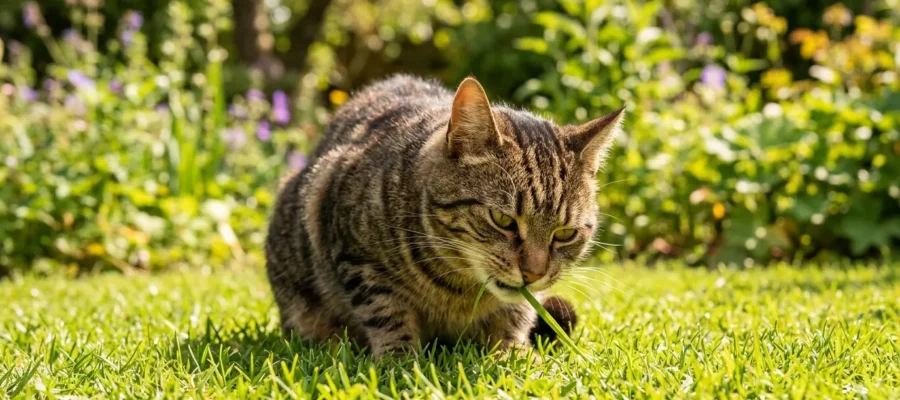
Most cat owners assume their cat is sick when they spot them chewing on a patch of grass. That assumption is almost always wrong.
A study published in the journal Behaviour found that 71% of cats eat plants at least six times in their lifetime — and in 91% of those cases, the cat showed no signs of illness beforehand. Grass eating is a normal feline behavior. It has biological roots that go back long before house cats existed.
Here’s what actually drives it.
It’s More Common Than Most People Think
Cats eat grass. Most of them do, at some point. Yet it still surprises people every time they see it happen.
The behavior shows up in indoor cats, outdoor cats, young cats, and senior cats. It cuts across breeds. A 2021 survey-based study in the journal Animals collected data from over 1,000 cat owners. Cats that ate plants were far more likely to eat grass than any other plant type. Only 27% of those cats vomited afterward.
That last number matters. The common assumption — that cats eat grass specifically to make themselves throw up — isn’t supported by the data. Vomiting happens, but it’s a side effect, not the goal.
So what is the goal? There are five solid explanations, backed by research and veterinary observation.
5 Reasons Cats Eat Grass
1. An Evolutionary Instinct to Flush Out Parasites
This is the most compelling theory, and the one backed by the strongest cross-species evidence.
Researchers at the University of California, Davis studied plant-eating behavior across dozens of wild animal species — including wolves, chimpanzees, and various wild cats. They found a consistent pattern: animals eat plant material specifically to increase intestinal muscle contractions. Those contractions help push intestinal parasites out of the gut before they can embed or reproduce.
Cats haven’t had intestinal worms for thousands of years? Doesn’t matter. The behavior is hardwired. Instincts don’t disappear just because the environment changes.
This is sometimes called zoopharmacognosy — the tendency of animals to self-medicate using plants. It’s well-documented in primates. It shows up in cats too.
Modern house cats may not carry parasites, but the biological trigger that says eat this grass is still active. It’s part of their ancestral toolkit.
2. To Help Pass Hairballs and Undigested Material
Cats swallow fur every time they groom. Short-haired cats. Long-haired cats. All of them. That fur collects in the stomach and has to go somewhere.
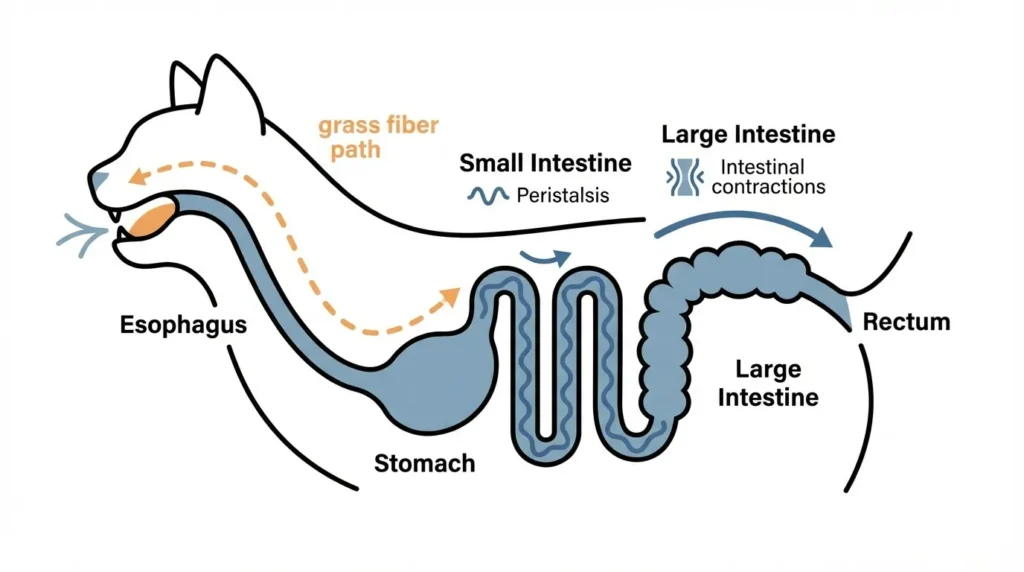
Grass adds indigestible fiber to the gut. That fiber acts as a physical aid — it bulks up stomach contents and helps push material through the digestive tract or back up through vomiting. Either way, it moves things along.
The 2021 Animals study found no significant difference in grass-eating frequency between long-haired and short-haired cats. That was a surprise to researchers who assumed the behavior was primarily hairball-driven. It suggests the behavior has more than one function — and that hairball management, while real, isn’t the whole story.
3. To Stimulate the Digestive System
Grass is high in insoluble fiber. Cats don’t digest it — but the gut doesn’t ignore it either.
Insoluble fiber stimulates the muscles lining the gastrointestinal tract. It triggers peristalsis — the wave-like contractions that move material through the intestines. For a cat dealing with mild constipation or slow gut motility, grass can act as a natural laxative.
This is especially relevant for indoor cats on high-protein, low-fiber diets. Commercial cat food doesn’t contain much roughage. A bit of grass provides something their meals can’t. If you’re unsure whether your cat’s current diet is contributing to digestive slowdowns, reviewing how much wet food to feed your cat is a good starting point — wet food has higher moisture content, which also supports healthy gut movement.
Another natural fiber option that some vets recommend: can cats eat pumpkin? — plain pumpkin is a safe, fiber-rich addition that some cat owners use alongside cat grass.
4. A Possible Source of Folic Acid
Grass juice contains folic acid — a B vitamin that cats need for normal cell function, oxygen transport in the blood, and DNA synthesis. A folic acid deficiency can lead to anemia.
The evidence here is less definitive. No study has directly confirmed that cats eat grass specifically to obtain folic acid. But the link between grass, folic acid, and feline nutrition is biologically plausible.
Mother cats’ milk contains folic acid. Wild prey animals contain it too. Grass may serve as a supplemental source when other folic acid inputs are low. It’s a reasonable explanation, even if the research hasn’t closed the loop yet.
5. They Simply Like It
Sometimes the explanation is plain.
Grass has a different texture than kibble or wet food. It’s cool, slightly moist, and requires real chewing effort. For a cat whose daily sensory input is limited — especially indoor cats in small apartments — that texture is stimulating.
Some cats chew grass out of boredom. Some seem to genuinely enjoy the taste. Behavioral enrichment studies consistently show that cats seek out novel textures and sensory experiences. Grass provides that.
Don’t overthink it. For some cats, grass is just an enjoyable thing to chew on.
Why Do Cats Eat Grass and Then Throw Up?
Cats lack the digestive enzymes needed to break down cellulose — the structural fiber in grass. Their gut simply cannot process it the way a cow or horse can.
When grass hits the stomach, it acts as an irritant. The stomach responds by contracting. In roughly 1 in 4 cats, that contraction is strong enough to trigger vomiting.
The vomit often contains more than just grass. Hairballs, bile, and partially digested food come up with it. That can look alarming. It usually isn’t.
The important distinction: the cat is not vomiting because it ate the grass to feel better. The grass caused the vomiting as a byproduct. In most cases, the cat wasn’t ill before eating the grass at all.
Occasional vomiting after grass is not a reason to panic. But if your cat is throwing up frequently — with or without grass involved — it’s worth reading about why your cat keeps throwing up to understand when vomiting crosses from normal into a warning sign.
Is Grass Safe for Cats?
Grass itself is not harmful to cats. The conditions around the grass often are.
Untreated grass: Generally safe. If it’s clean, pesticide-free, and not sprayed with fertilizer or weed killer, a cat can chew it without risk.
Treated lawns: A real problem. Herbicides, pesticides, and chemical fertilizers used on residential and commercial lawns are toxic to cats. A cat that walks across a treated lawn and then grooms their paws can ingest enough chemical to cause illness — even without eating the grass directly. Before you let your cat graze outdoors, run a quick check using the pet food safety checker to identify unsafe ingredient exposures.
Houseplants: Indoor cats that don’t have access to grass often turn to houseplants. Many common houseplants are toxic to cats. The ASPCA maintains a complete toxic plant list at aspca.org. Some specific plants to be aware of: tulips are toxic to cats and can cause drooling, vomiting, and lethargy. For a broader overview of what’s safe to keep in your home, the cat-safe flowers guide covers the most common species in one place.
Large amounts of grass: Eating a small amount occasionally is fine. Eating large quantities regularly is not. Excessive grass consumption can cause intestinal obstruction in rare cases, especially if the cat is also ingesting dirt or other foreign material along with it.
Indoor vs. Outdoor Cats: Different Risks
Outdoor cats have access to grass but face chemical exposure risks. If your cat roams a lawn treated with common herbicides — including glyphosate-based products — the risk of toxic ingestion is real. Rinse paws after outdoor time and avoid letting your cat graze on lawns you don’t control.
Indoor cats face a different problem. No grass access means they look for something else to chew. Houseplants become a target. Two of the most common indoor plants — pothos and snake plants — are both toxic to cats. Read the full breakdowns here: are pothos toxic to cats? and are snake plants toxic to cats? Both are popular, low-maintenance plants that end up in millions of homes — and both can cause real harm if chewed.
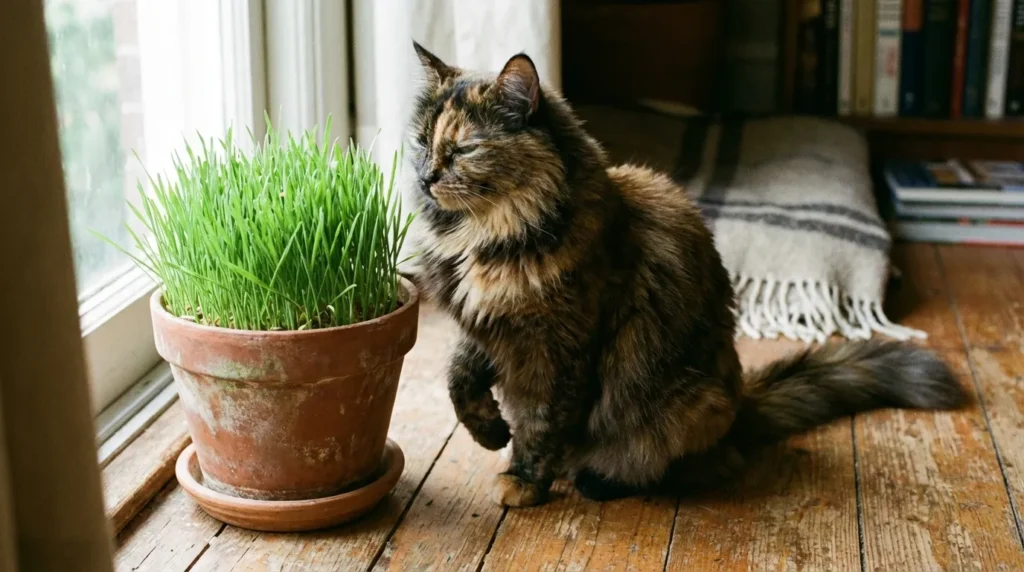
The solution is simple: grow safe cat grass inside and make it available.
How to Grow Safe Cat Grass at Home
The two best options are wheatgrass and oat grass. Both are safe, fast-growing, and widely available as seed kits.
| Wheatgrass | Oat Grass | |
|---|---|---|
| Taste | Slightly sweet | Mild, neutral |
| Growth time | 7–10 days | 7–10 days |
| Texture | Thin, fine blades | Slightly thicker |
| Availability | Very common | Common |
Both are nutritionally similar and equally safe. Some cats prefer one over the other. Try both.
Basic growing steps:
- Fill a shallow pot or tray with potting soil — about 3 inches deep
- Scatter seeds evenly across the surface and press lightly into the soil
- Water lightly and cover with plastic wrap for the first 2–3 days to retain moisture
- Move to indirect sunlight once sprouts appear (around day 3–4)
- Grass is ready for your cat in 7–10 days
Trim back to 2–3 inches if the cat ignores longer growth. Most cats prefer shorter blades. Rotate two trays so you always have a fresh batch ready.

When Should You Call the Vet?
Eating grass occasionally is normal. These signs alongside grass eating are not:
- Vomiting more than once or twice a week from grass
- Blood in vomit or stool
- Sudden dramatic increase in how much grass they’re eating
- Weight loss combined with grass eating
- Diarrhea lasting more than 24 hours
- Lethargy, hiding, or loss of appetite
- Grass eating combined with licking surfaces, eating litter, or consuming non-food objects (these can signal pica — a condition requiring veterinary assessment)
An uptick in grass eating can sometimes signal underlying inflammatory bowel disease (IBD), intestinal parasites, or nutritional deficiency. None of those should be managed at home without a diagnosis.
If you’re seeing multiple symptoms and aren’t sure what’s going on, the pet symptom checker can help you assess what warrants urgent attention before booking a vet appointment.
If your cat eats a small amount of grass a few times a week and seems otherwise healthy — active, eating well, normal litter box habits — there is no cause for concern.
Frequently Asked Questions
Why does my cat eat grass every day? Daily grass eating is unusual but not automatically a problem. If your cat eats small amounts and shows no other symptoms, it may simply be a strong behavioral preference. If consumption is heavy or combined with vomiting or weight loss, have your vet check for IBD or parasites.
Can kittens eat grass? Yes, but in small amounts. Kittens have more sensitive digestive systems than adult cats. Too much grass can cause vomiting or diarrhea in young cats. Limit access to small amounts of clean, untreated grass until they’re past 6 months.
Do indoor cats need cat grass? They don’t need it the way they need protein or water. But cat grass provides behavioral enrichment, fiber, and a safe chewing outlet. For indoor cats, especially those that chew houseplants, offering cat grass is a smart and easy preventive measure.
Why does my cat eat grass but not food? Grass eating and food avoidance together may signal nausea, dental pain, or gastrointestinal disease. Don’t attribute it to preference. See a vet if this pattern continues for more than 24–48 hours.
Is catnip the same as cat grass? No. Catnip (Nepeta cataria) is a different plant entirely. It produces a neurological response in cats due to a compound called nepetalactone — you can read more about what catnip actually does to cats and whether it’s safe in the complete catnip safety guide. Cat grass (wheatgrass, oat grass) produces no such effect. Both are safe, but they serve completely different purposes.
The Bottom Line
Cats eat grass because their biology tells them to. It’s an evolved behavior tied to parasite control, digestion, hairball management, and sensory stimulation. It predates house cats by thousands of years and shows up consistently across feline species worldwide.
The vomiting that sometimes follows isn’t cause for alarm on its own. The real concerns are what surrounds the behavior — treated lawns, toxic houseplants, and changes in frequency or health that signal something deeper.
For most cats, grass eating is a normal, healthy part of being a cat. Give them clean grass, watch for warning signs, and call your vet if anything seems off. Curious whether dogs do the same thing for similar reasons? See why dogs eat grass — the behavior overlaps in some ways, but the underlying biology is different.