


Dogs howl to communicate. It’s that simple — and that complex. A howl can mean your dog is lonely, in pain, responding to a siren, or just joining in because you started it. The tricky part is knowing which one you’re dealing with.
This guide covers every known reason dogs howl, which breeds do it most, how to tell normal howling from a warning sign, and what to do when it becomes a problem.
What Is Howling, Exactly?
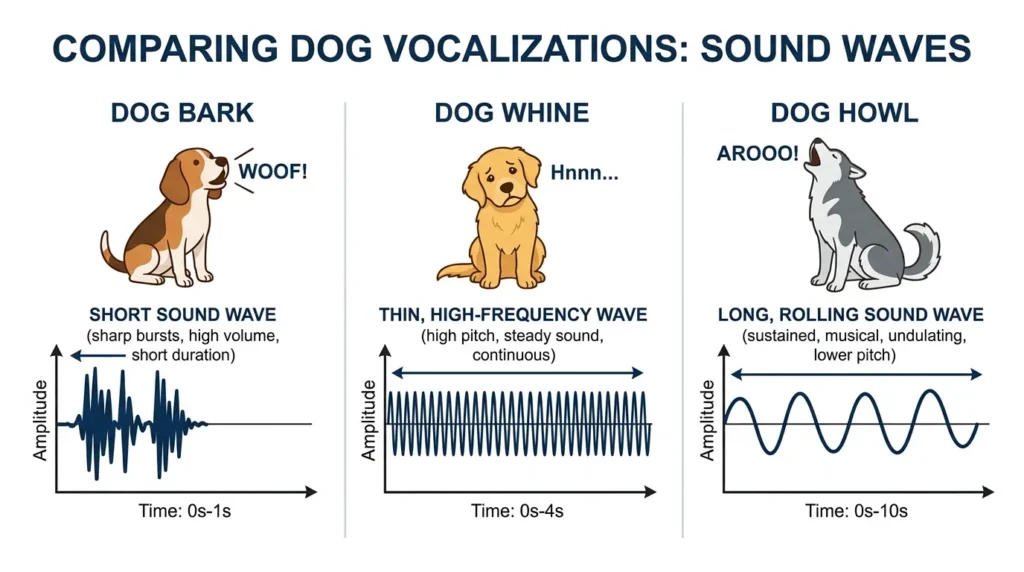
Howling is a sustained, long-pitched vocalization. It’s distinct from barking (short, repetitive), whining (high, nasal, soft), and growling (low, guttural). A howl carries far — sometimes over a mile in open space — and that’s the point. It evolved as a long-distance communication signal.
Dogs produce howls in the 150–900 Hz frequency range. That’s low enough to travel without scattering, and high enough to cut through ambient noise. When you hear your dog howl, you’re hearing a sound shaped by millions of years of evolutionary pressure to be heard across distances.
Howling is just one piece of a much larger communication system. Dogs also wag their tails, lick you, and stare at you to get a message across — each signal means something different.
The Wolf Ancestry Connection
Dogs descend from a wolf ancestor — Canis lupus familiaris diverged from gray wolves between 15,000 and 40,000 years ago. That’s a long time, but it hasn’t erased the howl.
How wolves use it
In wild wolf packs, howling does three things. First, it keeps the pack together. A wolf separated from the group howls to signal its location. Second, it guards territory. A pack’s collective howl tells rival packs to stay out. Third, it coordinates before hunts. Pack members howl together to synchronize before moving.
What dogs kept — and what changed
Dogs live very differently from wolves. They don’t hunt in packs, don’t maintain wild territories, and live alongside humans, not other dogs. So the howl has been repurposed.
Modern dogs bark far more than wolves, who rarely bark in the wild. Howling in dogs is less about pack coordination and more about emotional expression, social bonding, and responding to sound triggers. The mechanism is inherited. The reasons are adapted.
7 Reasons Dogs Howl
1. Social Communication
Howling is a “here I am” signal. Your dog may howl when separated from you, when they hear another dog in the distance, or when they sense you’re about to come home. It’s broadcasting location. Some dogs howl when they hear other dogs howling — a chain reaction that mirrors how wolf packs exchange calls.
This type of howl tends to be rhythmic and repetitive. It’s not urgent. It sounds like your dog is having a conversation with something you can’t hear.
2. Separation Anxiety
This is one of the most common causes of persistent howling. Dogs with separation anxiety don’t just dislike being alone — they panic. A study published in Applied Animal Behaviour Science found that howling in dogs left alone was closely linked to fear responses, not just boredom.
Signs that separation anxiety is driving the howl: it starts within minutes of you leaving, it doesn’t stop on its own, and it comes with other symptoms — destructive chewing, accidents indoors, pacing, or excessive drooling.
Around 14–17% of dogs develop some degree of separation-related disorder. If your dog falls into this group, training alone often isn’t enough. A vet or certified animal behaviorist should be involved. Learning how to crate train your dog can also help anxious dogs feel safer when left alone.
3. Responding to High-Pitched Sounds
Sirens. Musical instruments. Other dogs on TV. High-pitched alarms. These commonly trigger howling, and the most accepted explanation is frequency overlap.
Dogs hear in a range of roughly 40–65,000 Hz — far wider than human hearing (20–20,000 Hz). Sirens typically produce tones between 1,000 and 5,000 Hz. Dog howls land in a similar range. Your dog may not know what a siren is. They may simply hear something that sounds like a howl and respond to it the way they would to an actual howl: by joining in.
This is reflexive behavior, not a choice. Most dogs who howl at sirens stop quickly once the sound fades. It’s rarely a problem unless it happens constantly or causes distress.
4. Attention-Seeking
Dogs learn fast. If a dog howled once and you came running, looked at them, talked to them, or laughed — they’ve learned something. Howling gets a response. So they do it again.
This type of howl is different from anxiety or communication howls. It usually happens when you’re home, often right in front of you, and tends to escalate if you don’t react. The dog isn’t distressed. They want something — your attention, food, playtime.
The fix is straightforward but requires consistency: don’t respond to the howl. Reward silence instead. This principle is the same one used when you train a dog to stop barking — redirecting the behavior, not punishing it.
5. Territorial or Alert Behavior
Some dogs howl when they hear or smell something unfamiliar near the home. This is a territorial alert — the dog is warning you and warning the perceived intruder at the same time. It often comes with other alert behaviors: ears forward, tail raised, pacing near a door or window.
This type of howling tends to stop once the stimulus passes. If it doesn’t, or if it’s happening constantly at noises that don’t seem to justify it, check whether the dog is experiencing general anxiety or reactivity.
6. Pain or Physical Discomfort
A sudden increase in howling — especially in a dog who doesn’t normally howl much — can be a pain signal. Dogs can’t point to where it hurts. Vocalization is one of the few tools they have.
If your dog’s howling changes in character (longer, more urgent, more distressed-sounding) or increases sharply without an obvious trigger, treat it as a medical concern. Common causes include arthritis, dental pain, abdominal discomfort, and injuries that aren’t visible.
Rule: if a quiet dog starts howling frequently and you can’t explain why, get a vet exam within a few days. Don’t wait weeks. If you’re unsure whether something is wrong, running your dog’s symptoms through a pet symptom checker can help you decide how urgently to act.
7. Howling Back at You
This one is genuinely enjoyable to understand. When you howl at your dog and they howl back, it’s social bonding through pack mimicry.
Your dog doesn’t know you’re a human doing a funny impression. They hear a howl, identify it as coming from a pack member (you), and respond the way a pack member would — with a howl of their own. It’s communication. It’s acknowledgment. For many dogs, it seems to cause mild excitement or pleasure.
There’s no harm in doing this. In fact, some trainers use it to build engagement with shy or disconnected dogs.

Why Do Dogs Howl at Sirens?
This gets its own section because it’s one of the most searched questions about dog howling — and the answer is more specific than most articles provide.
The core mechanism is auditory confusion. A siren waveform rises and falls in a pattern similar to certain vocalizations — including howls. Dogs have no framework for understanding “emergency vehicle.” What they process is: high-pitched, fluctuating sound, within a frequency range associated with canine communication. Their instinct is to respond.
It’s not distress in most cases. Watch the dog’s body language. If they howl at the siren and then relax when it fades, they’re not scared — they’re responding to what they perceived as a distant howl. If they tremble, pant heavily, or try to hide, that’s a different story — that’s noise phobia, and it needs separate handling.
If your dog seems genuinely anxious during loud noises like sirens or thunderstorms, the same approach that helps with calming a dog during a storm applies here — a quiet space, a consistent routine, and avoiding unintentional reinforcement of anxious behavior.
Which breeds react most? Breeds with closer genetic ties to wolves — Siberian Huskies, Alaskan Malamutes, Basenjis, and Chow Chows — react most consistently. A 2023 study published in Nature found that these “ancient breeds” howl more frequently overall and show stronger responses to wolf-like vocalizations than more recently developed breeds like Golden Retrievers.
Which Dog Breeds Howl the Most?
Not all dogs howl equally. Breed genetics matter.
High-howling breeds (wolf-adjacent): Siberian Husky, Alaskan Malamute, Basenji (though the Basenji’s “howl” is technically a yodel — a unique vocalization called a barroo), Chow Chow, Shiba Inu, Samoyed. These breeds were developed in relative isolation and maintain a high degree of genetic similarity to wolves.
High-howling breeds (scent hounds — baying): Beagle, Bloodhound, Basset Hound, Black and Tan Coonhound, Bluetick Coonhound. These dogs don’t howl exactly — they bay. Baying is a lower-pitched, prolonged vocalization used during hunts to alert hunters that the dog has found a scent. It’s functionally different from a territorial or social howl, but it’s just as loud and carries just as far.
Lower-howling breeds: Golden Retriever, Labrador Retriever, Border Collie, Poodle. These breeds were developed more recently through selective breeding that emphasized other behaviors. They still howl — just less often and usually only with strong triggers.
Not sure which breed you have or what communication style to expect? The pet breed finder quiz can help you identify breed-specific traits, including vocalization tendencies.
Age factor: The 2023 Nature study also found that in ancient breeds, older dogs howled more than younger ones. Aging dogs may also howl more due to cognitive dysfunction — more on that below.

Normal Howling vs. Problem Howling
Not every howl needs attention. Here’s how to tell the difference.
Normal howling looks like this:
- Short bursts triggered by a specific sound (siren, another dog, music)
- Stops when the trigger goes away
- Dog is relaxed before and after
- Happens occasionally, not constantly
- No other behavioral symptoms alongside it
Problem howling looks like this:
- Lasts more than a few minutes without a clear trigger
- Starts the moment you leave and continues for extended periods
- Comes with other symptoms: destruction, pacing, not eating
- Sudden increase in frequency in a dog who didn’t used to howl much
- The howl sounds different — more distressed, more urgent, lower quality
Medical red flags — contact a vet if:
- Quiet dog suddenly howls frequently with no clear trigger
- Howling is accompanied by limping, appetite changes, or lethargy
- Dog is over 10 years old and newly howling — consider cognitive dysfunction syndrome (CDS)
- Howling happens at night and the dog seems disoriented
Cognitive dysfunction syndrome in senior dogs is underdiagnosed. It’s the canine equivalent of dementia. Affected dogs often howl or whine at night, seem confused, sleep at unusual times, and get “stuck” in corners. If your senior dog starts howling at 2am or 3am with no apparent cause, CDS is worth discussing with your vet. You can also use the pet age calculator to understand where your dog sits in their life stage — age context matters a lot when evaluating new behavioral symptoms.
How to Reduce Excessive Howling
Step 1: Identify the type
Attention-seeking howling, anxiety howling, and pain-related howling all need different responses. Don’t treat them the same way.
Step 2: Don’t accidentally reinforce it
For attention-seeking howlers, any response — including yelling “quiet!” — can reinforce the behavior. Turn away. Leave the room. Wait for silence, then return and reward.
Step 3: Teach a “quiet” cue
This works for situational howlers:
- Let the dog howl once or twice at the trigger.
- Say “quiet” calmly.
- Hold a treat near their nose — the act of sniffing tends to pause vocalization.
- The moment they’re silent for 2 seconds, reward.
- Gradually extend the silence required before the reward.
It takes consistency over weeks, not days. But it works reliably. For a broader foundation, training your dog from simple steps gives you the underlying framework that makes cue-teaching like this far more effective.
Step 4: Desensitize to triggers
If your dog howls at sirens or specific sounds:
- Find a recording of the trigger at low volume.
- Play it while giving the dog something enjoyable (a chew toy, treats).
- Gradually increase volume over multiple sessions.
- The goal is for the dog to associate the sound with calm, pleasant experiences rather than a need to respond.
This is called counter-conditioning. It works best when started before the behavior becomes deeply habitual.
Step 5: Address separation anxiety properly
If the howling is tied to separation, general training won’t fix it. Start with very short departures — 10 to 30 seconds — and build duration slowly. Crate training can help some dogs, but others find crates more stressful. A certified professional dog trainer (CPDT) or veterinary behaviorist can build a proper protocol.
For severe cases, vets may recommend short-term medication like fluoxetine or trazodone alongside behavioral work. Medication alone doesn’t solve separation anxiety — but it can reduce baseline panic enough for training to take hold.
When to bring in a professional:
- The howling has lasted more than a few weeks
- Nothing you’ve tried has made a dent
- The dog is showing other signs of anxiety or stress
- The howling is affecting neighbors or your living situation

Senior Dogs and Nighttime Howling
This deserves separate attention. Older dogs who suddenly start howling at night — especially if it’s new behavior — are not usually doing it for attention or territory. They’re often confused.
Cognitive dysfunction syndrome (CDS) affects an estimated 28% of dogs aged 11–12, and over 68% of dogs aged 15–16. One of its hallmark symptoms is nighttime vocalization — the dog wakes up in the dark, doesn’t recognize their surroundings, and vocalizes in distress.
If your senior dog is suddenly howling at 1am or 3am, schedule a vet visit. CDS can’t be cured, but it can be managed with medication, diet changes (antioxidant-rich foods), and environmental modifications. Catching it early improves quality of life.
It’s also worth checking whether your senior dog is showing other behavioral changes alongside the howling. Dogs that shake or tremble, pant excessively, or seem disoriented at night may be dealing with more than one issue at once.
Debunking the Death Omen Myth
Many cultures — across Europe, parts of Africa, and South Asia — have historically associated a dog’s howl with approaching death. The myth usually says a dog howling outside a house means someone inside will die soon.
There’s no scientific evidence for this. Dogs don’t predict death.
What they do is sense changes. A dog may howl more if a sick family member is in pain, acting differently, or spending more time at home. Dogs pick up on behavioral and scent cues humans miss. If someone is gravely ill, their routine changes, their smell changes, their emotional state changes — the dog reacts to those signals, not to some preternatural knowledge of mortality.
The howl seems ominous because it’s loud and unexpected. The timing near a death is coincidence, or the result of the dog reacting to stress in the household that preceded the event.
Frequently Asked Questions
Why does my dog howl at night? Nighttime howling usually means one of three things: a sound outside triggered it, the dog is anxious and uses darkness as a cue for distress, or — in older dogs — cognitive dysfunction is causing disorientation. If it’s sudden and new in a senior dog, see a vet.
Why does my dog howl when I leave? This is the primary symptom of separation anxiety. The dog experiences real distress when left alone and vocalizes in response. It’s not spite or attention-seeking — it’s a fear response. Address it with gradual desensitization and, in moderate to severe cases, professional guidance.
Is howling a sign of pain? It can be. Pain-related howling tends to be sudden, increased compared to the dog’s norm, and often accompanied by other changes — reluctance to move, loss of appetite, sensitivity to touch. If you suspect pain, don’t wait it out.
Should I howl back at my dog? Yes, if you enjoy it and your dog seems to like it. It’s a bonding behavior and won’t create any behavioral problems. Just know that some dogs get excited by it and may howl more in the short term.
Can I train my dog to stop howling? Yes — for behavioral howling. The “quiet” cue, counter-conditioning, and not reinforcing with attention all work. Training won’t fix howling caused by pain, medical issues, or severe anxiety. Those need a vet or professional behaviorist.
Why does my dog sometimes bite or nip when they’re worked up from howling? Arousal and vocalization sometimes go together. A dog who’s howling and then redirects into mouthing is over-threshold — they’re too stimulated. Understanding why dogs bite can help you identify whether this is a separate behavioral issue or just spillover from excitement.
Final Thoughts
A howl is never random. Something is driving it — instinct, emotion, a sound in the distance, or discomfort. Your job is to figure out which.
Most howling is normal and manageable. The cases that need attention are the ones that change: a quiet dog who starts howling, a dog whose howling intensifies, or one whose howls come with other symptoms you can’t explain.
When in doubt, a vet visit takes 20 minutes and can rule out a lot. That’s usually the right call when you’re not sure. And if you’re curious about other things your dog does that seem strange, the same logic applies — dogs communicate constantly. They’re chasing their tails, eating grass, and following you everywhere for specific reasons. Learning to read those signals is one of the most useful things a dog owner can do.