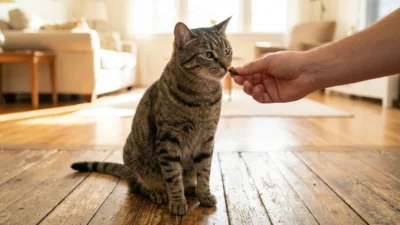

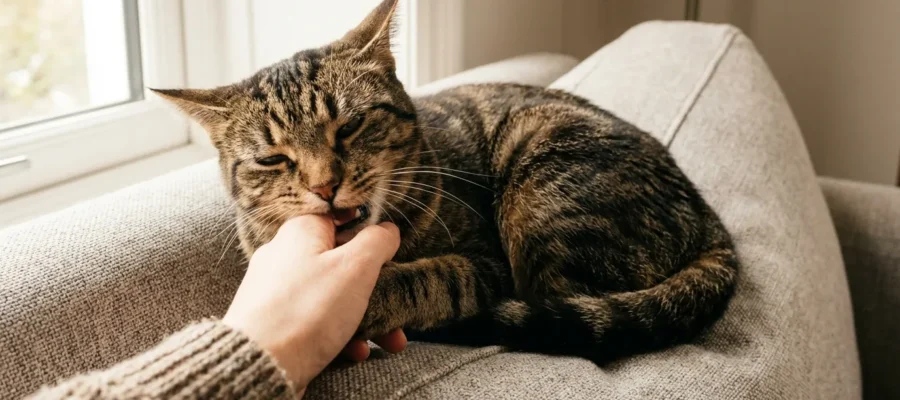
Cats don’t bite randomly. Every bite has a cause — and once you know what it is, the behavior usually makes complete sense. This guide covers the 8 most common reasons cats bite, how to spot the warning signs before it happens, and exactly what to do when it does.

Why Cats Bite People
Cats bite to communicate. They don’t have words, so they use their bodies — and teeth are part of that toolkit. A bite can mean your cat is overstimulated, scared, in pain, bored, or just playing too rough. The key is figuring out which one applies to your cat.
Some bites are gentle. Some draw blood. The reason behind each one is usually different, and the response should be too. Interestingly, the same cat that bites you might also stare at you for minutes at a time or follow you from room to room — all part of the same communication system cats use when they can’t just say what they need.
8 Reasons Your Cat Bites You
1. Overstimulation During Petting
This is the most common reason cats bite their owners. You’re petting your cat, everything seems fine, and then — bite.
It’s called petting-induced aggression. Cats have a tolerance threshold for physical contact, and when that threshold is crossed, they bite to end the interaction. Some cats hit that limit after 30 seconds. Others go for 10 minutes before they’ve had enough.
Watch for these signals before the bite:
- Skin twitching along the back
- Tail starting to flick or thump
- Ears rotating backward
- Sudden stillness in the body
When you see those signs, stop petting. Pull your hand away slowly and give the cat space. The bite won’t happen if you respond to the warning.
Certain areas are more likely to trigger overstimulation — the belly, the base of the tail, and the lower back near the hips. Stick to the head, chin, and cheeks if your cat bites during petting.
2. Play Aggression and Predatory Instinct
Cats are hunters. That instinct doesn’t disappear just because they live indoors and eat from a bowl. When they see movement — your fingers, your toes, your feet under a blanket — the predatory sequence activates. They stalk, pounce, and bite.
This is especially common in cats that were played with using bare hands as kittens. If someone dangled fingers in front of a kitten’s face as a toy, that kitten learned that human hands are fair game. By the time they’re 2 years old with fully developed teeth and claws, that’s a real problem.
Use toys. Wand toys, kicker toys, crinkle balls — anything that puts physical distance between your hands and the cat’s teeth. Play sessions of 10–15 minutes twice a day reduce biting significantly in most cats within 2–4 weeks. If you need help building better habits with your cat overall, our guide on how to train a cat walks through the fundamentals.
3. Fear or Stress
A scared cat bites. It’s not aggression in the traditional sense — it’s defense. When a cat feels trapped and can’t run away, biting is the last option they have.
Body language of a fearful cat:
- Crouched low to the ground
- Ears flat against the head
- Wide, fixed eyes
- Back arched, fur raised (piloerection)
- Tail tucked under the body
If your cat looks like that, don’t reach for them. Don’t try to comfort them with touch. Give them an exit. Let them retreat to a safe space — under a bed, inside a box, on a high shelf. Once they feel in control of the situation, the threat of biting drops.
4. Redirected Aggression
This one catches owners completely off guard. Your cat is watching something outside — another cat in the yard, a bird, a squirrel. They get worked up. You walk past at the wrong moment and they bite you.
You didn’t cause the problem. You just happened to be nearby when the cat had nowhere to direct its agitation.
Redirected aggression can be intense. The cat isn’t in a playful mood — they’re in a highly aroused, reactive state. Don’t try to pick them up or interact with them. Wait it out. Close the blinds if outdoor animals are the trigger. It can take 20–30 minutes for a cat’s arousal level to return to baseline after a redirected aggression incident.
Multi-pet households add another layer of stress. If you recently introduced a cat to a dog and biting behavior started shortly after, redirected aggression from the adjustment period may be the trigger.
5. Attention-Seeking Biting
Some cats learn that biting gets results. They nip your ankle and you immediately look down, say something, maybe even pick them up. From the cat’s perspective, biting worked.
This is a learned behavior. The fix is to not reward it. When your cat bites for attention, don’t react. Stand up, turn away, and leave the room. No eye contact, no talking, no pushing them away. Any response at all — even a negative one — can reinforce the behavior.
Cats that bite for attention are often under-stimulated. If yours is also meowing constantly, that’s a strong sign they need more scheduled interaction and enrichment throughout the day.
6. Pain or Underlying Medical Issues
A cat that has never bitten before and suddenly starts biting is telling you something is wrong physically. Pain changes behavior fast. Cats can’t tell you their back hurts or their mouth aches — they communicate distress through behavior, and biting is one of the clearest signals.
Medical conditions commonly linked to sudden biting include:
- Dental disease — sore gums or cracked teeth make any contact around the face painful
- Arthritis — being touched or picked up along the spine or hips causes sharp pain
- Ear infections — touching the head triggers a bite response
- Skin conditions or parasites — a sensitive, itchy coat makes petting unbearable
- Hyperthyroidism — common in older cats, causes irritability and lowered bite threshold
If the biting is new, sudden, or out of character, use our pet symptom checker to review your cat’s symptoms before your vet visit — it helps you arrive with the right information.
7. Learned Behavior from Kittenhood
Kittens go through a critical socialization window between 2 and 7 weeks of age. What they learn during that period shapes how they interact with humans for the rest of their lives. Kittens that were allowed to play-bite human hands and feet during those weeks learned that biting people is normal and acceptable.
This is one of the hardest biting patterns to change in adult cats because it’s deeply ingrained. It takes consistent redirection over 4–6 weeks to see meaningful improvement. Replace hands with toys every single time. Never use your fingers to play.
8. Environmental Stress and Depression
Cats are sensitive to change. A new baby, a new pet, a move, a change in routine, or the loss of a family member can push a cat into a state of chronic stress that shows up as aggression and biting.
Signs your cat may be stressed beyond a single incident:
- Changes in appetite
- Hiding more than usual
- Increased vocalization
- Urinating outside the litter box
- Biting combined with unpredictable behavior
Stress that expresses through biting sometimes also shows up as spraying around the home. If you’re seeing both behaviors at once, environmental anxiety is very likely the root cause.
FELIWAY® plug-in diffusers — which release synthetic feline facial pheromones — are a vet-recommended tool for reducing environmental stress. They don’t sedate the cat. They just create a calmer baseline.
If stress-related biting continues for more than 2–3 weeks, speak to your vet. In some cases, short-term anti-anxiety medication helps reset the cat’s baseline while behavioral changes take hold.
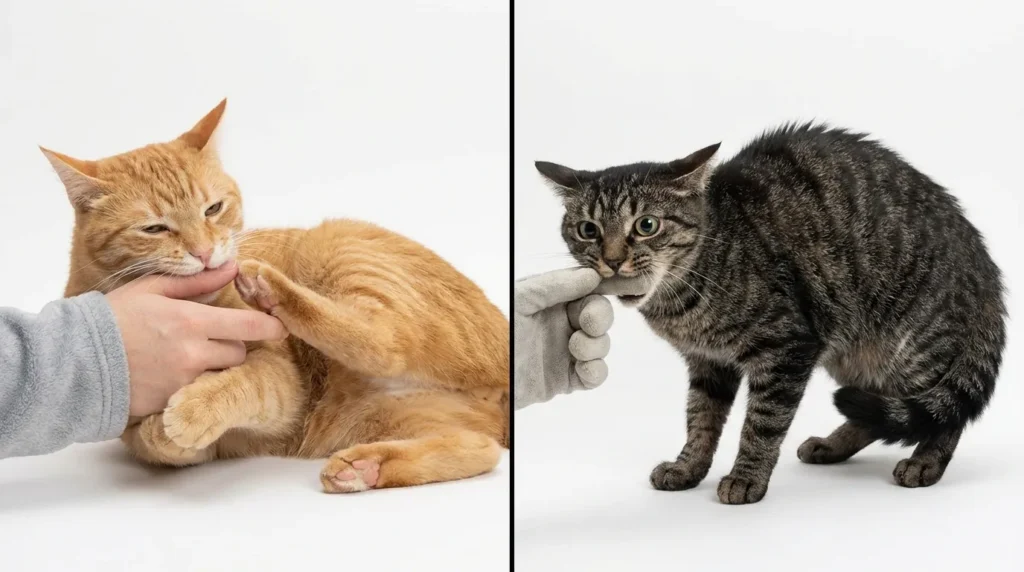
Love Bites vs. Aggressive Bites — What’s the Difference?
Not every bite is an attack. Knowing the difference matters.
Signs of a Love Bite
- Soft pressure — teeth make contact but don’t break skin
- Occurs during grooming or petting when the cat seems relaxed
- Often paired with purring or kneading
- Cat remains calm before and after
- Usually on hands, fingers, or arms during close contact
Love bites are a form of affection or a gentle signal to pause. Understanding what your cat’s purring actually means alongside the nibble helps you read the full picture — purring during a love bite usually means affection, while a sudden stop in purring before a bite often signals overstimulation.
Signs of an Aggressive Bite
- Hard pressure — skin punctured or bruised
- Happens fast, with no apparent warmup
- Cat’s body is tense before the bite
- May be followed by hissing, swatting, or running away
- Leaves a clear wound
Body Language Warning Signs Before a Bite
Cats almost never bite without warning. The warning signs are just easy to miss:
- Tail: starts flicking or thumping against the surface — learn more about what your cat’s tail movements mean
- Ears: rotate sideways or flatten back
- Eyes: pupils dilate rapidly; may narrow into slits
- Skin: visible rippling or twitching along the back
- Whiskers: pull back tight against the face
- Body: goes from relaxed to rigid
Learn these 6 signals and you’ll rarely be surprised by a bite again.
Common Biting Scenarios Explained
Why Does My Cat Bite Me When I Pet Them?
Petting-induced aggression. Your cat reached their stimulation limit and used a bite to end the session. Watch for tail flicking and skin twitching — those come a few seconds before the bite every time.
Why Does My Cat Bite Me and Then Lick Me?
This is usually overstimulation combined with affection. The licking is social bonding behavior. The bite follows when the arousal tips over. It’s not contradictory — cats can feel affectionate and overstimulated at the same time. Back off the petting briefly, let them settle, and try again with shorter sessions. For a deeper look at why cats lick the people they live with, read our full guide on why your cat licks you.
Why Does My Cat Hug My Arm and Bite Me?
This is textbook predatory behavior. Cats use this exact move on large prey — front legs wrap around, then bite, often combined with rapid back-leg kicks (the “bunny kick”). Your arm triggered the hunting sequence. Redirect immediately to a kicker toy that absorbs the whole sequence safely.
Why Does My Cat Bite Me Out of Nowhere?
Check for redirected aggression first. Was there something outside — another cat, a bird, a squirrel — that the cat was watching before the bite? If not, look for pain signals. Sudden unprovoked biting with no environmental trigger is a vet visit situation. Use the pet symptom checker to document what you’re seeing before the appointment.
Why Does My Cat Bite Me in the Morning?
Cats are crepuscular — most active at dawn and dusk. In the early morning, their predatory instinct peaks. They may wake you with bites on hands, feet, or face because the movement under the covers activates their hunting behavior. Interactive play the night before reduces the intensity of this significantly.
Why Does My Cat Bite Me and Not My Partner?
Several possibilities. That person may move their hands and feet more, making them a more attractive hunting target. They may have previously encouraged rough play. Or, the cat associates that specific person with overstimulation from past petting. Cats form distinct individual associations with different household members.
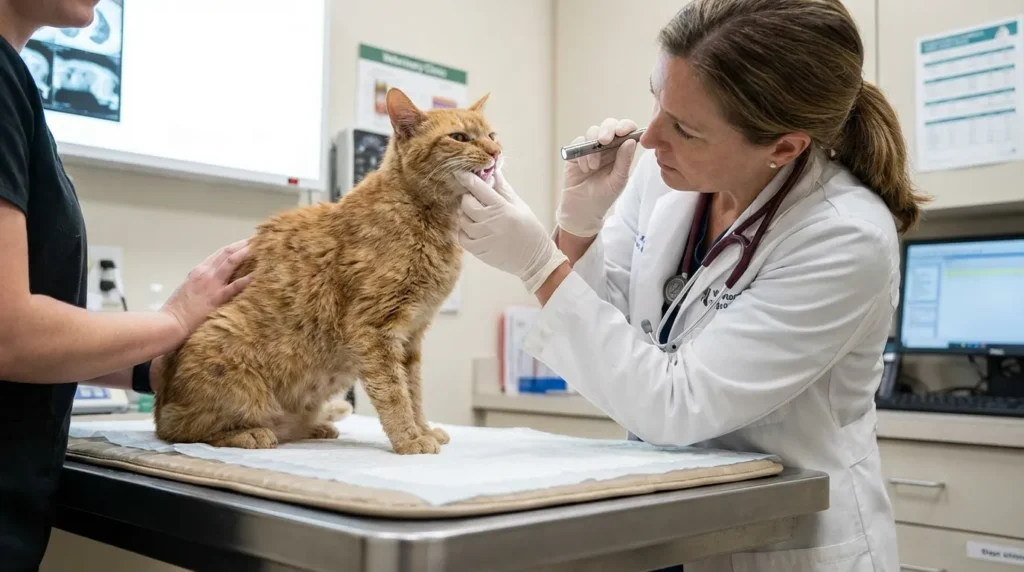
When Biting Is a Medical Red Flag
Treat biting as a potential medical symptom when:
- It started suddenly with no behavioral trigger
- Your cat winces, flinches, or vocalizes when touched in a specific area
- They’re eating less, grooming less, or moving differently
- The cat is over 8 years old (arthritis, hyperthyroidism, and dental disease all increase with age)
- They’ve stopped using the litter box alongside the biting change
If your cat is also throwing up more frequently alongside behavior changes, that’s another signal pointing toward a medical issue rather than a behavioral one.
Medical Conditions That Cause Sudden Biting
Dental disease is one of the most underdiagnosed causes of behavior change in cats. By age 3, over 70% of cats show signs of periodontal disease. A cat with a painful mouth will bite when touched near the face and may also stop eating dry food.
Arthritis affects an estimated 90% of cats over 12 years old. Being picked up, stroked along the spine, or handled around the hips causes pain. The bite is the cat’s version of “that hurts — stop.”
Hyperthyroidism in cats over 10 commonly causes irritability, increased aggression, and a lower tolerance for handling.
How to Tell If the Biting Is Pain-Related
The clearest indicator is location consistency. If your cat only bites when you touch a specific spot — the lower back, the face, a particular leg — that spot likely hurts. Pain-related biting also tends to be sharper and more sudden than behavioral biting, with no escalation pattern beforehand.
If you suspect pain, your vet can perform a physical exam, dental assessment, and blood panel to identify the cause. Don’t try to train your way out of a medical problem.
How to Stop Your Cat From Biting
In the Moment — What to Do Right Now
- Freeze. Don’t pull your hand away fast — rapid movement triggers the predatory chase reflex and makes the bite worse.
- Go limp and still. The “prey” stopping moving removes the stimulus for continued attack.
- Disengage calmly. Once the cat releases, slowly withdraw and step back.
- Don’t react loudly. No yelling, no scolding, no squirting with water. These responses elevate the cat’s arousal and increase the chance of another bite.
Long-Term Training Strategies
- Replace hands with toys every single time play biting starts. No exceptions.
- End petting sessions before warning signs appear, not after they start.
- Schedule two daily play sessions of 10–15 minutes each. Active play reduces biting frequency in most cats within 2–4 weeks.
- Give your cat more environmental control — elevated perches, hiding spots, and separate resources in multi-cat homes.
- Use a FELIWAY® diffuser if stress or anxiety is the root cause.
- Consult a certified veterinary behaviorist (DACVB) or an Animal Behaviour and Training Council (ABTC) accredited behaviourist for persistent cases.
Our full guide on how to discipline a cat using positive methods covers the behavioral science behind why punishment backfires and what actually changes a cat’s behavior long-term.
If you’re also dealing with your cat jumping on surfaces they shouldn’t, the same behavioral framework applies — read how to keep cats off counters for the parallel approach.
What Never to Do
- Never hit, flick, or physically punish your cat. It increases fear, which increases aggression. The biting gets worse.
- Never scruff an adult cat as a discipline method. It causes pain and breaks trust.
- Never use your hands or feet as toys, even with kittens. This is where most adult biting problems start.
- Never ignore sudden biting changes in an older cat. Pain is the first thing to rule out.
What to Do After a Cat Bite
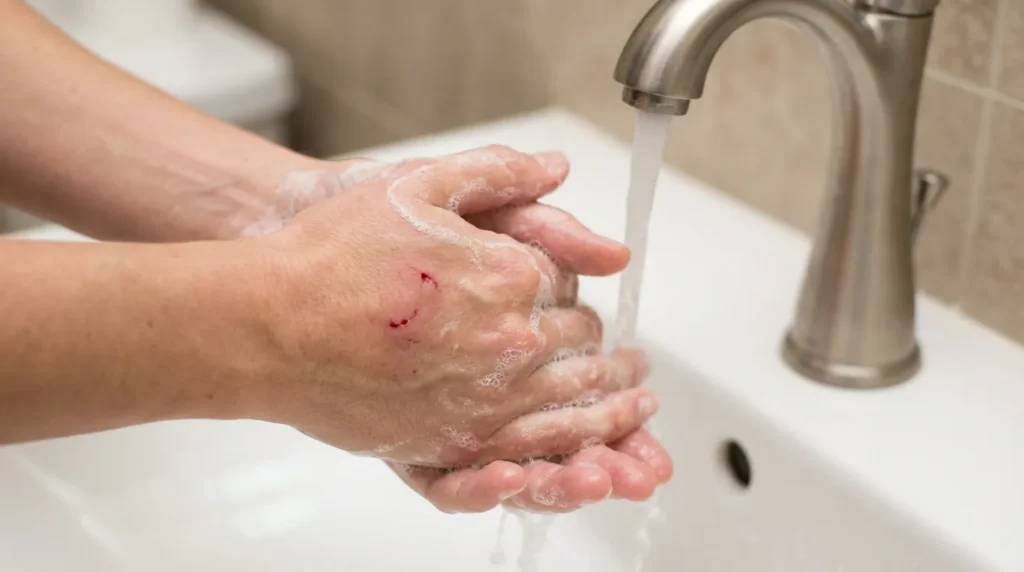
Cat bites carry a serious infection risk. Cat teeth are thin and sharp — they create deep puncture wounds that seal over quickly on the surface while bacteria are trapped below.
Wound Care Steps
- Wash immediately with soap and warm running water for at least 5 minutes.
- Let it bleed briefly — this helps flush bacteria out of the wound.
- Apply an antiseptic — povidone-iodine or chlorhexidine if available.
- Cover with a clean dressing.
- Monitor for infection signs: redness spreading beyond the wound, warmth, swelling, pus, or fever.
When to See a Doctor
Get medical attention within 24 hours if:
- The bite is on the hand, face, or near a joint
- The puncture is deep
- You are immunocompromised, diabetic, or on immunosuppressant medication
- The wound shows any signs of infection within 48 hours
Cat bite infections can progress to cellulitis or, in rare cases, septic arthritis if untreated. Pasteurella multocida is the most common bacterial pathogen in cat bite infections and responds well to antibiotics when caught early.
Frequently Asked Questions
Are cat love bites a sign of affection? Sometimes. Love bites during petting or grooming can reflect bonding. But they can also signal overstimulation or a request to stop. Context and body language tell you which one it is.
Is it normal for cats to bite during play? Yes — play biting is normal, especially in kittens and young cats. The problem is when it escalates in intensity or continues into adulthood because hands were used as toys. Redirect to appropriate toys early and consistently.
Should I punish my cat for biting? No. Punishment — hitting, yelling, squirting with water — increases fear and arousal. Both make biting more likely, not less. Calm redirection and ignoring the behavior works. Punishment doesn’t.
Why does my cat bite me in the morning? Dawn is a peak activity window for cats. Their predatory drive is highest at that time. Movement under covers, dangling feet, or a moving hand triggers the hunt sequence. Scheduled play before bedtime reduces the intensity of morning biting.
Can biting mean my cat loves me? Gentle nibbles during relaxed petting or grooming moments can reflect genuine affection. But “they bite because they love me” is often used to explain biting that actually needs addressing. If the bite ever breaks skin, it’s worth investigating the cause properly.
When should I call the vet about my cat’s biting? Call if biting is new and sudden, if your cat reacts to touch in a specific body area, if they’re also showing changes in appetite or mobility, or if the cat is over 8 years old. These are pain flags, not behavior problems. Our pet symptom checker can help you organize your observations before you call.
Final Thoughts
Your cat bites for a reason — always. It’s either communication, instinct, a learned habit, or pain. None of those require punishment. All of them respond to the right approach.
The pattern to remember: watch body language before the bite, respond calmly during it, and change the conditions after it. That three-step loop fixes most biting problems within a few weeks.
If the biting is sudden, severe, or in an older cat, start with a vet visit. Everything else follows from there. And if your dog has similar biting habits, the causes and fixes are different — read our guide on why your dog bites for the canine version of this breakdown.