

If you’ve cleaned up cat vomit three times this week, you’re probably wondering if something is seriously wrong — or if your cat is just being a cat.
Here’s the honest answer: vomiting in cats is common. It is not normal.
Those two things sound contradictory, but they’re not. Cats vomit frequently. That doesn’t mean their bodies are designed for it or that it’s okay to ignore. Every vomiting episode has a cause. Sometimes it’s minor. Sometimes it’s the first sign of a disease that’s been building for months.
This guide covers the 10 most common reasons cats throw up, what different types of vomit actually mean, and a clear decision framework for when you need a vet today versus when you can wait and watch. Not sure if your cat’s symptoms go beyond vomiting? Run them through our pet symptom checker for a quick assessment before calling your vet.
Is It Normal for Cats to Vomit?
No. Vomiting is a clinical sign — meaning it’s your cat’s body signaling that something is wrong. It might be as simple as eating too fast. It might be the early stages of kidney disease. The frequency and pattern are what matter most.
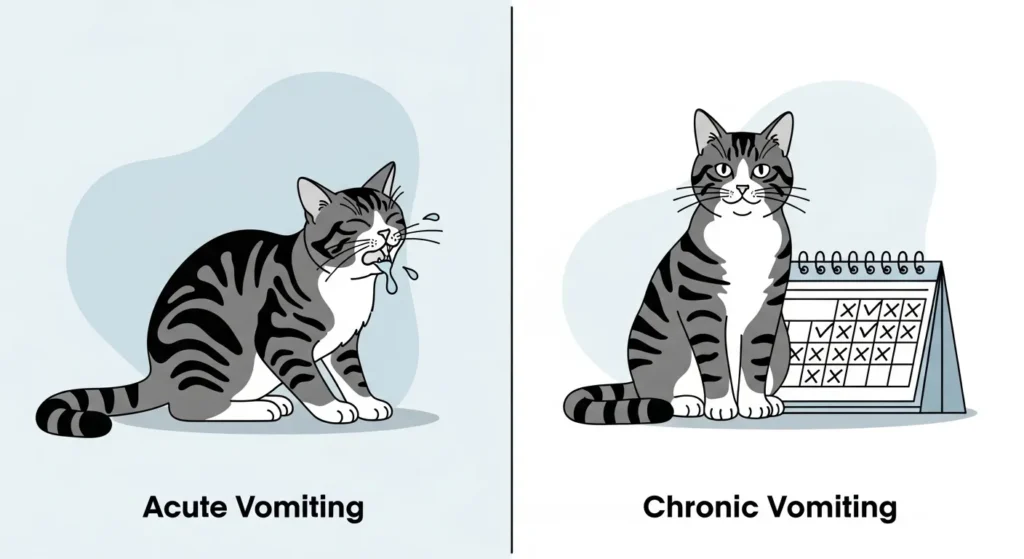
Acute vs. Chronic Vomiting — What’s the Difference?
Acute vomiting means it started suddenly. Your cat doesn’t usually vomit, and now they are. One to three episodes with no other symptoms is usually not an emergency. More than three times in 24 hours, combined with lethargy or refusal to eat, means you should call your vet that day.
Chronic vomiting means your cat throws up regularly — at least once a month, sometimes daily — over a period of weeks or months. Some owners accept this as their cat’s “normal.” Veterinarians increasingly do not. Chronic vomiting almost always points to an underlying condition. It warrants an exam and workup even when the cat seems otherwise fine.
How Often Is Too Often?
Once a month is the threshold most vets use. If your cat vomits more than once monthly on a consistent basis, that pattern deserves investigation. Cats who vomit weekly, several times a week, or after most meals are not just “pukey cats” — they need medical evaluation.
Vomiting vs. Regurgitation — This Distinction Matters
Most articles lump these together. They’re not the same thing, and telling them apart helps your vet narrow down the cause faster.
Vomiting is active. You’ll see your cat crouch down, heave with visible abdominal effort, and expel partially digested food or fluid. It often comes with retching sounds. The stomach and upper intestines are involved.
Regurgitation is passive. The food comes back up without warning — no heaving, no crouching. It usually looks like a tube-shaped blob of undigested food and comes up within minutes of eating. The esophagus is typically the problem, not the stomach.
If your cat drops their head and food just falls out, that’s regurgitation. It points to different conditions — esophageal disorders, megaesophagus, or eating too quickly — and changes the diagnostic path entirely.
When you call your vet, describe what you saw. “She crouched and heaved for 20 seconds before anything came up” gives your vet much more to work with than “she threw up.”
10 Common Reasons Cats Throw Up
1. Eating Too Fast
This is the most frequent cause of regurgitation in otherwise healthy cats. When a cat inhales food in under 30 seconds, the stomach doesn’t have time to signal fullness. Food comes back up quickly, still whole or barely chewed. It’s more common in multi-cat households where food competition is real, even if subtle.
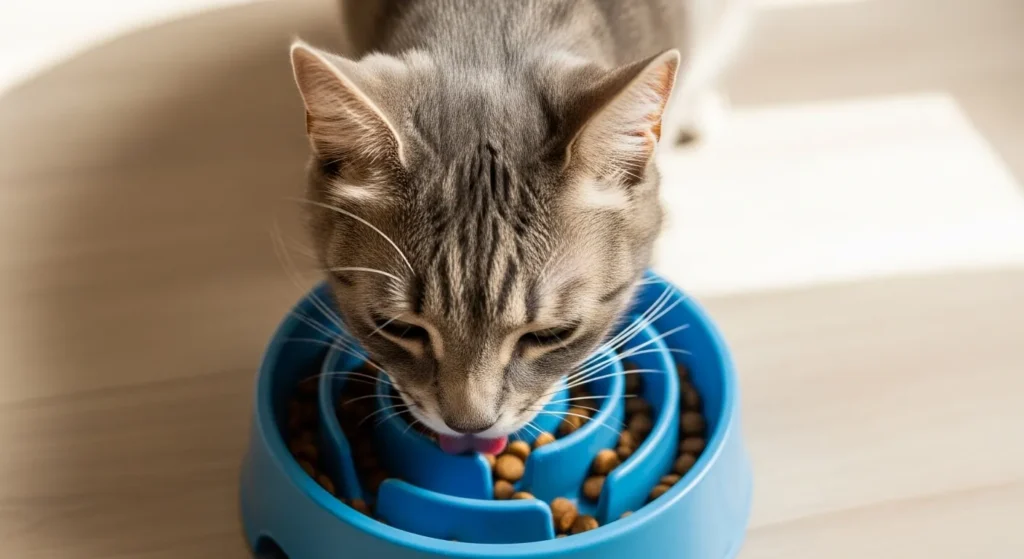
A slow feeder bowl or puzzle feeder can eliminate this entirely. These tools extend a meal from 30 seconds to 5–10 minutes and significantly reduce regurgitation episodes. Also pay attention to how much wet food you’re feeding your cat — overfeeding in a single sitting is just as likely to trigger vomiting as eating speed.
2. Hairballs
Cats swallow loose fur while grooming. Most of it passes through the digestive tract without issue. Some of it accumulates in the stomach and gets vomited up as a cylindrical, hair-packed mass.
Occasional hairballs — a few times a year — are generally not concerning. Frequent hairball vomiting (weekly or more) is a red flag. It can mean your cat is over-grooming due to stress, skin disease, or pain. It can also indicate a gastrointestinal motility problem that prevents hair from moving through normally. You might also wonder why cats eat grass during this time — it’s often connected to the same instinct to clear the gut. Cats with IBD, for example, vomit hairballs more frequently than healthy cats. Don’t assume frequent hairballs are just a grooming issue. Tell your vet.
3. Dietary Changes or Food Intolerances
Switch a cat’s food overnight and the stomach often revolts. Cats have sensitive GI tracts, and an abrupt protein or formula change can trigger vomiting for several days.
Food intolerances are different from food allergies but produce similar symptoms — vomiting, loose stool, or both. Beef, fish, chicken, and dairy are common offenders. A hydrolyzed protein diet or a novel protein diet (rabbit, duck, venison) can identify and eliminate the problem under veterinary guidance. If you’re preparing food at home, check out these high protein cat recipes that are designed with digestive health in mind. You can also run any ingredient you’re uncertain about through our pet food safety checker before adding it to your cat’s bowl.
The standard protocol for switching foods: take 7–10 days to transition. Start with 25% new food mixed into 75% old food for the first 3 days. Move to 50/50 for the next 3 days. Then 75% new for 3 more days before fully switching.
4. Ingesting Foreign Objects
Cats — especially younger ones — eat things they shouldn’t. String, ribbon, rubber bands, hair ties, small toy parts. Linear foreign bodies (string, thread) are particularly dangerous. They can get anchored under the tongue or at the pylorus while the intestines bunch up around them, causing life-threatening obstruction.
Vomiting caused by a foreign body obstruction is usually persistent, worsens over hours, and doesn’t stop on its own. This is an emergency.
5. Toxic Plants and Household Poisons
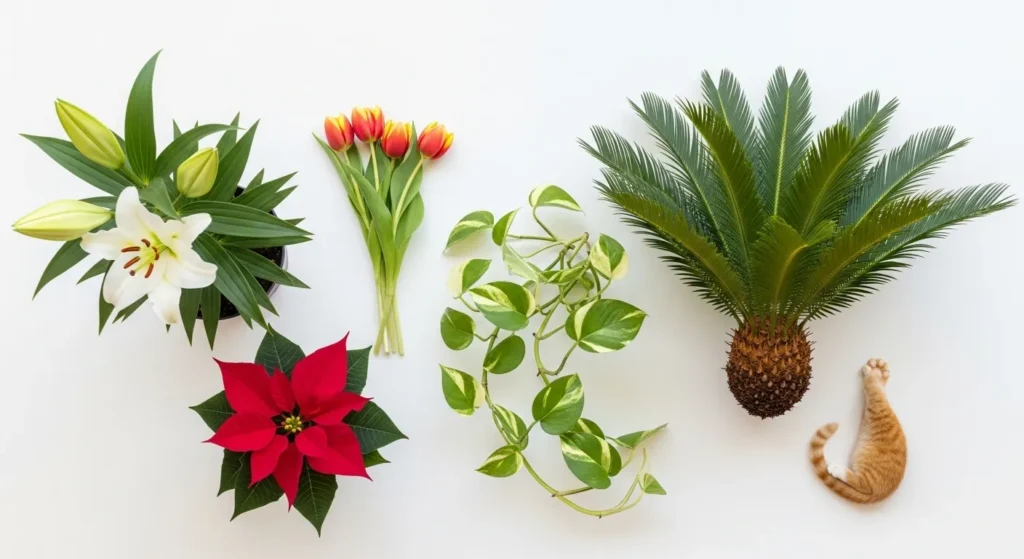
Lilies are the most dangerous plant for cats — all parts of true lilies (Easter lily, tiger lily, Asiatic lily) can cause acute kidney failure even in small amounts. Other common offenders hiding in many homes include tulips, which are toxic to cats and can cause drooling, vomiting, and GI distress, and pothos, which is also toxic to cats despite being one of the most popular houseplants around. Antifreeze (ethylene glycol) is highly toxic and often lethal. NSAIDs like ibuprofen and aspirin cause GI ulceration and kidney damage.
If your cat has access to any of these and starts vomiting suddenly, don’t wait. Go to an emergency clinic immediately.
6. Inflammatory Bowel Disease (IBD)
IBD is one of the most common causes of chronic vomiting in cats. The immune system attacks the walls of the digestive tract, causing chronic inflammation. Cats with IBD typically vomit multiple times a week, lose weight gradually, and may have intermittent diarrhea.
IBD requires a biopsy for definitive diagnosis. It’s managed long-term, usually with corticosteroids and dietary changes, not cured. Left unmanaged, IBD in cats can progress to intestinal lymphoma — a reason early diagnosis matters.
7. Chronic Kidney Disease (CKD)
CKD is extremely common in cats over 7 years old. As kidney function declines, waste products build up in the bloodstream. Those toxins trigger nausea and vomiting. Cats with CKD also drink more water, urinate more frequently, lose weight, and become lethargic.
Vomiting from CKD is usually chronic and gradual in onset. Blood work and urinalysis together are needed to diagnose it — neither test alone is sufficient.
8. Hyperthyroidism
The thyroid gland produces excess hormones. This speeds up nearly every body system. Affected cats vomit, have increased appetite despite weight loss, drink and urinate more, become hyperactive or restless, and sometimes develop heart complications.
Hyperthyroidism is very treatable once diagnosed — with medication (methimazole), radioactive iodine therapy, or surgery. Most affected cats are over 10 years old. Certain breeds with known genetic health tendencies, like Persians, can be more prone to systemic illnesses — read more about Persian cat health problems if you own one.
9. Liver Disease and Hepatic Lipidosis
Liver disease in cats causes vomiting because the liver can’t properly process toxins and metabolic waste. Hepatic lipidosis (fatty liver disease) deserves special mention — it can develop rapidly in cats who stop eating for even 2–3 days. If you’re ever unsure how long is too long, understand how long cats can go without eating and why even short starvation periods are dangerous in overweight cats. Vomiting, jaundice (yellowing of eyes or gums), and extreme lethargy are warning signs.
Hepatic lipidosis is life-threatening but reversible with aggressive early treatment.
10. Pancreatitis
Inflammation of the pancreas causes nausea, vomiting, abdominal pain, and lethargy. Cats with pancreatitis often stop eating entirely. The condition can be acute or chronic, and it frequently occurs alongside IBD and liver disease — a combination called “triaditis” in feline medicine.
Diagnosis requires specific bloodwork (feline pancreatic lipase immunoreactivity, or fPLI) in addition to standard panels.
What Your Cat’s Vomit Is Telling You
The appearance of vomit doesn’t give a definitive diagnosis. But it narrows the field and gives your vet a starting point.
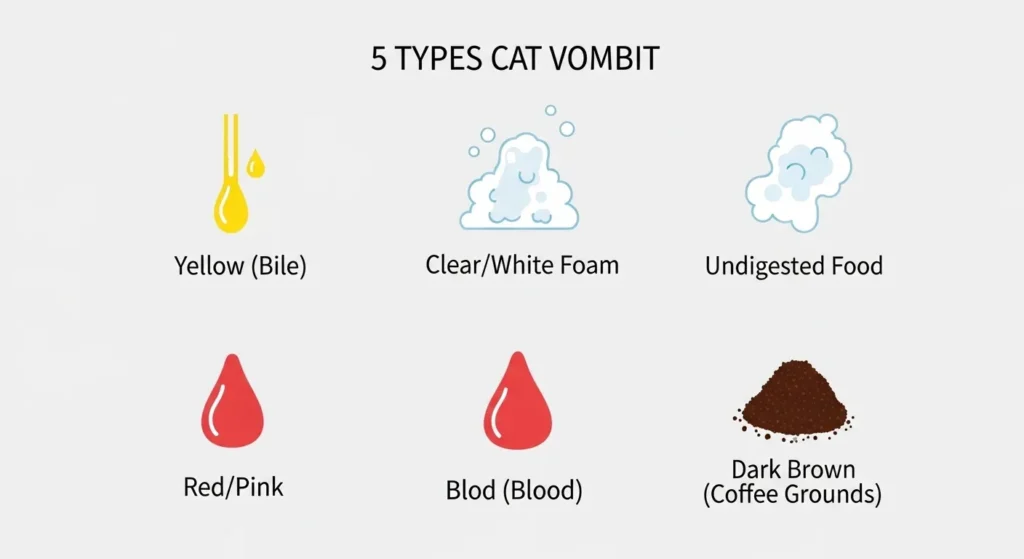
Yellow or green (bile-colored): Bile comes from the upper small intestine. Yellow vomit usually means the stomach was empty at the time. It can also point to liver disease or small intestinal inflammation. Single episode in an otherwise normal cat? Monitor. Repeated? Call your vet.
Clear liquid or white foam: Often comes from the esophagus or an empty stomach. Repeated clear or foamy vomiting is worth reporting, especially if it happens before meals or overnight.
Undigested food: Food that looks exactly like it did going in. Classic sign of regurgitation (esophageal issue) or very rapid eating. If the cat hasn’t eaten in several hours and still vomits undigested food, suspect a motility disorder or obstruction.
Blood (red or pink): Fresh blood in vomit means there’s bleeding somewhere between the mouth and the upper stomach. It could be from esophageal irritation, or something more serious like ulceration or trauma. Any blood in vomit = call your vet that day. You may also notice your cat drooling alongside this — that combination in particular warrants urgent attention.
Coffee-ground appearance (dark brown, grainy): This is digested blood. It indicates bleeding in the stomach or upper intestinal tract — most commonly associated with ulcers. This is urgent.
Brown and foul-smelling: Could be ingestion of fecal material, or in serious cases, intestinal obstruction causing backflow from the lower GI tract. Either way, this warrants same-day veterinary contact.
When to Go to the Vet — A 3-Tier Decision Framework
🚨 Emergency — Go Now or Call an Emergency Clinic
- Vomiting blood (red or coffee-ground appearance)
- Suspected toxin ingestion (lily, antifreeze, medications)
- Cat is vomiting and cannot stand, is unresponsive, or is in visible pain
- Suspected foreign body obstruction — vomiting is frequent, persistent, and worsening
- Vomiting combined with a distended or hard abdomen
- Cat has not urinated in over 24 hours alongside vomiting
⚠️ Urgent — Call Your Vet Today
- More than 3 vomiting episodes in 24 hours
- Vomiting combined with lethargy, hiding, or complete refusal to eat
- Kitten or senior cat (over 10 years) vomiting more than once
- Any vomiting in a cat with a known chronic condition (CKD, IBD, hyperthyroidism)
- Vomiting plus visible weight loss over recent weeks
- Repeated vomiting that resumes after a brief pause
- Vomiting occurring alongside unusual sneezing — learn more about why your cat might be sneezing, as respiratory and GI symptoms together can indicate systemic illness
✅ Monitor at Home — Under These Specific Conditions
- Single vomiting episode, cat is alert, eating, and acting normally afterward
- Known hairball, brought up fully, no further retching
- Cat ate something new or got into food it doesn’t normally eat — one to two episodes, resolved
- Mild regurgitation immediately after rapid eating, isolated occurrence
If monitoring at home: withhold food for 2–4 hours, offer water in small amounts, then reintroduce a small bland meal (plain cooked chicken or a prescribed GI food). If vomiting resumes within 12 hours, call your vet.
How Vets Diagnose the Cause
History Questions Your Vet Will Ask
Come prepared to answer: When did it start? How many times? What does the vomit look like? Has your cat’s diet changed recently? Does the cat go outside? Does the cat have access to plants, string, or small objects? Is the cat on any medications? Is there also diarrhea, weight loss, or increased thirst?
The more detail you provide, the faster the workup moves.
Physical Exam
Your vet will check for abdominal pain, palpable masses, an enlarged thyroid gland (at the neck), signs of dehydration, weight loss, and mouth abnormalities like string anchored under the tongue.
Blood Work, Urinalysis, and X-Rays
This is almost always the first diagnostic step. A complete blood panel checks organ function, red and white cell counts, and can flag conditions like hyperthyroidism, CKD, diabetes, and anemia. Urinalysis is essential alongside bloodwork — kidney disease in particular cannot be accurately assessed without both. Abdominal X-rays reveal foreign bodies, organ size abnormalities, constipation, and masses.
Ultrasound, Barium Study, and Endoscopy
Ultrasound gives a more detailed view of organ architecture and can be used to collect tissue samples. A barium study (the cat swallows contrast material) shows motility problems and partial obstructions that X-rays miss. Endoscopy allows the vet to visualize the stomach and upper intestines directly and take biopsies — essential for diagnosing IBD and distinguishing it from intestinal lymphoma.
Exploratory Surgery
Reserved for cases where imaging suggests obstruction or a mass that can’t be sampled another way. Uncommon, but occasionally the only definitive path forward.
Treatment Options
Treatment depends entirely on the diagnosis. There’s no single solution.
Dietary modification: Hydrolyzed protein diets or novel protein diets address food intolerances and support IBD management. A prescription GI diet improves digestive transit and reduces irritation.
Medications: Antiemetics (like maropitant/Cerenia) control nausea. Corticosteroids manage IBD. Methimazole treats hyperthyroidism. Sucralfate coats and protects ulcerated stomach lining.
Fluids and supportive care: Dehydration from repeated vomiting is a real risk. Subcutaneous fluids at the vet or in-home fluid administration (common for cats with CKD) keeps the cat hydrated and flushes toxins.
Chronic condition management: CKD, IBD, and hyperthyroidism are managed long-term, not cured. Regular rechecks, periodic bloodwork, and dietary adjustments are part of keeping these cats comfortable and stable for years.
How to Reduce Vomiting at Home
Slow down eating. A slow feeder bowl or puzzle feeder adds physical obstacles to the food, forcing the cat to eat more slowly. For cats who regurgitate right after meals, this is often the entire solution.
Hairball prevention. Regular brushing removes loose fur before it gets swallowed. Learning how to bathe a cat safely also reduces loose fur load, especially during heavy shedding seasons. Hairball-formula foods contain higher fiber to help move hair through the GI tract. Adding pumpkin to your cat’s diet is a natural, vet-approved way to increase fiber intake and help hair pass through the digestive system more easily. Hairball lubricant gels (petroleum-based pastes given 2–3 times weekly) help pass accumulated hair. If hairballs are still frequent despite these steps, talk to your vet about underlying GI disease.
Transition foods slowly. Use the 7–10 day protocol described earlier every time you change your cat’s diet. Never switch cold turkey.
Cat-proof your space. Remove toxic plants (lilies, pothos, sago palm, tulips). Keep string, rubber bands, hair ties, and small objects off the floor. Lock away medications, cleaning products, and antifreeze.
Watch for stress. Some cats vomit in response to changes in their environment — a new pet, a move, construction noise, a changed schedule. Stress triggers over-grooming, which increases hairball vomiting, and can directly cause gastric upset. If vomiting coincides with a stressful life change, that connection is worth mentioning to your vet.
Frequently Asked Questions
Why does my cat throw up white foam? White or foamy vomit usually comes from an empty stomach or the esophagus. Stomach acid and mucus produce the foam. It can happen when a cat hasn’t eaten for a while or if nausea is triggered on an empty stomach. A single episode is usually not alarming. Repeated foamy vomiting — especially if it happens at the same time each day — should be evaluated by your vet.
Why does my cat throw up after every meal? If this happens consistently, the most likely causes are eating too fast (regurgitation), a food intolerance, or an esophageal motility problem. Switching to a slow feeder bowl is the first step. If vomiting continues after meals even with a slow feeder, a vet exam is needed to rule out structural or medical causes.
Is it normal for cats to throw up hairballs every week? No. Once or twice a year is within normal range for most cats. Weekly hairball vomiting is a red flag — it may indicate GI motility issues, stress-related over-grooming, or early IBD. Increase brushing and try a hairball prevention gel, but also schedule a vet visit to rule out underlying disease.
What home remedy can I give my cat for vomiting? Withhold food for 2–4 hours to let the stomach rest. Offer water in small amounts. After the rest period, offer a small bland meal — plain cooked chicken breast works well for most cats. Never give human medications like Pepto-Bismol or Imodium to cats. These are toxic. If vomiting resumes or the cat won’t eat, call your vet.
Can stress cause vomiting in cats? Yes. Psychological stress activates the brain-gut axis in cats just as it does in humans. Anxiety from changes in the home, conflicts with other pets, or disruption to routine can cause GI upset, over-grooming, and vomiting. Stress-related vomiting often resolves when the stressor is addressed, but it can also mask or worsen underlying medical conditions.
Conclusion
Your cat throwing up once in a while isn’t cause for panic. Your cat throwing up regularly absolutely is cause for a conversation with your veterinarian.
Know the difference between vomiting and regurgitation. Pay attention to what the vomit looks like. Use the three-tier triage framework in this guide to decide how quickly you need to act. Causes range from eating too fast — solved with a slow feeder bowl — to early-stage kidney disease that needs ongoing management. Both produce the same symptom.
When in doubt, start with our pet symptom checker to help organize what you’re seeing, then call your vet. A clear description of what you observed — and even a photo of the vomit — gives them a strong head start before you walk through the door. And while you’re taking stock of your cat’s health, our 13 genius cleaning hacks for cat owners will at least make the cleanup side of things a little easier.