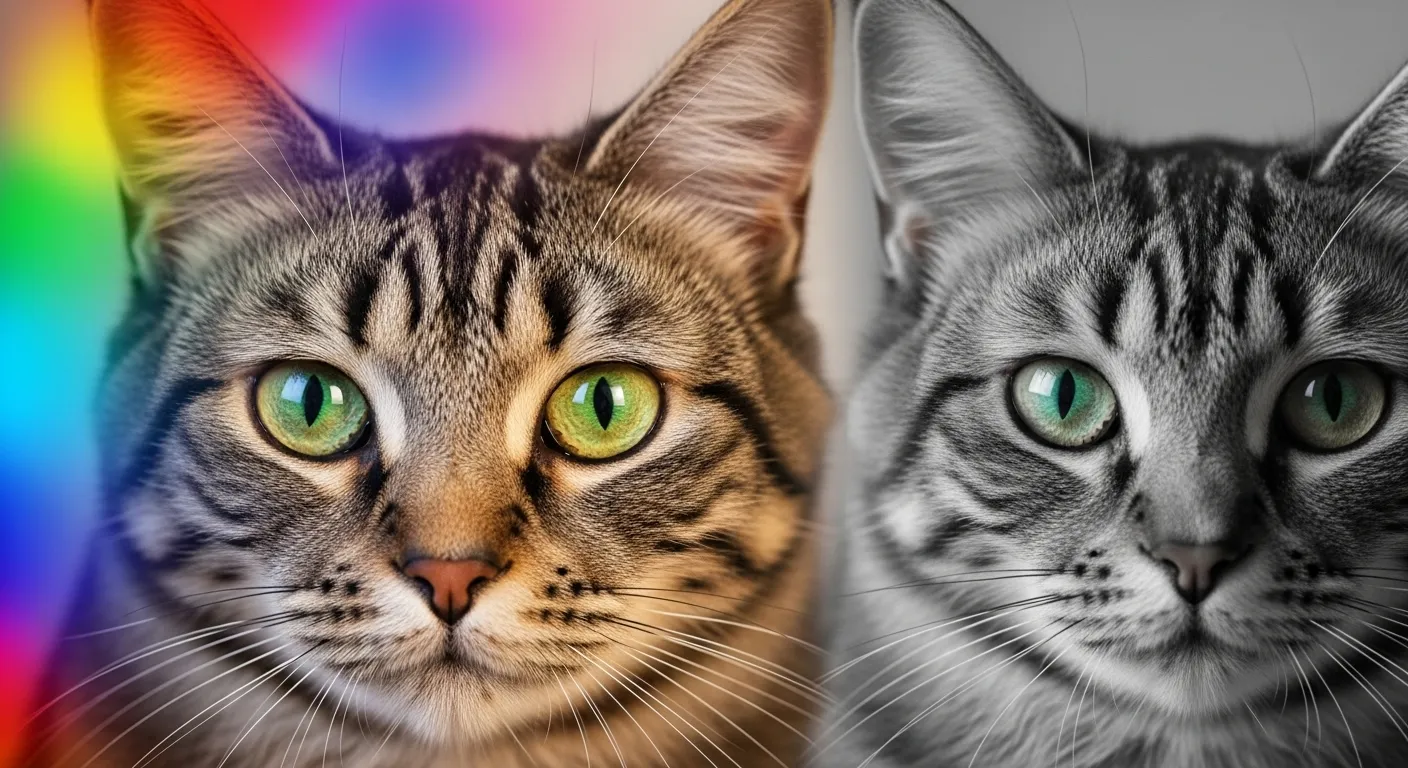
Many cat parents wonder if their furry friends see the world the same way humans do. The short answer is no – cats are not completely color blind, but they don’t see colors the way we do either. Cats are not completely color blind, and they probably see colors similar to a human with red-green color blindness.
Let’s break down exactly what your cat can see and how it affects their daily life.
Understanding How Cat Vision Works
The Science Behind Color Vision
Both humans and cats use special cells called cones to detect colors. These cone photoreceptors sit in the retina and contain photopigments that respond to different wavelengths of light.
Humans have three types of cones that detect:
- Red light
- Green light
- Blue light
Cats are actually the closest to people, with three populations of cone photopigments, just like we have. The main difference in color perception between people and cats is in the number of cones they have compared to us. Humans reportedly have 10 times as many cones as cats do
What Makes Cat Vision Different
Cats have far fewer cone cells than humans. This means they can still see colors, but not as many or as vividly as we can. Think of it like having a dimmer switch on a rainbow.

What Colors Can Cats Actually See?
Colors Cats See Best
The colors that they can see best are blues, greens, and yellows. Cats can see green, blue, and grey colors.
- Blue: Cats see blues clearly and vividly
- Green: Different shades of green appear distinct to cats
- Yellow: Some research suggests cats can distinguish yellow tones
- Gray: Cats excel at seeing various shades of gray
Colors Cats Struggle With
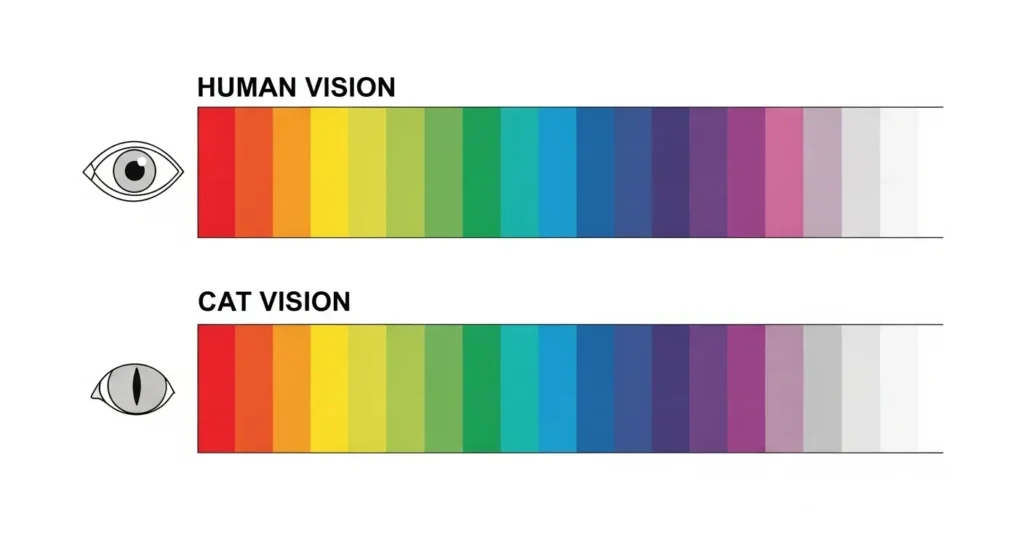
Cats can’t see orange, red, and brown. Meanwhile red and green appear to them as shades of grey, like for people who are red-green colourblind.
- Red: Appears as dark gray or green
- Pink: Looks grayish to cats
- Purple: Cats likely see this as blue
- Orange: Appears as a dull yellow or brown shade
How Cat Vision Compares to Human Vision
Night Vision Superiority
While cats might not win the color contest, they excel in other areas. Cats have many more rod cells in their retinas than humans. Rods help detect:
- Motion
- Light in dark conditions
- Shapes and shadows
This is why your cat can spot a tiny mouse moving across a dark room while you’re still squinting.
Visual Acuity Differences
Cats are naturally nearsighted. Objects that appear sharp to us at 20 feet look blurry to cats until they’re about 6 feet away. But this trade-off helps them focus on nearby prey and movement.
Why Did Cats Develop This Type of Vision?
Evolutionary Advantages
In the wild, cats don’t need to see bright colors as much as they need to detect motion and see in low-light conditions. Their eyes are still adapted to hunting in arid desert areas with little color variation.
Cats evolved from desert hunters who needed to:
- Track moving prey at dawn and dusk
- See in low light conditions
- Detect subtle movements in sandy, neutral-colored environments
Bright color vision wasn’t as important as motion detection and night vision for survival.
Practical Implications for Cat Parents
Choosing the Right Toys
Cats will most likely be attracted to toys in blues and yellows. Red, pink, and purple toys are least likely to catch their attention.
When shopping for cat toys, consider:
- Best choices: Blue, green, and yellow toys
- Less effective: Red, pink, or purple toys
- Most important: Movement and texture matter more than color

Food and Water Bowl Colors
Consider using blue or green bowls, as cats can see these colors clearly. This might help them locate their food and water more easily.
Understanding Your Cat’s Behavior
Your cat’s vision affects how they:
- React to new objects in the house
- Play with different colored toys
- Navigate spaces in low light
- Respond to visual cues during training
Common Myths About Cat Vision
Myth 1: Cats Only See in Black and White
Truth: Although they can’t appreciate the full spectrum and the vast variety of shades that we humans can, their world isn’t black and white like many previously believed.
Myth 2: Cats Are Completely Color Blind
Truth: Cats can distinguish between several colors, just not as many as humans.
Myth 3: Color Vision Doesn’t Matter to Cats
Truth: While not crucial for survival, color vision does affect how cats interact with their environment and toys.
When to Worry About Your Cat’s Vision
Normal vs. Concerning Signs
Normal behavior:
- Being more active at dawn and dusk
- Having excellent hearing to compensate for vision limitations
- Relying on whiskers and scent for close-up navigation
Signs to watch for:
- Bumping into furniture they know well
- Hesitation when jumping to familiar places
- Changes in behavior around food or litter boxes
- Cloudiness in the eyes
If you notice vision problems, use our pet symptom checker and consult with your veterinarian.
How This Knowledge Helps You Care for Your Cat
Creating a Cat-Friendly Environment
Understanding your cat’s vision helps you:
- Choose toys they’ll actually notice and enjoy
- Set up feeding stations they can easily locate
- Create safe spaces with good contrast for navigation
- Understand why your cat might ignore certain colored objects
Training and Interaction Tips
When training your cat or getting their attention:
- Use toys in colors they can see well
- Rely on movement rather than color to catch their interest
- Remember that texture, sound, and smell matter more than appearance
- Be patient if they don’t respond to red laser pointers as strongly
For more guidance on cat behavior and training, check out our guide on how to discipline a cat using positive methods.
Frequently Asked Questions
Can cats see in complete darkness?
No, cats need some light to see. However, they can see in light levels six times lower than what humans need.
Do all cats have the same color vision?
Most cats have similar color vision, but individual variations can exist. Some cats might see colors slightly differently due to genetics.
Will my cat be happier with colorful toys?
What matters, though, is if your cat enjoys playing with toys or not! The movements and smells of their toys will attract them more than the colors. Focus on interactive toys that move and have interesting textures.
Can cats see TV screens clearly?
Cats can see TV screens, but the images might look different due to their color vision and how screens refresh. They’re more likely to notice movement on screen than static images.
The Bottom Line on Cat Color Vision
Your cat’s vision might be different from yours, but it’s perfectly designed for their needs. While they can’t appreciate a vibrant sunset or your carefully chosen home decor colors, they excel at the visual tasks that matter most to them: hunting, navigating in low light, and detecting movement.
Understanding how your cat sees the world helps you make better choices for their toys, environment, and care. Remember that a cat’s other senses – hearing, smell, and touch through their whiskers – more than make up for any color vision limitations.
For more insights about your feline friend’s unique traits, explore our articles on what cats can and cannot eat safely and understanding other cat behaviors.
Always consult with your veterinarian if you have concerns about your cat’s vision or eye health. Use our pet age calculator to understand your cat’s life stage and corresponding vision changes.