

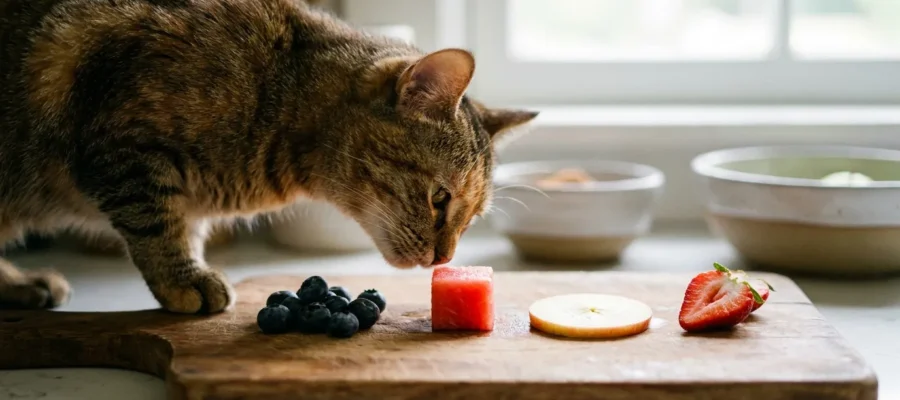
Cats are obligate carnivores. Their bodies run on animal protein, not plant sugars. But that doesn’t stop them from sniffing your fruit bowl — or stop cat owners from wondering whether sharing a bite is actually okay.
The short answer: some fruits are safe for cats in small amounts. Others can cause kidney failure even in tiny quantities. This guide covers the complete safe list, the toxic list with the specific compounds responsible, exact serving sizes, and what to do if your cat eats something it shouldn’t.
Can Cats Eat Fruit?
Yes — but with clear conditions.
Cats’ digestive systems evolved entirely around animal protein and fat. They can’t efficiently convert plant-based nutrients into usable forms. Fruit doesn’t supply taurine, arachidonic acid, or preformed Vitamin A — the nutrients cats genuinely depend on. What’s in fruit that cats need? Almost nothing that a complete cat food doesn’t already provide.
Why Cats Don’t Need Fruit
Fruit offers cats very little of actual value. The vitamins in berries or apples? Cat food already covers those. The fiber? Cats process it poorly. The natural sugars? They’re unnecessary calories that feline metabolisms weren’t designed to handle.
This matters especially for cats with existing health conditions. Diabetic cats, cats with chronic kidney disease, and overweight cats should avoid fruit entirely. High sugar content can spike blood glucose, and fruits high in potassium — like bananas — can put extra strain on compromised kidneys.
Why Some Cats Still Show Interest
Here’s the part most owners don’t expect: cats lack a functional Tas1r2 gene — the gene responsible for sweet taste perception in mammals. They literally cannot taste sweetness. When your cat paws at your watermelon, it isn’t craving the sugar. It’s responding to moisture, texture, smell, or plain curiosity.
That curiosity isn’t a nutritional signal. It’s the same instinct that makes cats investigate a plastic bag.
Fruits Cats Can Eat — Safe Options With Serving Sizes
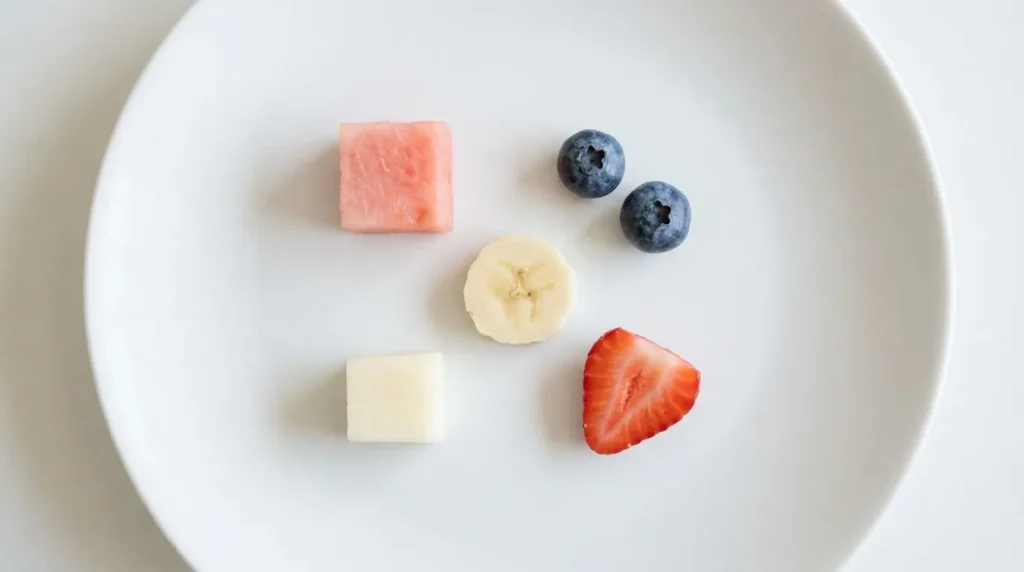
These fruits are non-toxic when properly prepared. “Safe” does not mean unlimited. Every fruit on this list comes with a serving cap.
| Fruit | Safe Part | Max Serving | Frequency |
|---|---|---|---|
| Apple | Flesh only, no seeds/core | 1–2 small cubes | Once or twice a week |
| Blueberries | Whole berry | 2–3 berries | A few times a week |
| Watermelon | Seedless flesh, no rind | 1–2 small cubes | Occasional |
| Strawberry | Flesh only, no stem or leaves | 1 small slice | Occasional |
| Banana | Flesh only | 1 thin slice | Once a week max |
| Pineapple | Inner yellow flesh only | Quarter-sized piece | Every 2 weeks |
| Mango | Peeled flesh, no pit | 1–2 small cubes | Occasional |
| Pear | Flesh only, no seeds or core | 1–2 small cubes | Occasional |
| Peach | Flesh only, no pit, no fuzzy skin | Fingertip-sized piece | Rare |
| Cantaloupe | Flesh only, no rind or seeds | 1 small cube | Occasional |
| Kiwi | Peeled flesh only | Fingernail-sized piece | Rare |
| Dragon Fruit | Inner flesh only, peeled | 1 small cube | Rare |
Apples
Apple flesh is safe. Apple seeds are not — they contain cyanogenic glycosides, which the body converts into cyanide. Always remove the core, seeds, and stem completely before serving. Cut the flesh into small cubes, no bigger than a thumbnail, and limit it to 1–2 pieces per serving. For a complete breakdown, see the apple safety guide for cats.
Blueberries
One of the safest fruits for cats. Small, low choking risk, and a solid source of antioxidants. Two to three berries at a time is a reasonable treat. They rarely trigger digestive issues, but if your cat develops soft stool or reduced appetite afterward, cut them out. Read more about feeding cats blueberries safely.
Watermelon
Watermelon is roughly 90% water — genuinely useful for cats that don’t drink enough from their bowl. Always remove the seeds and the rind before serving. Seedless varieties are the safest choice. One to two small cubes is the right amount. Our full cat watermelon guide covers portion sizes and prep in detail.
Strawberries, Bananas, and Other Safe Fruits
Strawberries are non-toxic but higher in sugar than most berries — one small slice is enough. Bananas are safe but carb-heavy; a thin slice the size of a fingernail is plenty, and they should be avoided for overweight cats entirely. Pineapple, mango, pear, peach, cantaloupe, kiwi, and dragon fruit are all safe in very small amounts when fully peeled and pit-free. Peach pits contain cyanogenic glycosides (the same family as apple seeds), so complete removal is non-negotiable before offering any piece.
Fruits Cats Must Never Eat
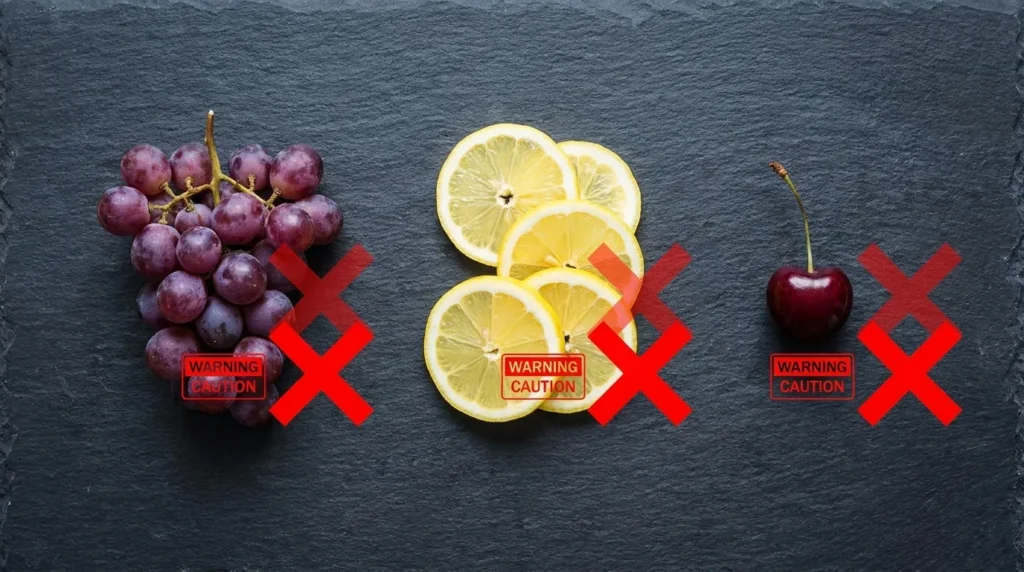
Some fruits aren’t just unhealthy — they cause serious, fast-moving medical harm.
| Fruit | Toxic Compound | Risk |
|---|---|---|
| Grapes & Raisins | Tartaric acid | Acute kidney failure |
| Citrus (lemons, limes, oranges, grapefruit) | Psoralen, essential oils | GI distress, neurological effects |
| Cherries | Cyanogenic glycosides (pits, stems, leaves) | Cyanide poisoning |
| Avocado | Persin | Vomiting, diarrhea, myocardial stress |
| Unripe tomatoes & tomato plant parts | Solanine | GI toxicity, neurological symptoms |
Grapes & Raisins — Tartaric Acid and Kidney Failure
The most dangerous fruit for cats on this list. Grapes and raisins contain tartaric acid, and even a single grape has triggered acute kidney failure in some cats. There is no established safe dose relative to body weight. If your cat eats even one grape, call your vet immediately. Do not wait for symptoms — kidney damage begins before external signs appear. Read the full guide to cats and grapes for the complete toxicity breakdown.
Citrus Fruits — Psoralen and Essential Oils
Lemons, limes, oranges, and grapefruit contain psoralen compounds and essential oils that are harmful to feline systems. Even the peel in small quantities can cause drooling, vomiting, and in higher exposures, neurological symptoms. Cats also strongly dislike the smell of citrus — it’s widely used as a natural cat repellent, which is a good signal about how their bodies respond to it.
Cherries — Cyanogenic Glycosides
Ripe cherry flesh is not acutely toxic, but no part of a cherry is worth the risk. Pits, stems, and leaves all contain cyanogenic glycosides. Cherry pits are also a choking hazard for cats. Avoid entirely.
Avocado — Persin Toxicity
Avocado contains persin, a fungicidal toxin that causes vomiting, diarrhea, and cardiovascular stress at higher doses. The flesh carries lower persin concentrations than the skin or pit, but none of it offers any benefit to a cat, and the risk profile makes it not worth testing. See the complete guide to cats and avocado for more.
Unripe Tomatoes and Tomato Plants
Ripe tomato flesh is generally tolerated in very small amounts by healthy adult cats. Unripe tomatoes and all green plant parts — leaves, stems, the calyx — contain solanine, which is toxic to cats. If you grow tomatoes at home, keep cats away from the plant itself, not just the fruit.
How to Prepare Fruit Safely for Your Cat
Step-by-Step Prep
- Wash thoroughly — remove pesticide residue and surface bacteria
- Remove all seeds, pits, stems, and leaves
- Peel fruits with tough or irritating skins (kiwi, mango, peach, dragon fruit)
- Cut into small pieces — no larger than a pea for smaller cats, thumbnail-sized for larger breeds
- Serve plain — no added sugar, honey, syrup, or artificial sweeteners of any kind
Fresh vs. Frozen vs. Canned
Fresh is the best option. No additives, easy to control portion size, and full texture.
Frozen works for berries — blueberries and strawberries are fine frozen. Thaw slightly first to reduce choking risk and avoid a cold shock to the mouth.
Canned is generally not recommended. Canned fruit in syrup contains concentrated sugar or artificial sweeteners. If you do use canned, it must be packed in water only — with no additives — and rinsed before serving.
What to Never Give Your Cat
- Fruit juice — concentrated sugar, no fiber, no benefit
- Dried fruit — higher sugar density per gram than fresh fruit; raisins are often mixed in
- Fruit snacks, gummies, or fruit roll-ups — loaded with corn syrup, artificial colors, and sometimes xylitol, which is toxic
- Yogurt with fruit — most adult cats are lactose intolerant; the combination of dairy and fruit sugars doubles the digestive stress
How Much Fruit Can a Cat Eat?
The 10% Treat Rule
Treats — including fruit — should make up no more than 10% of a cat’s daily calorie intake. The average healthy adult cat needs around 200–250 calories per day. That puts the treat budget at 20–25 calories max. Most small fruit cubes clock in at 2–5 calories each, so you’re looking at roughly 4–8 small pieces across all treats for the day — not just fruit.
Use the cat calorie calculator to get a precise daily calorie target based on your cat’s weight, age, and activity level. For broader feeding guidance including wet food amounts, how much wet food to feed your cat covers daily portions by weight and life stage.
Cats That Should Skip Fruit Entirely
- Diabetic cats — any natural fruit sugar can destabilize blood glucose control
- Cats with chronic kidney disease (CKD) — high potassium in bananas and some melons puts extra strain on compromised kidneys
- Kittens — their digestive systems are still developing and require high-protein, meat-based nutrition; skip fruit entirely until 12 months
- Overweight cats — fruit adds unnecessary carbohydrate calories with no protein payoff
If your cat has any underlying health condition, check with your vet before adding any new food. You can also run a quick check using the pet food safety checker to verify whether a specific food is appropriate for your cat’s profile.
What to Do If Your Cat Eats a Toxic Fruit
Symptoms by Toxin Type
| Toxin | Symptoms to Watch For | Onset Timeline |
|---|---|---|
| Tartaric acid (grapes/raisins) | Vomiting, lethargy, reduced urination, kidney pain | 24–72 hours |
| Solanine (unripe tomato/plant) | Drooling, dilated pupils, tremors, GI upset | Within hours |
| Cyanogenic glycosides (cherry pits, apple seeds) | Rapid breathing, bright red gums, shock | Minutes to hours |
| Persin (avocado) | Vomiting, diarrhea, labored breathing | 12–24 hours |
| Psoralen (citrus) | Drooling, vomiting, photosensitivity | Within hours |
When to Call — Thresholds and Emergency Contacts
Grapes and raisins: Call your vet immediately after any ingestion. There is no established safe threshold. Kidney damage can begin before symptoms appear.
Citrus, unripe tomato, or avocado: If the amount was more than a lick or accidental taste, contact your vet.
Cherry pits, apple seeds, or other cyanide-containing parts: Any quantity warrants immediate contact — don’t wait to see how your cat reacts.
Emergency Contacts:
- Pet Poison Helpline: 855-764-7661 (fee applies)
- ASPCA Animal Poison Control: 888-426-4435 (fee applies)
- Your nearest emergency veterinary clinic
If you’re unsure whether your cat’s symptoms warrant an emergency visit, the pet symptom checker can help you assess urgency. That said, if toxicity is suspected, always follow up with a vet directly rather than waiting for a symptom pattern to confirm.
Frequently Asked Questions
Can kittens eat fruit?
No. Kittens need high-protein, meat-based nutrition while their bodies are developing. Their digestive systems can’t handle plant sugars efficiently, and calories spent on fruit are better used by protein. Wait until your cat is at least 12 months old before considering fruit as an occasional treat — and even then, only in the tiny amounts described above.
Can cats eat dried fruit?
No. Dried fruit is sugar-dense, much higher in calories per gram than fresh fruit, and frequently mixed with raisins. Even “safe” dried fruits like dried mango or dried banana can cause digestive upset and unnecessary blood sugar spikes. Always use fresh.
Can cats eat fruit snacks, juice, or processed fruit products?
No. Processed fruit products contain added sugars, artificial colors, corn syrup, and often artificial sweeteners. Some fruit snacks contain xylitol. Fruit juice removes all the fiber and concentrates the sugar — there is no version of it that benefits a cat in any way.
Can cats taste sweetness?
No. The Tas1r2 gene — responsible for detecting sugar in most mammals — is a pseudogene in cats. It exists in their genome but it doesn’t function. When a cat shows interest in fruit, it’s responding to texture, moisture content, or scent — not sweetness. This is also why cats won’t binge-eat sweet foods the way dogs sometimes do.
Final Takeaway
Blueberries, watermelon, apple flesh, strawberries — safe in small amounts with the right prep. None of them are necessary. A complete meat-based diet already covers everything a cat needs nutritionally.
Grapes, raisins, and citrus are the hard stops. Keep them away entirely. And if your cat gets into something toxic — especially grapes — act immediately rather than waiting to see symptoms develop.
If you want to reward your cat with something beyond their regular meals, cooked plain chicken is a far better fit for their biology than any fruit in the bowl.