
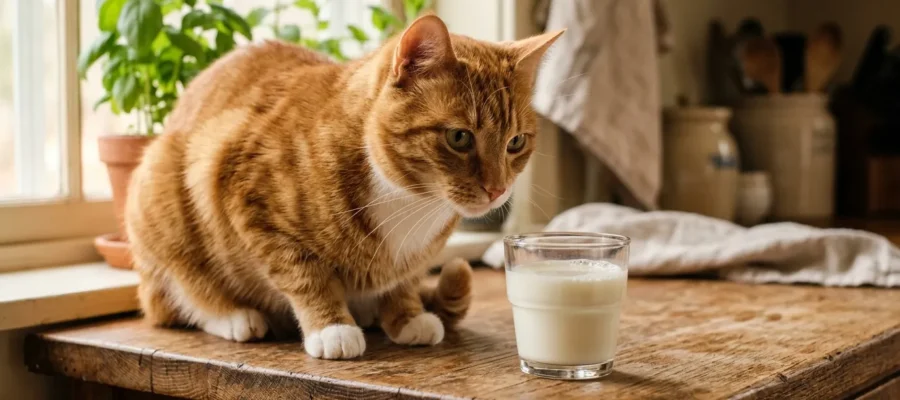
Most cats should not drink milk. Despite the classic image of a cat lapping from a saucer, cow’s milk causes digestive problems in the majority of adult cats — and the science behind it is straightforward. Here’s what actually happens inside your cat’s body when they drink dairy, which milk types are safer than others, and what to do if your cat already got into the carton.
The Short Answer: No, Most Cats Should Not Have Milk
Cow’s milk is not safe for most adult cats. It contains lactose — a sugar their digestive systems can no longer break down properly — and drinking it commonly causes diarrhea, bloating, and stomach pain.
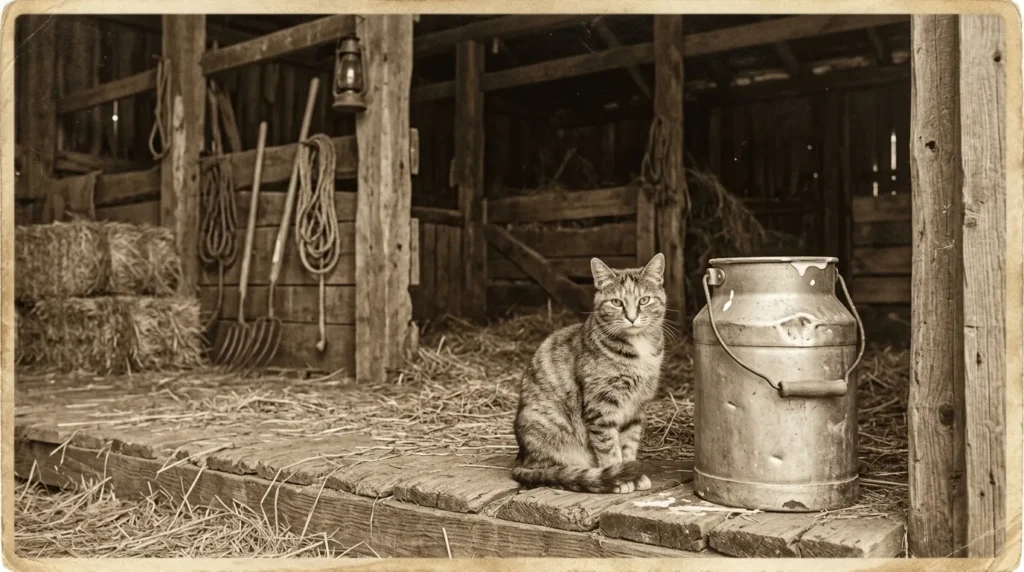
The stereotype comes from barn cats of the past, who hung around dairy farms and drank spilled milk. That doesn’t mean it was good for them. It just means cats find the smell of fat and protein in milk attractive. Attraction and tolerance are two different things.
Why Are Cats Lactose Intolerant?
What Lactose Is and Why It Matters
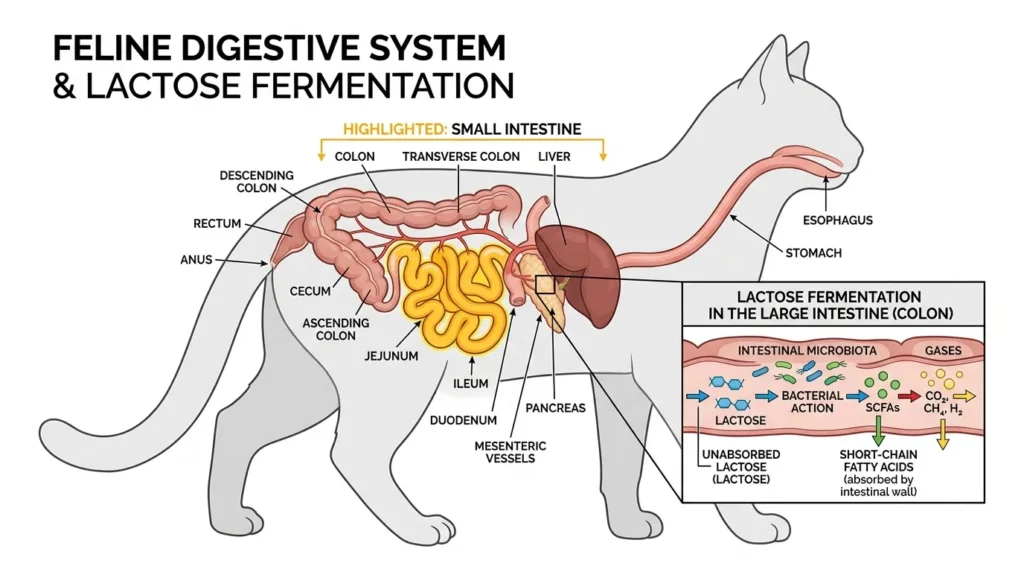
Lactose is the primary sugar found in all mammal milk — cow, goat, human, and cat. It’s a disaccharide, meaning it’s made of two smaller sugars bonded together: glucose and galactose. The body needs to split that bond before it can absorb either sugar. Without that split, lactose passes into the large intestine undigested.
That’s where the trouble starts.
Bacteria in the large intestine ferment the undigested lactose. That fermentation produces gas and draws water into the gut. The result: bloating, cramping, loose stools, and diarrhea. If your cat is already showing GI issues for other reasons, our Pet Symptom Checker can help you identify what might be going on before your vet visit.
The Lactase Enzyme — And What Happens When It’s Gone
The enzyme responsible for splitting lactose is called lactase. It’s produced in the lining of the small intestine. When lactase levels are adequate, lactose gets broken down and absorbed before it ever reaches the large intestine. No fermentation. No symptoms.
The problem is that lactase production drops sharply in most mammals after infancy — including cats. This is called post-weaning lactase decline, and it’s completely normal from a biological standpoint. Mammals are designed to drink milk only when young. Once they move to solid food, the body dials back lactase production because it’s no longer needed.
Most adult cats produce little to no lactase. Some produce a small amount and can tolerate tiny quantities of dairy without obvious symptoms. But the majority cannot digest milk properly, and you often won’t know which kind of cat you have until they’ve already eaten it.
Weaning at 4–6 Weeks Changes Everything
Kittens are born with high lactase production. They need it — mother’s milk is their only food source for the first few weeks of life. Around 4 to 6 weeks of age, kittens naturally begin to wean. Solid food replaces milk in the diet, and lactase production starts to fall.
By the time a kitten is fully weaned, their ability to digest lactose has dropped significantly. Most cats carry that lower tolerance into adulthood for the rest of their lives. Curious about where your cat is in their development? Our Pet Age Calculator can help you understand your cat’s life stage in human-equivalent years.
Symptoms of Lactose Intolerance in Cats
If your cat drinks milk and is lactose intolerant, symptoms typically show up within 8 to 12 hours. In some cats, the reaction comes faster — within 2 to 4 hours of drinking.
Watch for:
- Diarrhea — the most common symptom, often loose or watery
- Vomiting — can occur alongside or independently of diarrhea
- Bloating — visible or palpable abdominal swelling
- Excessive gas — flatulence or audible gut sounds
- Stomach cramping — shown by hunching, reluctance to move, or sensitivity when touching the abdomen
- Lethargy — general tiredness from fluid loss and GI discomfort
If vomiting is a recurring issue — not just after milk — it’s worth reading more about why cats keep throwing up to rule out other causes.
The Casein Problem — Separate From Lactose
Here’s something most articles skip: lactose isn’t the only issue with cow’s milk for cats.
Casein is the main protein in cow’s milk, making up roughly 80% of its protein content. Some cats develop an immune response to casein — not a digestive intolerance, but a true allergic reaction. Symptoms include skin itching, hives, redness, or hair loss in addition to GI problems.
This matters because lactose-free milk still contains casein. A cat who reacts to casein will still have problems with lactose-free dairy products. If your cat shows skin symptoms after drinking any type of cow’s milk, the issue may be casein allergy rather than — or in addition to — lactose intolerance. A vet can help distinguish between the two.
What About Different Types of Milk?
Not all milk is the same, and some options carry less risk than others. Before giving your cat any new food or drink, it’s smart to run it through our Pet Food Safety Checker for a quick safety read. Here’s how the common milk types stack up.
Cow’s Milk (Whole and Skim)
Neither whole nor skim cow’s milk is recommended for cats. Both contain significant lactose. Whole milk adds a high fat load — around 60 calories per 100ml — which matters in a cat that only needs roughly 200–250 calories per day. Even occasional servings contribute meaningfully to excess calorie intake and weight gain over time. Skim milk has less fat but the same lactose content as whole milk.
Lactose-Free Milk
Lactose-free cow’s milk has the lactose pre-broken down using added lactase enzyme. It’s safer for lactose-intolerant cats, but it still contains casein and cow’s milk proteins. Cats with casein sensitivity will still react. It’s also higher in natural sugars than water, so it shouldn’t replace water as the primary drink. Treat it as an occasional, small-quantity option only — and only if your cat shows no casein sensitivity.
Goat Milk
Goat milk has roughly 20–30% less lactose than cow’s milk, making it easier for many cats to digest. It also contains oligosaccharides — compounds with prebiotic effects that support healthy gut bacteria and reduce gastrointestinal inflammation. Some integrative vets recommend small amounts of raw goat milk as a supplemental option for cats with digestive issues.
That said, goat milk still contains lactose. Sensitive cats will still react. Treat it as a lower-risk option, not a free pass.
Soy Milk
Avoid soy milk for cats. Cats are obligate carnivores. Their digestive systems are not equipped to handle plant-based proteins or the complex carbohydrates found in soy. Soy also contains phytoestrogens — plant compounds that mimic estrogen — which may disrupt hormone balance in cats with regular exposure. Some cats are also outright allergic to soy proteins.
Almond and Oat Milk
Plain, unsweetened almond milk or oat milk in very small amounts is unlikely to be toxic. But neither offers any benefit to cats, and both carry risks. Many commercial versions contain added sugars, artificial sweeteners (xylitol in particular is dangerous), or flavorings. Oat milk contains carbohydrates that cats have no nutritional need for. Neither should be given intentionally.
Always check the label for xylitol before letting a cat have any non-dairy milk product. Xylitol is toxic to many pets — don’t risk it.
Cat-Specific Milk Products
The safest dairy-adjacent option for cats is a product specifically formulated for feline digestion. Cat-Sip is one example — it’s a lactose-free 1% real cow’s milk that includes taurine, an essential amino acid cats cannot synthesize adequately on their own. Products like this are designed to let cats enjoy a milk-like treat without the digestive fallout.
KMR (Kitten Milk Replacer) is a separate product, formulated specifically for orphaned or motherless kittens. It’s not a treat for adult cats — it’s a nutritional substitute for mother’s milk in young kittens who are not yet weaned.
Milk Type Comparison at a Glance
| Milk Type | Lactose Level | Safe for Most Cats? | Notes |
|---|---|---|---|
| Cow’s milk (whole/skim) | High | No | Common cause of GI upset |
| Lactose-free cow’s milk | None | Limited | Still contains casein |
| Goat milk | Lower | Small amounts only | Prebiotic benefits; still has some lactose |
| Soy milk | None | No | Plant proteins; possible hormonal effects |
| Almond milk | None | Not recommended | Check for xylitol; no nutritional value |
| Oat milk | None | Not recommended | High carbs; no benefit for cats |
| Cat-Sip / cat milk | None | Yes (as treat) | Formulated for cats; contains taurine |
| KMR | Low | Kittens only | Not for adult cats |
Can Kittens Drink Cow’s Milk?
No. This is a common mistake.
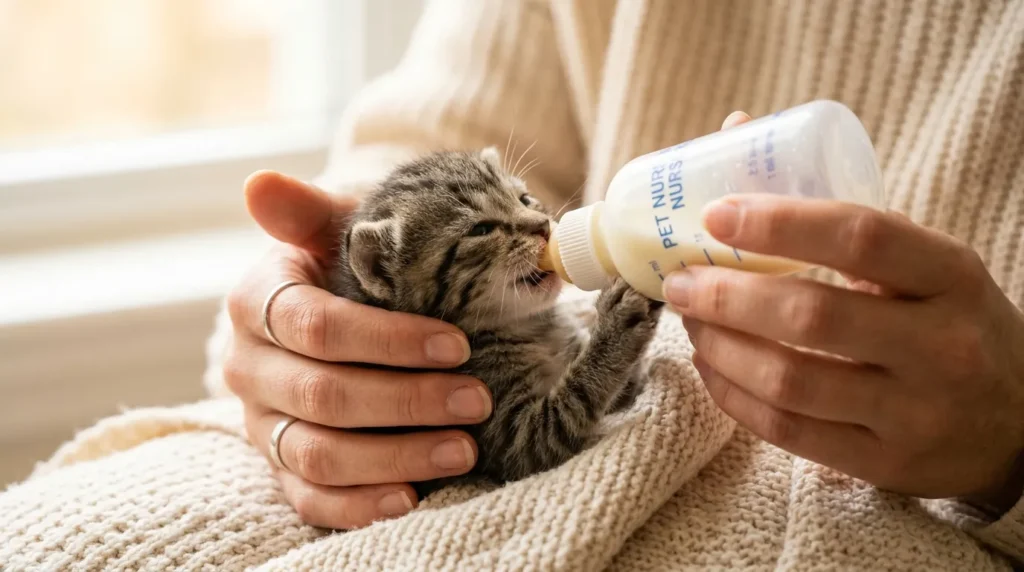
Kittens who are orphaned or separated from their mother need Kitten Milk Replacer (KMR) — not cow’s milk. Cow’s milk has the wrong nutritional profile for kittens. It’s too low in protein, missing critical nutrients like taurine and arachidonic acid, and still contains enough lactose to cause diarrhea in young, vulnerable animals.
A kitten with diarrhea from improper milk can become dehydrated quickly. This is a medical emergency in neonatal cats.
If you find an orphaned kitten, contact a vet or animal rescue immediately. KMR is available at most pet stores and provides the correct balance of proteins, fats, and nutrients a developing kitten requires. Understanding how long cats are pregnant and what to expect in the early weeks can help you prepare for kitten care from the start.
Mother’s milk from the kitten’s own mother is always the gold standard. If that’s not available, KMR is the only appropriate substitute.
My Cat Just Drank Milk — What Should I Do?
Don’t panic. A small amount of milk — a tablespoon or two — is unlikely to cause serious harm in most cats. Here’s how to handle it:
- Note how much they drank. A few laps is different from half a cup. The more they drank, the higher the risk of significant symptoms.
- Watch for symptoms over the next 8–12 hours. Diarrhea and vomiting are the most likely signs.
- Make sure fresh water is available. Diarrhea causes fluid loss. Hydration matters.
- Don’t give more dairy. If they seem fine after a small amount, that’s lucky — don’t push it.
- Call your vet if: symptoms are severe, last more than 24 hours, your cat is a kitten, your cat is elderly or has a known health condition, or you notice skin reactions like itching or redness.
Persistent vomiting or diarrhea lasting more than a day warrants a vet call regardless of the cause. If your cat is showing other unusual symptoms alongside GI upset, our Pet Symptom Checker can help you figure out whether a vet visit is urgent.
What Should Cats Drink Instead?
Water is the only drink cats need.
Cats evolved as desert animals and have a naturally low thirst drive. They historically got most of their moisture from prey. This means many cats don’t drink enough water on their own, which can lead to urinary and kidney problems over time.
The best ways to keep your cat well-hydrated:
- Wet food: A diet that includes canned or wet food provides significant moisture — often 70–80% water content — compared to dry kibble at around 10%. See our guide on how much wet food to feed your cat to get the portions right.
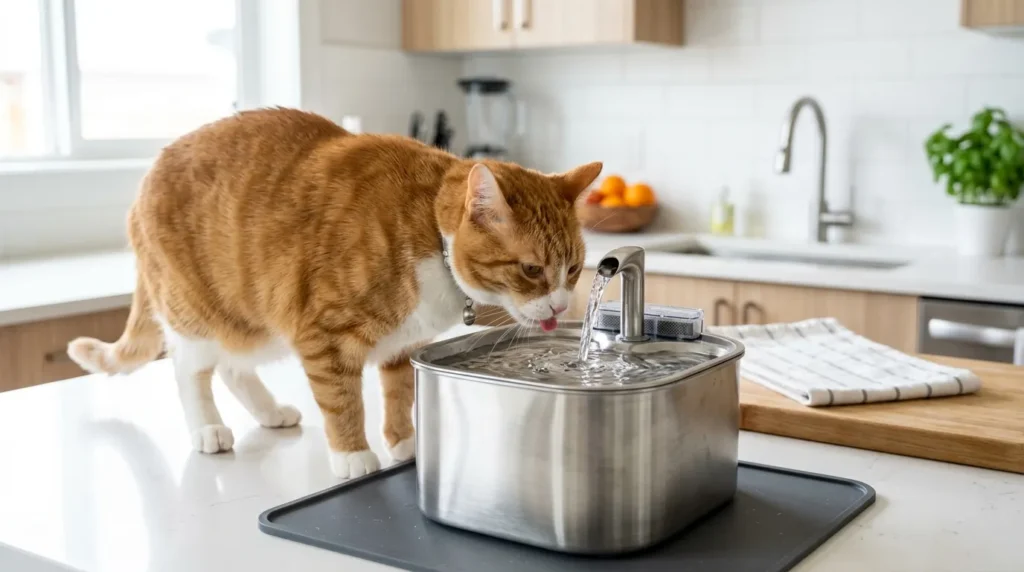
- Running water: Many cats prefer moving water. A cat water fountain encourages more frequent drinking.
- Multiple water stations: Place water bowls in several locations, away from the litter box.
- Flavor water occasionally: A small amount of low-sodium chicken or tuna broth (no onion, no garlic) can make water more appealing without adding harmful ingredients.
Knowing how long cats can go without water puts the stakes in perspective — dehydration in cats happens faster than most owners realize.
If you’re rethinking your cat’s overall diet and want to explore safer food treats, take a look at what fruits cats can eat or whether cats can eat yogurt — another dairy question with a nuanced answer.
Frequently Asked Questions
Can cats have milk as an occasional treat? A very small amount — a teaspoon or less — is unlikely to cause serious harm in cats who aren’t severely lactose intolerant. But there’s no nutritional benefit, and the risk of digestive upset is real. If you want to give a milk-like treat, a cat-specific product like Cat-Sip is a safer choice.
Are all cats lactose intolerant? Most are, but not all. Some cats retain enough lactase enzyme to tolerate small amounts of dairy without obvious symptoms. However, symptom-free doesn’t mean zero impact — even cats that seem fine with milk may experience low-grade digestive disruption over time.
Can cats drink plant-based milk? Generally, no. Plant-based milks offer no benefit to cats and carry risks — from unsuitable proteins to added sweeteners. Plain, unsweetened options are not acutely toxic in tiny amounts, but they shouldn’t be offered intentionally.
Is milk dangerous for cats? In large amounts or with frequent exposure, yes. A serious episode of diarrhea and vomiting can lead to dehydration, especially in kittens, senior cats, or cats with underlying health issues. Occasional small amounts in a healthy adult cat are less likely to cause lasting harm, but it’s still not recommended.
Can cats eat other dairy products like cheese or yogurt? Cheese and yogurt come with their own set of considerations. Check out our full guides on whether cats can eat cheese and whether cats can eat yogurt for complete breakdowns of each.
What do I give an orphaned kitten if I have no KMR? Contact a vet or emergency animal clinic immediately. As a very short-term emergency measure, some vets suggest a diluted goat milk option, but this is a bridge — not a solution. KMR is the only appropriate long-term substitute for mother’s milk. Get it as fast as possible.
The Bottom Line
Cats and milk make a charming image. The biology tells a different story. Most adult cats are lactose intolerant, many are sensitive to the casein protein in cow’s milk, and none of them need dairy to be healthy. Water — and a diet with adequate moisture — is what actually keeps cats thriving.
If your cat loves the smell of milk and begs every time you open the fridge, a cat-specific milk product gives them the taste without the digestive fallout. That’s a reasonable compromise. Regularly pouring them a bowl of cow’s milk is not.
When in doubt about what’s safe for your cat, your vet is the right call — or use our Pet Food Safety Checker for a fast first answer on any ingredient. Nutrition questions that seem minor can have real long-term effects, and a five-minute check can save your cat a lot of discomfort.