
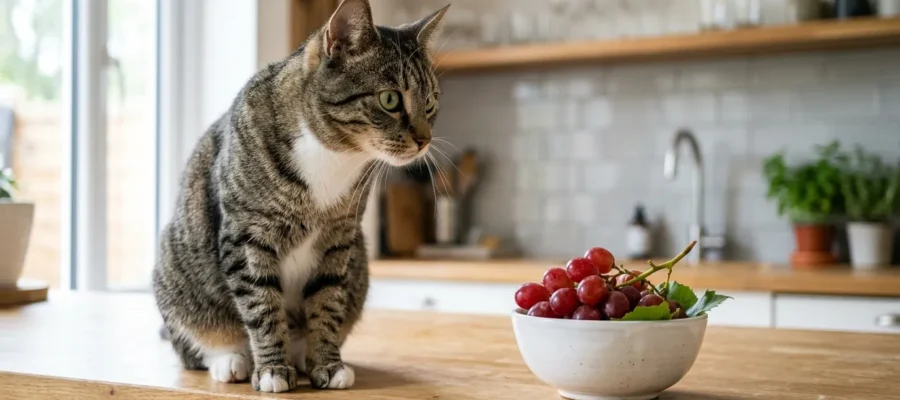
Grapes are sitting on your counter. Your cat is eyeing them. Or maybe your cat already got one, and now you’re searching frantically. Either way, you need a straight answer fast.
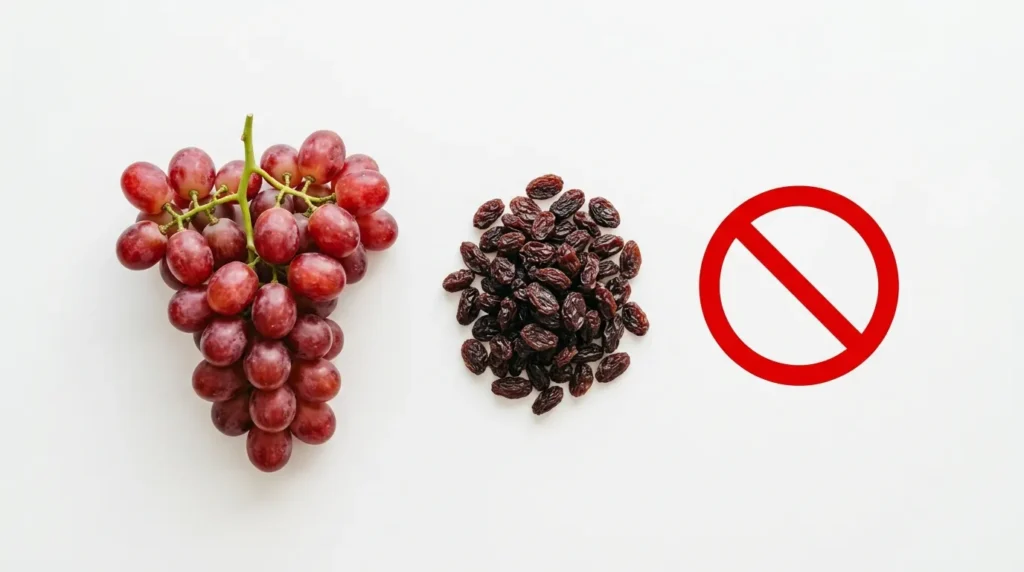
No. Cats cannot eat grapes. Grapes are toxic to cats and can cause sudden kidney failure — sometimes from a single grape.
Here’s everything you need to know, including what to do if your cat already ate one.
Quick Answer
Grapes — and raisins, which are just dried grapes — are dangerous for cats. They have been linked to acute kidney failure in both dogs and cats. The exact toxic compound hasn’t been fully confirmed, but current research points to tartaric acid and its salt, potassium bitartrate.
No amount of grapes is considered safe. There is no established “harmless” dose.
If your cat ate a grape, call a vet right now. Don’t wait for symptoms. If you’re not sure what you’re dealing with, the Pet Food Safety Checker can help you quickly verify whether a food is dangerous for your pet before your next vet call.
Why Are Grapes Toxic to Cats?
Scientists have been studying grape toxicity in pets for years. The full mechanism still isn’t completely understood, but the strongest current evidence points to tartaric acid — the primary organic acid in grapes — and its salt, potassium bitartrate (also known as cream of tartar).
The Tartaric Acid Theory
Tartaric acid is found in high concentrations in grape flesh. It appears to act on the kidneys directly, possibly through an osmotic mechanism that disrupts the filtering cells inside the kidney tubules. When those cells stop working, the kidneys lose their ability to filter waste from the blood. That’s acute renal failure.
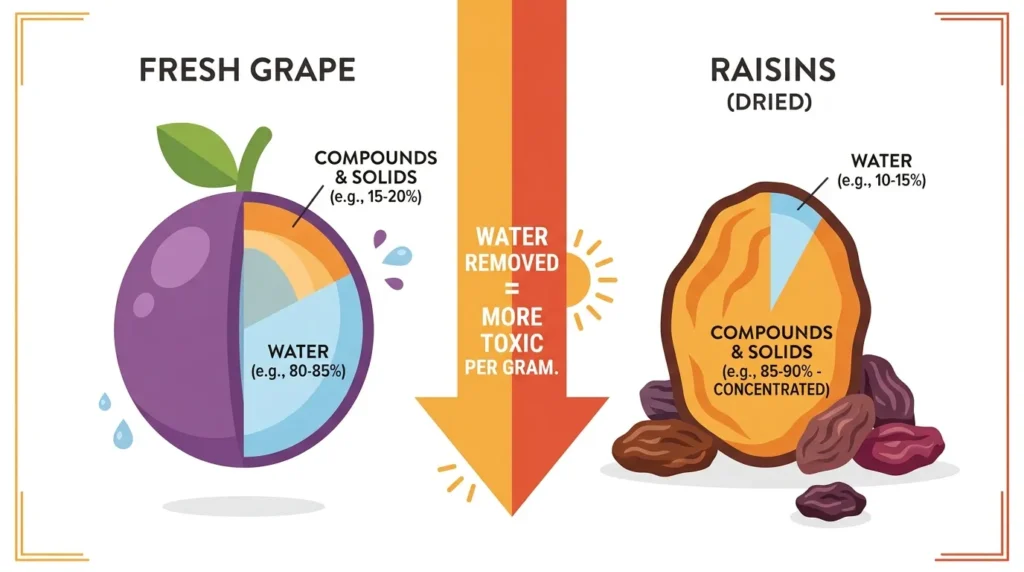
This also explains why raisins are considered more dangerous per gram — dehydrating a grape concentrates all its compounds, including tartaric acid, into a much smaller volume.
The toxin is not in the seeds. Both seedless and seeded grapes have caused poisoning. Organic grapes carry the same risk as conventional ones.
Why Cats Can’t Process It the Way Humans Do
Cats are obligate carnivores. Their digestive systems evolved entirely around animal protein — not fruit. They lack the metabolic pathways to safely process many plant compounds that humans handle without issue.
There’s another piece of biology worth knowing: cats lack the TAS1R2 gene, the gene responsible for detecting sweetness. This means they have no interest in sweet flavors at all. A grape holds no taste appeal to a cat. But cats are curious. They bat things off counters. They chew on items that roll. A grape on the kitchen floor is a toy, not a snack — and that’s exactly how accidental ingestion happens.
If your cat is a known counter-surfer or food thief, it’s worth reading how to keep cats off counters — a habit that directly reduces this kind of risk.
How Many Grapes Are Dangerous?
This is where most articles stay vague. Here are the actual numbers.
Toxic Dose by Cat Weight
The lowest documented amount to cause kidney damage in a pet is 0.7 oz of grapes per 2.2 lbs of body weight. For raisins, that threshold is 0.11 oz per 2.2 lbs.
There are approximately 4 grapes in one ounce, depending on size. There are approximately 60 raisins in one ounce.
| Cat Weight | Potentially Toxic Grape Amount | Potentially Toxic Raisin Amount |
|---|---|---|
| 5 lbs | ~6 grapes | ~15 raisins |
| 8 lbs | ~10 grapes | ~24 raisins |
| 10 lbs | ~12 grapes | ~30 raisins |
| 12 lbs | ~15 grapes | ~36 raisins |
These are minimums. Some cats have shown kidney damage at amounts far lower than these thresholds. Individual sensitivity varies — and veterinarians don’t yet understand why some cats react severely to very small amounts while others don’t.
The safest position is this: any grape eaten by any cat is a reason to call a vet.
Not sure how old or how heavy your cat is? Use the Pet Age Calculator to get a better picture of where your cat is in their life stage, which also matters when assessing health risks.
Are Raisins Even More Dangerous?
Yes. Raisins are concentrated grapes. The same toxic compounds that exist in one fresh grape exist in a much smaller piece of raisin. Per gram, raisins require a smaller amount to hit the toxic threshold.
A single raisin is not automatically safe for a small cat. The math puts a 5-lb cat at risk from as few as 15 raisins — and some pets have developed kidney damage from less.
Signs of Grape Poisoning in Cats
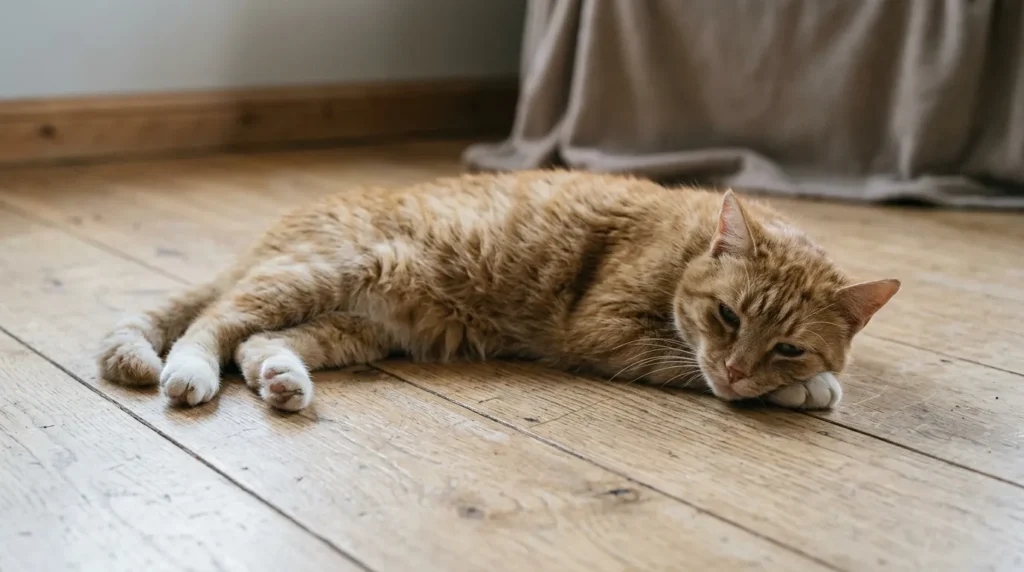
Symptoms can begin within a few hours of ingestion. They progress in two stages.
Hours 1–24: Early Warning Signs
These symptoms typically appear within the first 12–24 hours after a cat eats grapes:
- Vomiting
- Diarrhea
- Lethargy or sudden weakness
- Decreased appetite or complete refusal to eat
- Abdominal pain or discomfort
- Restlessness
At this stage, the body is reacting to the toxic compounds but kidney damage may not yet be permanent. This is the window that matters most.
If any of these signs appear suddenly, use the Pet Symptom Checker to document what you’re seeing before you call your vet — it helps you give clearer information in an emergency.
Hours 24–48: Kidney Failure Signs
If the cat wasn’t treated in the first stage, more severe signs develop as kidney damage progresses:
- Excessive thirst and increased urination (early kidney failure)
- Then, reduced or no urination at all (oliguria — a sign kidneys are shutting down)
- Strong ammonia-like smell from the breath (uremia — waste building up in the blood)
- Significant vomiting that doesn’t stop
- Complete loss of appetite
- Neurological signs: tremors, loss of coordination
- In severe cases: seizures and coma
Why the 12-Hour Window Is Critical
Once kidney damage becomes significant, it is often not fully reversible. The kidneys are made of cells that do not regenerate the way other tissues can. Early treatment — particularly IV fluid therapy that flushes the kidneys before damage sets in — can prevent permanent injury. After 24–48 hours of untreated toxin exposure, vets are managing damage that already happened, not preventing it.
Acting within the first 12 hours gives your cat the best chance of full recovery.
Persistent vomiting after any toxic exposure is a serious sign. If your cat keeps vomiting, read more about why cats keep throwing up to understand when it crosses from mild to medically urgent.
My Cat Ate a Grape — Do This Right Now
Emergency Contacts
📞 Your primary vet — Call immediately, even outside business hours for an emergency line.
📞 Pet Poison Helpline — (855) 764-7661 (fee applies)
📞 ASPCA Animal Poison Control Center — (888) 426-4435 (fee applies)
📞 Nearest emergency veterinary hospital — If you can’t reach anyone, go directly.
Step-by-Step Response
- Stay calm. Panicking delays action.
- Note how many grapes your cat may have eaten and when.
- Call your vet or an emergency line immediately — even if your cat seems completely fine.
- Follow the vet’s instructions exactly. They may ask you to bring your cat in or monitor closely at home.
- If your cat is already vomiting, lethargic, or showing any symptoms — don’t wait. Go to an emergency vet now.
Do Not Induce Vomiting Without Vet Instruction
This is important. Inducing vomiting in cats is far more dangerous than it is in dogs. Cats can aspirate vomit into their lungs. Certain methods safe for dogs can injure or kill a cat. Never attempt to make your cat vomit unless a veterinarian has specifically told you to and told you how.
This is different from dogs, where some emergency vomiting guidance exists. Even for dogs, the guidance is strict — you can review how to make a dog throw up safely to understand how different the protocols are between species. For cats, the rule is simple: don’t do it without a vet.
How Vets Treat Grape Toxicity in Cats
Treatment depends on how soon after ingestion the cat arrives, and whether kidney damage has already started.
Decontamination
If the cat arrives within a short window of eating grapes, the vet will attempt to reduce how much toxin the body absorbs. This typically involves inducing vomiting under controlled clinical conditions, followed by administering activated charcoal — a binding agent that attaches to remaining toxins in the gastrointestinal tract and prevents them from entering the bloodstream.
IV Fluids and Kidney Protection
The core treatment for grape toxicity is aggressive IV fluid therapy. High volumes of fluid are administered directly into the bloodstream to dilute the toxin, support kidney function, and maintain urine output. High urine flow helps flush the kidneys before damage can accumulate.
Vets will check blood values — creatinine, BUN, electrolytes — repeatedly throughout treatment to track whether the kidneys are being affected.
How Long Will My Cat Be Hospitalized?
If the kidneys show no signs of damage, many cats can go home after 24–36 hours of IV fluid support. If kidney damage is detected, hospitalization is longer. Some cats require ongoing kidney-support medications at home after discharge. In severe cases where kidney failure is extensive, the outcome may be poor regardless of treatment.
The faster a cat is treated, the better the odds. This is not a situation where watchful waiting is safe.
All Grape Types and Products Are Off-Limits
There is no grape variety that has been shown to be safe for cats.
Every Color, Seedless or Not
- Red, green, black, purple, cotton candy, muscat — all dangerous
- Seedless grapes: still toxic (the toxin is not in the seed)
- Organic grapes: still toxic (the toxin is naturally present in the fruit)
- Cooked grapes: still toxic — heat does not neutralize tartaric acid
- Frozen grapes: still toxic
Hidden Grape Sources in Human Food
Many everyday foods contain grapes or raisins in forms that aren’t obvious. Keep your cat away from:
- Raisins and currants (dried grapes — more concentrated toxin)
- Raisin bread and bagels
- Fruitcake and holiday cookies
- Trail mix containing raisins
- Grape juice and grape-flavored drinks
- Wine (also contains ethanol, a second toxin)
- Balsamic vinegar (made from grapes)
- Fruit cake, mince pies, and scones with currants
- Any baked goods or cereals that list raisins or currants in the ingredients
The holiday season is the highest-risk period. Raisin-containing foods appear on tables, counters, and in grocery bags during Thanksgiving, Christmas, and New Year.
Grapes aren’t the only plant-based danger in a typical home. Certain common flowers are also toxic. Tulips are toxic to cats and so are pothos plants — if you’re cat-proofing your home, those are worth reviewing too. You might also want to check whether your houseplants are safe while you’re doing a full safety audit.
How to Keep Grapes Away From Your Cat
A few simple habits eliminate most of the risk:
- Store grapes in the refrigerator — not in a fruit bowl on the counter
- Keep raisins and currants in sealed, cat-proof containers
- Never leave grocery bags unattended after shopping — cats investigate quickly
- Pick up any dropped grapes from the floor immediately
- Don’t use grapes as toys or toss them for a cat to chase
- Tell houseguests and children not to share grapes or raisins with the cat
- During the holidays, treat every dish with raisins as a hazard and keep it covered or out of reach
If your cat is a skilled counter climber, these storage tips alone won’t be enough. Pair them with consistent cat training techniques to reinforce boundaries around food prep areas.
Safe Fruit Alternatives for Cats
Cats don’t need fruit. They’re carnivores and get everything they need from animal protein. But if you want to give an occasional treat, a few fruits are safe in small quantities.
The rule: all treats combined should make up no more than 10% of your cat’s daily calorie intake.
Safe options in moderation:
- Blueberries — low sugar, antioxidant-rich, safe in small amounts
- Strawberries — fine occasionally, no stems or leaves
- Watermelon — seedless only, mostly water, safe in small pieces
- Apples — peeled, no seeds (seeds contain cyanogenic compounds)
- Bananas — small pieces, high in sugar so keep it rare
- Pumpkin — plain, cooked, good for digestive health
- Pear — no seeds, peeled
- Mango — small pieces, no skin
- Pineapple — tiny portions only
- Raspberries — fine in moderation
Skip citrus entirely — lemons, limes, and oranges are not safe for cats — they contain compounds that irritate the digestive system and nervous system.
For a full breakdown of every fruit your cat can and can’t have, what fruits cats can eat covers the complete list with safety notes for each.

Frequently Asked Questions
Can one grape kill a cat? Potentially, yes. While many cats survive eating a single grape without visible harm, some develop kidney failure from very small amounts. Individual sensitivity varies. Any grape ingestion should be treated as a medical emergency until a vet says otherwise.
Can cats eat green grapes? No. Green grapes are just as toxic as red, purple, or black grapes. The color has nothing to do with the toxic compound.
Can cats eat grape jelly or grape jam? No. Grape jelly contains concentrated grape compounds, added sugar, and other ingredients that aren’t safe for cats. If you’re wondering about other spreads, cats and peanut butter is a separate question — but grape-based products of any kind are a firm no.
Can cats eat grape stems or grape leaves? Neither has been confirmed safe. Grape leaves are used in some human foods but carry unknown risk for cats. Grape stems can be a choking hazard. Neither should be given to cats.
Are raisins worse than grapes for cats? Yes. Raisins have a lower toxic threshold per gram because dehydration concentrates tartaric acid. A smaller quantity of raisins can cause the same damage as a larger quantity of fresh grapes.
What if my cat ate grapes and seems totally fine? Call a vet anyway. Early grape toxicity often looks like nothing for the first several hours. Kidney damage can begin silently. Normal behavior in the first few hours does not mean the cat is safe.
Can cats eat currants? No. Currants are in the same botanical family and carry the same toxicity risk as grapes and raisins.
My cat ate a bite of raisin bread. Should I be worried? Yes. Call a vet and tell them how much raisin bread your cat ate and roughly how many raisins were in it. The vet will advise based on your cat’s weight and the estimated raisin exposure.
Why does my cat try to eat grapes if they’re not sweet? Cats are drawn to grapes by texture, movement, and curiosity — not flavor. Cats cannot taste sweetness. A grape rolling on a floor is a toy, not a snack. That’s how most accidental ingestions happen. You can learn more about why cats drool or show unusual food interest as a sign of something else going on.
Can kittens eat grapes? No — and kittens are at even greater risk due to their smaller body weight. The toxic threshold is reached with an even smaller amount. A kitten that eats even part of a grape needs immediate veterinary attention.
Final Word
Grapes are one of the more deceptive kitchen hazards for cat owners. They look harmless. Cats seem uninterested in them most of the time. But the combination of unknown individual sensitivity, an unconfirmed toxic mechanism, and a narrow treatment window makes grapes genuinely dangerous.
The rule is simple: grapes, raisins, and currants have no place in a cat’s diet — ever. Keep them stored, keep them covered, and act immediately if your cat gets one.
The 12-hour treatment window is real. Quick action is the difference between full recovery and permanent kidney damage.
If you’re actively reviewing what your cat can and can’t eat, the Pet Food Safety Checker is a useful first stop before introducing any new food. And for a broader picture of your cat’s health and nutrition needs, explore how much wet food to feed your cat to make sure their core diet is solid.