
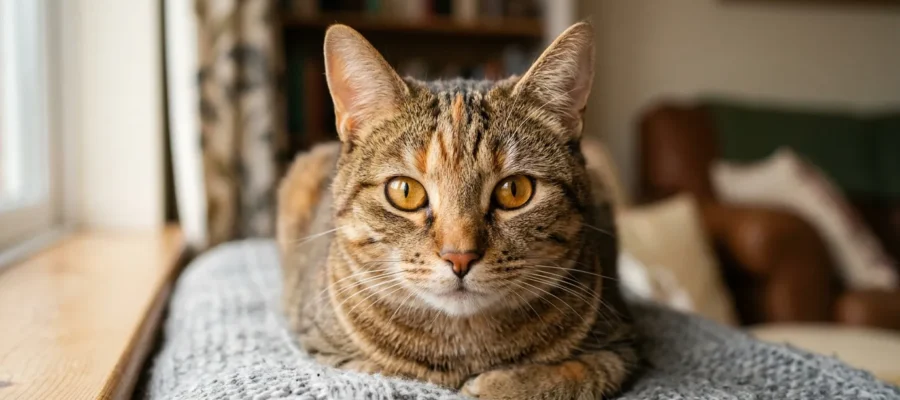
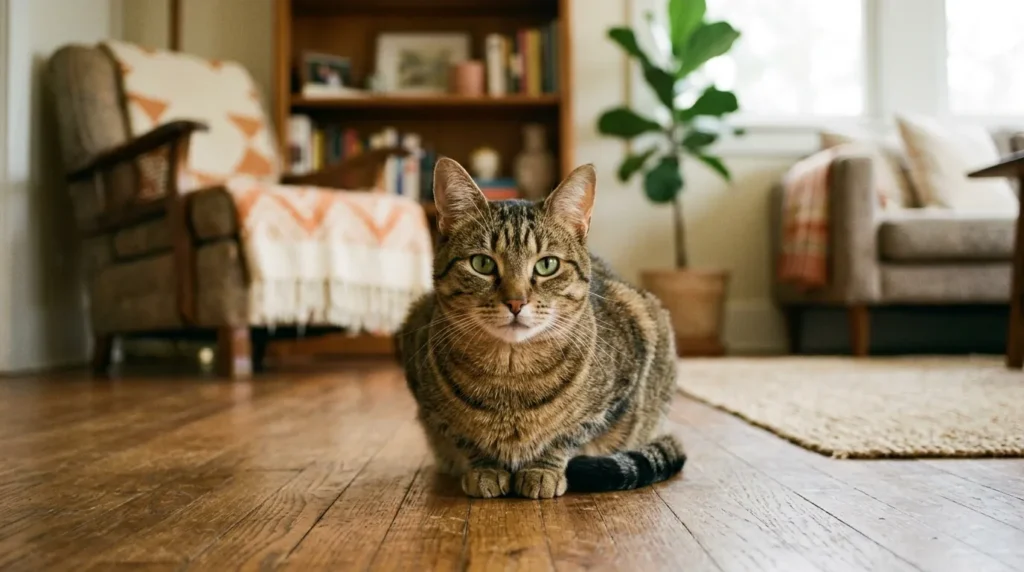
Your cat is sitting across the room, perfectly still, eyes locked on you. You look up. They don’t look away. They just keep staring.
It’s a little unnerving — especially at 2 a.m.
But that stare isn’t random. Cats don’t do things without reason. The stare is communication. And once you know how to read it, it tells you exactly what your cat wants, feels, or needs.
If you’ve also noticed your cat following you everywhere, the stare is usually part of the same pattern — your cat is keeping close tabs on you.
Here’s everything behind the stare.
The Short Answer
Cats stare at you to communicate. They don’t have the full range of vocal tools that humans use. So they rely heavily on eye contact, body posture, and movement to send messages. A stare can mean hunger, affection, curiosity, fear, or a warning — and the difference comes down to the body language around the eyes, not the stare alone.
Curious how dogs handle the same behavior? Our breakdown of why your dog stares at you covers the cross-species comparison well.
Why Does My Cat Stare at You? 7 Real Reasons
1. They Want Food or Water
This is the most common reason, and most cat owners figure it out fast.
Cats are smart. They learn what works. If staring at you once led to breakfast arriving early, they’ll stare again. And again. This is operant conditioning playing out in your kitchen — your cat figured out that eye contact produces food, so eye contact becomes the strategy.
The giveaway: the stare usually happens near feeding time, near the food bowl, or right after you walk into the kitchen. Many cats pair it with a meow or will walk toward the bowl once you acknowledge them. If you’re unsure how much wet food to feed your cat, getting on a consistent schedule is one of the fastest ways to reduce food-driven staring.
2. They’re Asking for Attention or Play
Some cats stare when they’re bored and want interaction.
The posture here looks a little different. A play-motivated cat may crouch low, pupils slightly dilated, tail flicking. They’re in a light predatory mode — locked onto you as the “target.” Don’t be surprised if the stare ends with them sprinting across the room or swatting at your ankle.
If it’s pure attention-seeking (not play), the cat usually looks relaxed. Ears forward. Body loose. They may meow softly or walk over and bump their head against you once you respond. If the meowing alongside the stare has become constant, it’s worth reading up on why your cat is meowing so much — it often connects to the same unmet needs.
Grab a wand toy if the stare looks playful. It redirects the energy productively and gives your cat what they actually need.
3. They’re Showing Affection
Not every stare is a demand. Sometimes it’s just love.
When a cat stares at you with a relaxed body, half-closed eyes, and then slowly blinks — that’s a trust signal. Animal behaviorists call this the “slow blink” or “cat kiss.” Research out of the University of Sussex (2020) found that cats slow blink more frequently toward humans who slow blink back, suggesting it’s a real form of social bonding, not coincidence.
You can try it yourself. Catch your cat’s gaze, relax your face, and slowly close and open your eyes. Many cats respond by doing the same. That exchange is as close to “I love you” as cats get. This affectionate communication pairs closely with other bonding behaviors — if your cat also licks you regularly, they’re showing the same trust through a different channel. The same goes for kneading — it’s all part of how cats show comfort around people they trust. Understanding cat purring meaning adds another layer to reading these affection signals correctly.
4. They’re Watching Out of Pure Curiosity
Cats are sensory-driven animals. You are the most interesting thing in their environment.
When you move around the house — cook, type, fold laundry — your cat tracks you. The stare isn’t about emotion here. It’s about information. Cats are built to monitor movement. It’s the same instinct that makes them watch birds through a window. You just happen to be the bird.
This type of stare is usually passive. The cat isn’t still — their eyes track your hands or your feet. No tension in the body. No tail movement. Just observation.
5. They’re Afraid or Hypervigilant
Fear produces a hard, wide-eyed stare. It looks intense, but it’s not aggression — not yet.
A scared cat stares to gather information before deciding whether to flee or fight. The pupils are fully dilated. The ears flatten to the sides or back. The body shrinks low to the ground or presses against a wall. The tail may tuck.
If you see this combination, don’t approach. Don’t stare back directly — in cat language, prolonged direct eye contact is a threat. Look slightly to the side, make your body small, and let the cat decompress on their own timeline.
6. They’re Warning You
This is the stare that matters most to get right.
An aggressive stare is hard and unblinking. The cat holds their body rigid and upright. Their tail may lash slowly. Ears rotate back. Pupils may be narrow slits (in bright light) or wide (in low light). The overall impression is tension — a body ready to act.
This stare says: Back off. I’ve had enough.
It can happen when a cat is overstimulated from petting, cornered, in pain, or defending territory. The correct response is to stop what you’re doing, avoid direct eye contact, and give them space. Pushing past this stare is how people get scratched. If this escalates into biting, our guide on why your cat bites you walks through the triggers and exactly how to respond.
7. They’ve Learned That Staring Gets Results
This is the underappreciated reason — and it explains a lot of “pushy” cat behavior.
Every time you responded to your cat’s stare (fed them, played with them, gave attention), you reinforced the behavior. Over time, the stare became a trained tool. Your cat isn’t doing this consciously. They simply know it works.
This doesn’t mean you should ignore your cat. But it does explain why some cats seem relentless about eye contact — they’ve built up a long history of it paying off. If the staring has become disruptive, knowing how to train a cat gives you the right framework for adjusting the behavior without damaging the bond.
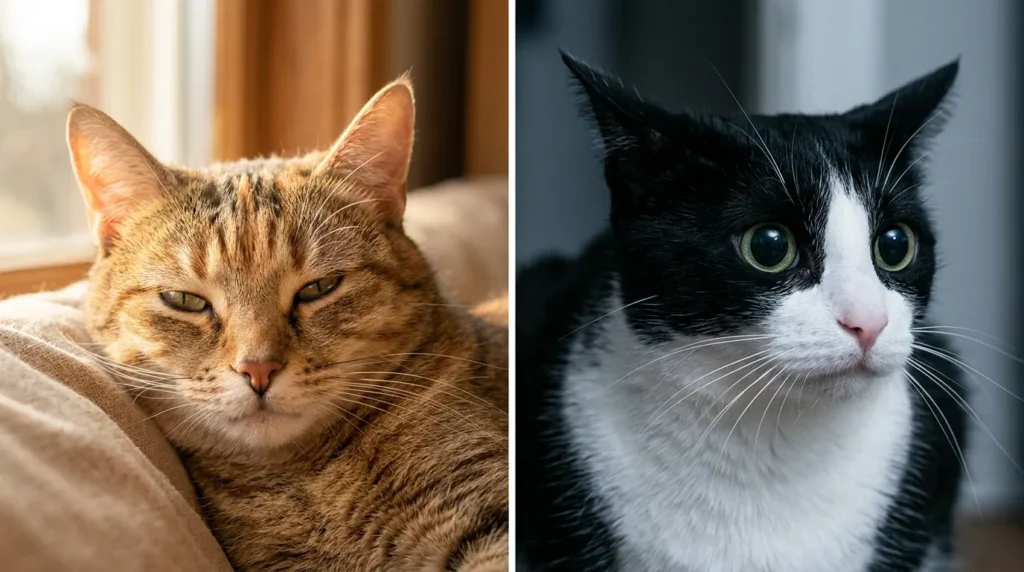
How to Read the Stare: Body Language Decoder
The stare alone doesn’t tell you everything. The rest of the body does.
Soft stare: Relaxed face, half-closed eyes, slow blinking. Means contentment, affection, or mild curiosity. Respond warmly.
Hard stare: Wide-open eyes, no blinking, fixed gaze. Means fear, aggression, or high arousal. Do not escalate.
| Signal | Relaxed/Affectionate | Fearful | Aggressive |
|---|---|---|---|
| Pupils | Normal/slightly dilated | Fully dilated | Dilated or narrow slits |
| Ears | Forward or slightly out | Flattened sideways | Pinned back flat |
| Tail | Still or slowly curling up | Tucked under | Lashing or puffed |
| Body | Loose, sometimes rolling | Low, pressed down | Stiff, upright |
| Vocalization | Soft meow or silent | Silent or hissing | Growling, hissing |
Read at least 3 of these signals together before deciding how to respond. One signal alone can mislead you. The tail is one of the most reliable indicators — our full guide on why cats wag their tails breaks down every tail position and what it means in context.
Why Cats Barely Blink During a Stare
Cats have a third eyelid called the nictitating membrane — a thin, translucent layer that sweeps across the eye horizontally. It keeps the eye lubricated even when the cat isn’t blinking visibly. This is why their stares look so fixed and intense. They’re not straining to keep their eyes open. Their eyes are protected even while unblinking.
When you see this membrane visible in the corner of your cat’s eye at rest, it usually means the cat is sleepy or very relaxed. If it’s visible while the cat is awake and alert, it can occasionally signal illness — worth noting.
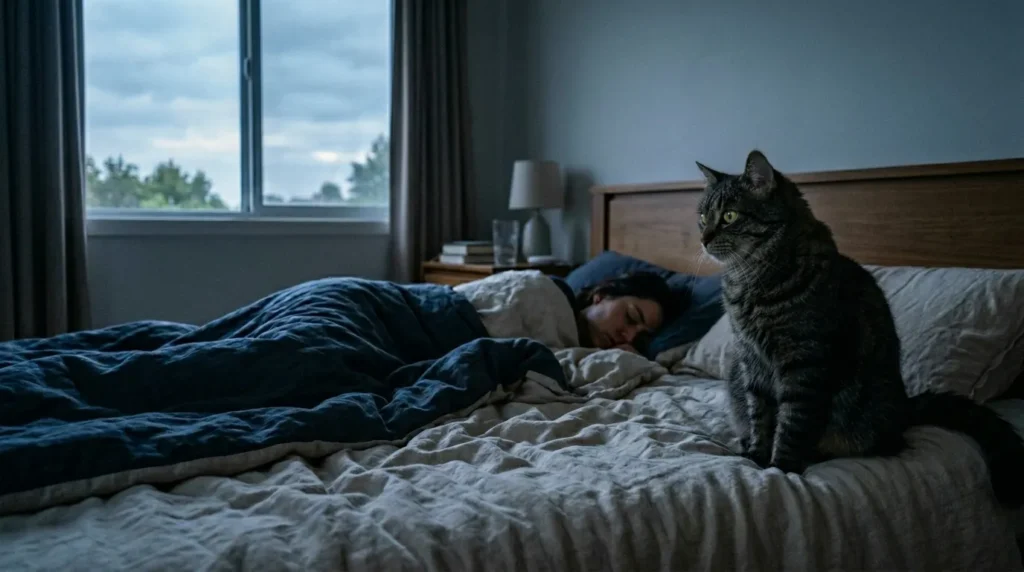
Why Does My Cat Stare at Me While I Sleep?
You wake up and your cat is six inches from your face, just staring.
A few things drive this. Cats are crepuscular — most active at dawn and dusk — so early morning is peak activity time for them. You’re asleep, warm, breathing, occasionally making sounds. From their perspective, you’re a large, interesting object that hasn’t responded to them yet.
Some cats have also learned that staring (or proximity) wakes you up. And once you’re awake, good things happen — food, attention, play. Again: learned behavior. This connects directly to the same reasons your cat sleeps on you — proximity to you is both comforting and strategic for them.
If it bothers you, the fix isn’t complicated. Feed your cat on an automatic feeder set for early morning. It breaks the association between waking you and getting fed.
Why Does My Cat Stare at Strangers?
This is almost the opposite of the owner stare.
When a stranger enters your home, your cat may freeze and stare — not out of curiosity, but out of assessment. New person, unknown scent, unpredictable behavior. The cat is deciding whether this person is a threat.
Here’s the irony: people who love cats and immediately approach them tend to trigger more staring and retreating. People who ignore cats and let them approach on their own terms usually get accepted faster. The stranger who looks away and stays calm signals safety. The enthusiastic greeter signals unpredictability.
This is especially relevant if you’re introducing a cat to a dog or bringing a new pet into the home — the same principle applies. Tell guests to let your cat come to them. It speeds up the process considerably.
When Staring Becomes a Health Warning
Most staring is behavioral. But sometimes it signals a medical problem.
Senior Cats and Cognitive Decline
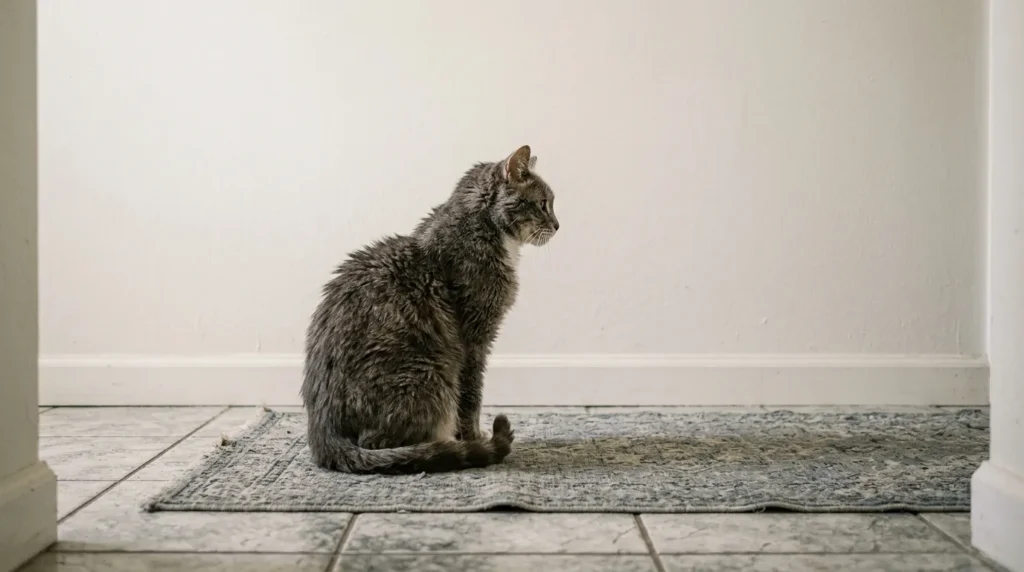
Cats over 10 years old can develop cognitive dysfunction syndrome (CDS) — the feline equivalent of dementia. One of the notable signs is prolonged, purposeless staring. The cat looks at a wall, a corner, or into space for extended stretches. They may seem confused about where they are.
Use our Pet Age Calculator to find out where your cat falls on the aging spectrum — it’s more nuanced than most people expect.
Other signs of CDS include nighttime vocalization, disorientation, changes in litter box use, and altered sleep cycles. If you notice these alongside the staring, talk to your vet. While CDS isn’t curable, it’s manageable. Nutritional support, environmental enrichment, and in some cases medication can slow the progression.
Vision Problems and Neurological Issues
Sudden changes in staring behavior — especially a blank stare with no environmental trigger — can indicate a neurological event or vision loss. Cats losing vision may stare at light sources or fixed points as their visual system compensates.
If the stare is new, sustained, and paired with head tilting, circling, or stumbling, that’s a vet visit today, not next week. Our Pet Symptom Checker can help you identify whether the symptoms you’re seeing warrant urgent care. If your cat is also throwing up frequently alongside behavioral changes, bring both issues to your vet at the same time.
How to Respond to Your Cat’s Stare
What you do matters. Here’s a simple decision map:
If the stare looks relaxed: Slow blink back. Speak softly. Approach if they seem receptive.
If the stare is near the food bowl: Check if it’s feeding time. If not, don’t reward with early feeding — it reinforces schedule disruption.
If the stare looks playful: Use a wand toy. Redirect the predatory energy into structured play.
If the stare looks fearful: Don’t make direct eye contact. Sit or crouch lower. Let the cat leave if they want to.
If the stare looks aggressive: Stop moving. Break eye contact by looking to the side. Back away slowly. Give space.
If the staring is paired with other behavior you want to address — like following you into every room or demanding attention constantly — a consistent approach using positive discipline methods helps set boundaries without damaging trust.
One thing not to do: Never stare back hard and long at an agitated or fearful cat. It reads as a direct challenge in their language and almost always makes things worse.
FAQs
Is it normal for a cat to stare at you for a long time? Yes, in most cases. Cats communicate through eye contact more than most people realize. Long stares are normal when they’re attention-seeking, curious, or bonded to you. If the staring is sudden, sustained, and paired with disorientation, that warrants a vet visit.
Should I stare back at my cat? It depends on the context. With a relaxed cat, a slow blink exchange is a positive interaction. With an agitated or fearful cat, direct prolonged eye contact is interpreted as a threat. Read the body language first.
Why does my cat stare at me and then look away? This is often a sign of trust. In cat communication, looking away breaks the tension of sustained eye contact. When your cat stares and then casually glances away, they’re showing they feel safe with you — not threatened or challenged.
Why does my cat stare at nothing? Cats have sharper senses than humans. They hear frequencies up to 64,000 Hz and can detect minor air movements. What looks like “nothing” to you may be a sound, scent, or tiny motion you can’t perceive. Occasional blank staring is normal. Frequent, prolonged staring at walls in an older cat can signal cognitive decline — run it through our Pet Symptom Checker if you’re unsure.
Do cats stare at people they like? Generally, yes. Sustained, soft eye contact is a form of attention — and cats don’t give attention to things they’re indifferent to. A relaxed stare paired with a slow blink is one of the clearest affection signals cats show.
Final Takeaway
Your cat’s stare is not random, strange, or unsettling — it’s a sentence in a language they’re speaking all the time.
Most stares mean something simple: feed me, play with me, I feel safe with you, or I’m watching what you’re doing. A small number signal fear or aggression, and a smaller number still point to health problems worth checking out.
The difference between all of them is in the body language surrounding the eyes. Pupils, ears, tail, and posture together give you the full message. Once you start reading those signals, the stare stops being mysterious. It’s just your cat talking.